Subsection 2.4.3 Trigonometric ratios of Special Angles((30°, 45° and 60°))

Subsubsection 2.4.3.1 Tangent, Cosine and Sine of 45°

In this section you will use isosceles right-angle triangle to explore on how to find Tangent, Cosine and Sine of \(45^\circ\)
An isosceles triangle is a triangle whose two sides and base angles are equal.

Activity 2.4.7.

\(\textbf{Work in groups}\)
What you require: A ruler, a piece of paper and a protractor.
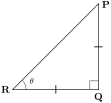
  1. Draw the isosceles right-angle triangle like the one below,(ensure that two sides are equal)
  2. Measure the angle that substend the Hypotenues and the adjacent that is \(\theta\text{.}\)
  3. Measure the length \(PQ \, \text{and}\, QR\)
    What do you notice about \(PQ \, \text{and}\, QR\)
  4. Find the following trigonometrc ratios:
    1. \(\displaystyle tan \, \theta\)
    2. \(\displaystyle cos \, \theta\)
    3. \(\displaystyle sin \, \theta\)
  5. Compare the value of \(cos \, \theta \, \text{and} \,sin \, \theta \text{,}\) How do they relate?
\(\textbf{Key Takeaway}\)
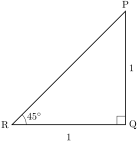
Look at the figure below;
To find the tangent, cosine and sine of \(45^\circ\text{,}\) find first the length \(PR\)
\begin{align*} PR^2=\amp 1^2+1^2 \\ = \amp 1+1 \\ =\amp 2\\ PR=\amp \sqrt{2} \end{align*}
Therefore,
\begin{align*} Sin\,45^\circ=\amp \frac{1}{\sqrt{2}} \\ Cos\,45^\circ=\amp \frac{1}{\sqrt{2}}\\ Tan\,45^\circ=\amp 1 \end{align*}

Checkpoint 2.4.24. Finding Trigonometric Ratios in a Right Angled Triangle (45°).

Load the question by clicking the button below.

Checkpoint 2.4.25. Determining the Length of a Divider Arm from Vertical Height.

Load the question by clicking the button below.

Subsubsection 2.4.3.2 Tangent, Cosins and Sine of 30° and 60°

In this section, you will be using equilateral triangle to find the Tangent, Cosine and Sine of \(30^\circ \, \text{and}\, 60^\circ\) .
Equilateral triangle is a triangle whose sides and angles are equal.
\(\textbf{Work at home}\)
Use the same procidure above to identify the Tangent, Cosine and Sine of \(30^\circ \, \text{and}\, 60^\circ\) using equilateral triangle.
Discuss your work with other learners in your class.
\(\textbf{Further activity}\)

Activity 2.4.8.

\(\textbf{Work in groups}\)
What you require: Ruler, pencil, protractor, graph paper.
  1. Drawing a \(45-45-90\text{:}\)
    1. Draw a square.
    2. Draw a diagonal to make two triangles.
    3. Label angles (\(45^\circ, \,45^\circ,\, 90^\circ\)).
  2. Draw \(30-60-90\text{:}\)
    1. Draw an equilateral triangle.
    2. Draw a line from a corner to the middle of the opposite side.
    3. Label angles (\(30^\circ, \,60^\circ,\, 90^\circ\)).
  3. Measure and Calculate:
    • Measure sides of each triangle.
    • Calculate sin, cos, tan for \(30^\circ, 45^\circ, 60^\circ\) angles.
    • Record your results in the table below.
      Angle Triangle type Opposite side length Adjacent side length Hypotenuse length \(sin(\theta)=\frac{\text{Opposite}}{\text{Hypotenuse}}\) \(cos(\theta)=\frac{\text{Adjacent}}{\text{Hypotenuse}}\) \(tan(\theta)=\frac{\text{Opposite}}{\text{Adjacen}}\)
      \({\color{blue} 30^\circ}\) \(30-60-90\)
      \({\color{blue} 60^\circ}\) \(30-60-90\)
      \({\color{blue} 45^\circ}\) \(45-45-90\)
  4. Discuss your result with other . What do you notice for the \(\textbf{Special Angles}\) (\(30^\circ, 45^\circ, 60^\circ\))?
\(\textbf{Essential concepts.}\)
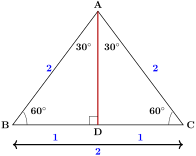
The figure below shows an equilateral triangle \(ABC\text{.}\) \(AD\) Is the perpendicular bisector of \(BC\text{.}\)
Notice that;
length \(AD\) is given by,
\begin{align*} AD^2=\amp 2^2-1^2\\ = \amp 4-1\\ AD= \amp \sqrt{3} \end{align*}
Therefore, \(sin\,30^\circ=\frac{1}{2},\quad cos\,30^\circ=\frac{\sqrt{3}}{2},\quad \text{and} \quad tan\,30^\circ=\frac{1}{\sqrt{3}}\)
Similarly,
\(sin\,60^\circ=\frac{\sqrt{3}}{2},\quad cos\,60^\circ=\frac{1}{2},\quad \text{and} \quad tan\,60^\circ=\sqrt{3}\)
Conclusion
  • Sin and Cos are just swapped between \(30^\circ \) and \(60^\circ \text{.}\)
  • Tan \(30^\circ \) is small while tan \(60^\circ \) is large.
  • \(sin\,\theta \times sin \, \theta \text{,}\) can be written as \(sin^2\,\theta\)

Example 2.4.26.

Simplify the following without using tables or calculator.
  1. \(\displaystyle sin \,30^\circ \, cos\,45^\circ\)
  2. \(\displaystyle 8\,cos\,45^\circ\, sin\,45^\circ \)
  3. \(\displaystyle sin\,60^\circ\, cos\,45^\circ +sin\,30^\circ\,tan\,45^\circ\)
Solution.
  1. \begin{align*} sin \,30^\circ \, cos\,45^\circ= \amp \frac{1}{2} \times \frac{1}{\sqrt{2}} \\ =\amp \frac{1}{2\sqrt{2}} \end{align*}
  2. \begin{align*} 8\,cos\,45^\circ\, sin\,45^\circ=\amp \left( 8\times \frac{1}{\sqrt{2}} \right) \times \frac{1}{\sqrt{2}}\\ =\amp \frac{8}{\sqrt{2}} \times \frac{1}{\sqrt{2}} \\ =\amp \frac{8}{\sqrt{2} \times \sqrt{2}} \\ =\amp \frac{8}{2} \\ = \amp 4 \end{align*}
  3. \begin{align*} sin\,60^\circ\, cos\,45^\circ +sin\,30^\circ\,tan\,45^\circ =\amp \left(\frac{\sqrt{3}}{3} \times \frac{1}{\sqrt{2}}\right) +\left(\frac{1}{2} \times 1 \right)\\ = \amp \frac{\sqrt{3}}{2\sqrt{2}} + \frac{1}{2} \\ =\amp \frac{\sqrt{3}+ \sqrt{2}}{2\sqrt{2}} \end{align*}

Example 2.4.27.

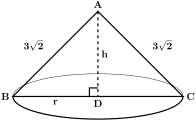
The angle at the vertex of a cone is \(90^\circ\text{.}\) If the slant height is \(3\sqrt{2\,cm}\text{.}\) Find without using tables:
  1. The diameter of the cone
  2. The height of the cone.
Solution.
Since the vertex angle is \(90^\circ\text{,}\) the cone can be thought of as half of a right circular cone, meaning that the base of the cone forms the hypotenuse of a right-angled triangle.
Let:
  • \(r\) be the radius of the base,
  • \(h\) be the height of the cone,
  • \(l=3\sqrt{2\,cm}\) be the slant height (hypotenuse of the right-angled triangle).
Since the triangle formed is a right-angled isosceles triangle (because of the \(90^\circ\) vertex angle), we can say:
\(r=h\)
Since the right-angled triangle has radius \(r\) and height \(h\text{,}\) we use:
\(r^2=h^2=l^2\)
Since \(r=h\text{,}\) we substitute:
\begin{align*} r^2+r^2=\amp \left(3\sqrt{2}\right) \\ 2r^2= \amp 9 \times 2\\ r^2= \amp 18 \\ ^2=\amp 9 \\ r=\amp 3\,cm \end{align*}
  1. The diameter of the cone is:
    Diameter \(=2r=2(3)=6\,cm\)
  2. The height of the cone;
    Since \(h=r\text{,}\) we conclude:
    \(h=3\,cm\)

Checkpoint 2.4.28. Finding the Trigonometry Ratios in a 30°, 60° and 90° Triangle.

Load the question by clicking the button below.
\(\textbf{Exercises}\)
  1. The angle made by the arms of an upright pair of dividers and the horizontal is \(45^\circ\text{.}\) The vertical distance from the horizontal to the vertex is \(15\,cm\text{.}\) Find without using tables:
    1. The horizontal distance between the tips of the arms.
    2. The length of the arms.
  2. Without using a calculator, find
    \(sin\,60^\circ+cos\,30^\circ\)
  3. Given that \(\theta=45^\circ\text{,}\) calculate:
    \(tan^2\,\theta-sin^2\,\theta\)
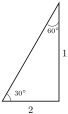
  4. Using the triangle below, calculate the value of:
    1. \(\displaystyle sin \,30^\circ\)
    2. \(\displaystyle cos \,60^\circ\)
    3. \(\displaystyle tan \,30^\circ\)
  5. Given: \(sin\,\theta = \frac{1}{2}\)
    Find the angle \(\theta\text{,}\) where \(\theta^\circ \leq \theta \leq 90^\circ\)