Skip to main content
Contents
Search Book
Search Results:
No results.
Read aloud Readability settings Prev Up Next \(\newcommand{\N}{\mathbb N} \newcommand{\Z}{\mathbb Z} \newcommand{\Q}{\mathbb Q} \newcommand{\R}{\mathbb R}
\newcommand{\lt}{<}
\newcommand{\gt}{>}
\newcommand{\amp}{&}
\definecolor{fillinmathshade}{gray}{0.9}
\newcommand{\fillinmath}[1]{\mathchoice{\colorbox{fillinmathshade}{$\displaystyle \phantom{\,#1\,}$}}{\colorbox{fillinmathshade}{$\textstyle \phantom{\,#1\,}$}}{\colorbox{fillinmathshade}{$\scriptstyle \phantom{\,#1\,}$}}{\colorbox{fillinmathshade}{$\scriptscriptstyle\phantom{\,#1\,}$}}}
\)
Subsection 3.2.1 Introduction to Probability
Curriculum Alignment
Strand
3.0 Statistics and Probability
Sub-Strand
Specific Learning Outcomes
Perform experiments involving probabilities in different situations
Identify the range of probability in different situations
Teacher Resource 3.2.2 .
To assist your teaching, we have prepared lesson resources, aligned with this textbook and the CBC. The Lesson Plan links to syllabus learning outcomes and provides suggest time allocations. The Step-by-Step Guide provides more detailed guidance on how to teach the content, including suggested questions to ask learners, and possible answers.
Learner Experience 3.2.3 .
\({\color{black} \textbf{Work in groups}}\)
Write down 3 events that could happen today (e.g., “It will rain” or “I will be late to school”)
Predict the probability of each event:
\(\textbf{Is it likely, unlikely, or certain}\text{?}\)
\({\color{black} \textbf{Key Takeaway}}\)
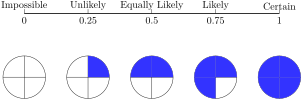
\(\text{Probability}\) is the measure of how likely an event is to occur. It is expressed as a number between 0 and 1, where:
\(0\) means the event is impossible.
\(1\) means the event is certain.
A probability closer to
\(1\) indicates a higher likelihood of the event occurring.
Probability is always between 0 and 1
\(\text{Probability Scale}\)
\({\color{black} \text{Key Terms in Probability}}\)
\(\text{Experiment}\) - A process that leads to a specific result.
\(\text{Outcome}\) - A possible result of an experiment.
\(\text{Event}\) - A collection of one or more outcomes.
\(\text{Sample Space (S)}\) - The set of all possible outcomes.
\(\text{Probability (P)}\) - A measure of how likely an event is to occur.
Probability is widely used in everyday life, including:
\(\text{Weather Forecasting}\) - Meteorologists predict the likelihood of rain based on past data.
\(\text{Sports}\) - Coaches analyze the probability of winning based on past performance.
\(\text{Medicine}\) - Doctors assess the probability of a patient responding to treatment.
\(\text{Finance and Insurance}\) - Insurance companies use probability to determine policy pricing.
\(\text{Games of Chance}\) - Dice rolling and card games use probability.
Learner Experience 3.2.4 .
\({\color{black} \textbf{Work in groups}}\)
Kanyama rolls a fair six-sided die. What is the probability of Kanyama rolling a
\(4\)
Identify the Sample Space.
Identify the Favorable Outcomes
Apply the Probability Formula
Discuss and compare answers
\({\color{black} \textbf{Key Takeaway}}\)
A simple event is an event that consists of only one outcome in the sample space.
The probability of a simple event is given using the formula
\begin{gather*}
\textbf{P(E)} = \frac{\textbf{Number of favorable outcomes}}{\textbf{Number of Outcomes}}
\end{gather*}
where;
\(\textbf{P(E)}\) is the probability of event
\(\textbf{E}\)
Favorable outcomes refer to the specific event we are interested in
Total outcomes refer to all possible outcomes in the sample space
Example 3.2.5 .
A bag contains 5 red balls and 3 blue balls. If one ball is picked at random, what is the probability that it is red?
Solution .
Total number of balls
\(\textbf{ = 5 + 3 = 8}\)
Number of red balls
\(\textbf{ = 5}\)
Given a bag with
\(5\) red balls and
\(3\) blue balls, the possible outcomes when picking one ball are
\(\textbf{S = {Red,Blue}}\)
Total outcomes
\(\textbf{ = 5 + 3 = 8}\)
Probability of drawing a red ball is given by:
\(\textbf{P(Red)}=\frac{\textbf{Number of favorable outcomes}}{\textbf{Number of Outcomes}} = \frac{5}{8}=\textbf{0.625}\)
the probability of picking a red ball is
\(0.625\) or
\(62.5\%\)
Example 3.2.6 .
A teacher at Sironga Secondary school randomly selects a student from a class of 30 students. If there are 12 girls and 18 boys in the class, what is the probability that the selected student is a girl?
Solution .
Sample Space is
\begin{gather*}
\textbf{S = {Girl, Boy}}
\end{gather*}
The number of favorable outcomes that is choosing a girl =
\(\textbf{12}\)
Now, Applying our formula gives
\begin{gather*}
\textbf{P(Girl)}=\frac{\textbf{Number of girls}}{\textbf{Total number of students}}
\end{gather*}
\begin{gather*}
= \frac{12}{30}
\end{gather*}
\begin{gather*}
=\textbf{0.4}
\end{gather*}
The probability of selecting a girl is
\(0.4\) or
\(40\%\)
Checkpoint 3.2.7 .
Checkpoint 3.2.8 .
Checkpoint 3.2.9 .
Checkpoint 3.2.10 .
Exercises Exercises
1. What is the probability of selecting the letter ’a’ from the name "Mukabwa"?
Answer .
\(\approx 0.286\) or
\(28.6\%\text{.}\)
2. A deck of standard playing cards has 52 cards. What is the probability of drawing the 5 of Hearts?
Answer .
\(\approx 0.0192\) or
\(1.92\%\text{.}\)
3. A bag has 3 yellow marbles, 5 black marbles, and 2 white marbles. What is the probability of selecting a white marble?
Answer .
\(\approx 0.2\) or
\(20\%\text{.}\)
4. A month is selected at random from a year. What is the probability that it is June?
Answer .
\(\approx 0.0833\) or
\(8.33\%\text{.}\)
5. A coin is tossed. What is the probability of getting tails?
Answer .
\(\approx 0.5\) or
\(50\%\text{.}\)
6. A box contains tickets numbered from 1 to 10. What is the probability of drawing a ticket with the number 7?
Answer .
\(\approx 0.1\) or
\(10\%\text{.}\)
7. A class has 25 students, and one student is chosen at random. What is the probability that a specific student is chosen?
Answer .
\(\approx 0.04\) or
\(4\%\text{.}\)
8. What is the probability of selecting the letter "e" from the word "elephant"?
Answer .
\(\approx 0.222\) or
\(22.2\%\text{.}\)