Subsection 2.6.4 Area of Segments
Teacher Resource 2.6.24.
To assist your teaching, we have prepared lesson resources, aligned with this textbook and the CBC. The Lesson Plan links to syllabus learning outcomes and provides suggest time allocations. The Step-by-Step Guide provides more detailed guidance on how to teach the content, including suggested questions to ask learners, and possible answers.
Learner Experience 2.6.9.
Work in groups
What you require;
-
A compass
-
A ruler
-
A protractor
-
A scientific calculator
-
A worksheet with given radii and angles
-
Use a compass to draw a circle of radius \(r\text{.}\)
-
Draw a chord across the circle using a ruler.
-
Use a protractor to measure the angle subtended at the center by the chord.Shade the segment formed
-
Find the area of the segment part and record your results.
-
Perform the same process for different chords and angles eg \(70^\circ, \,90^\circ,\,120^\circ,\,150^\circ...\)
-
Discuss your work with other learners in your class.
Exploration 2.6.10. Exploring the Area of a Circular Segment.
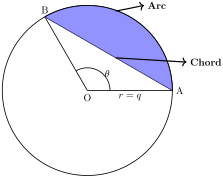
A circular segment is the region between a chord of a circle and the arc it cuts off. It can be formed by taking a sector of a circle and removing the triangle formed by the two radii.
In this exploration, you will adjust the radius and the central angle. Observe how the shaded region changes and how its area is related to both a sector and a triangle.
Before starting, review the instructions below to understand how to use the interactive.
Instructions.
-
Use the
Radius (r)slider to change the size of the circle. -
Use the
Angle (ΞΈ)slider to adjust the central angle (between \(0^\circ\) and \(180^\circ\)). -
Observe the shaded region. This is the circular segment.
-
Notice the triangle drawn inside the sector. The segment is formed by subtracting this triangle from the sector.
-
Look at the calculation panel, which shows:
-
The area of the sector,
-
The area of the triangle, and
-
The resulting area of the segment.
-
Use the interactive to investigate the following questions:
-
Set the angle to about \(60^\circ\text{.}\) How does the shaded segment compare to the sector? Which part is being removed to form the segment?
-
Increase the angle gradually from \(30^\circ\) to \(150^\circ\text{.}\) How does the shape of the segment change? What happens to its area?
-
At what angle does the segment appear largest? Explain your reasoning based on what you observe.
-
Keep the angle fixed and increase the radius. How does the segment area change? What does this suggest about the role of the radius in the formula?
-
Compare the sector area and triangle area for different angles. How does their difference determine the segment area?
-
When the angle is very small, what happens to the segment? What does this suggest about the relationship between the arc and the chord?
-
Based on your observations, how would you describe a formula for the area of a segment using the sector area and the triangle area?
Key Takeaway 2.6.26.
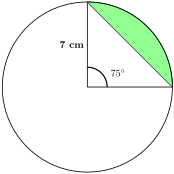
A segment is the region of a circle bounded by a chord and an arc as shown in the figure below.
\(\textbf{Area of a segment of a circle.}\)
The area of a segment is given by;
\(\text{Area of a segment}=\text{ Area of sector}-\text{ Area of triangle}\)
Example 2.6.27.
A chord in a circle of radius \(7\, cm\) subtends an angle of \(75^\circ\) at the center as shown below. Find the area of the segment.
Solution.
To find the area of the segment, you the area of the triangle and subtract from the area of the sector.
\(\textbf{Area of sector }\)
\(A= \frac{\theta}{ 360} \times \pi r^2\)
\begin{align*}
A=\amp \frac{75^\circ}{ 360} \times \frac{22}{7} \times 7^2 \\
=\amp \frac{5}{24} \times \frac{22}{7} \times 49\\
=\amp \frac{385}{12} \\
=\amp 32.0833 \,cm^2
\end{align*}
\(\textbf{Area of a triangle }\)
\(A= \frac{1}{2} ab sin \,\theta\)
Where \(a=7\,cm \,\text{and} \,b= 7 \,cm\)
\begin{align*}
A=\amp \\
=\amp \frac{1}{2} \times 7 \times 7\times \times sin \,75^\circ\\
=\amp \frac{1}{2} \times 49 \times sin \,75^\circ\\
=\amp 23.6652 \,cm^2
\end{align*}
Therefor,
\begin{align*}
A= \amp 32.0833 \,cm^2- 23.6652 \,cm^2 \\
= \amp 8.4181\,cm^2
\end{align*}
Example 2.6.28.
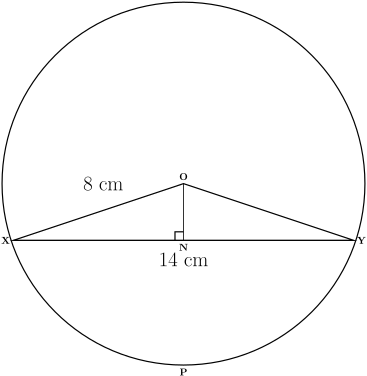
A chord XY of length \(14 \,cm\) is drawn in a circle with centre O and radius \(8 cm\text{,}\) as in the figure below
Calculate:
-
The distance ON.
-
The area of the sector OXPY.
-
The area of triangle OXY
-
The area of the minor segment.
-
The area of the major segment.
Solution.
Given a circle with center \(O\text{,}\) radius \(8\) cm, and a chord \(XY\) of length \(14\,cm\) , we find the required values step by step.
-
Finding the Distance \(\text{ON}\)Since ON is the perpendicular bisector of XY, we use the right triangle ONX where:\begin{align*} \text{OX}=\amp 8\,cm (\text{radius}) \\ \text{NX}=\amp \frac{\text{XY}}{2} \\ = \amp \frac{12}{2} \\ = \amp 7\,cm \end{align*}Using Pythagorasβ Theorem in \(\triangle\) ONX:\begin{align*} \text{ON}^2+ \text{NX}^2 =\amp \text{OX}^2\\ \text{ON}^2+ 7^2= \amp 8^2 \\ \text{ON}^2+ 49= \amp 64 \\ \text{ON}^2=\amp 64-49\\ \text{ON}^2= \amp 15 \\ \text{ON} =\amp \sqrt{15} \\ ββ\amp 3.87 \,cm \end{align*}
-
Finding the area of sector OXPY.Finding the \(\angle\) XOY which is given by:\begin{align*} cos\,\theta= \amp (\frac{\text{XN}}{\text{XO}} )\\ =\amp \frac{7}{8} \\ =\amp 0.875 \\ \theta=\amp cos^{-1}(0.875) \\ =\amp 28.9550^\circ \end{align*}therefor, \(\angle \text{XOY}= 28.9550^\circ\times 2\)\begin{equation*} =57.9100^\circ \end{equation*}The area of a sector is:\begin{align*} A=\amp \frac{\theta}{360} \times \pi r^2\\ =\amp \frac{57.9100}{360} \times \pi 8^2 \\ =\amp \frac{57.9100}{360} \times \frac{22}{7} \times 64\\ =\amp 32.3561 \,cm^2 \end{align*}Therefore, area of sector OXPY \(= 32.3561 \,cm^2\)
-
Finding the area of triangle OXY\begin{align*} \text{Area}= \amp \frac{1}{2} \times \text{base} \times \text{height} \\ =\amp \frac{1}{2} \times 14 \times 3.87 \,cm \\ = \amp 7 \times 3.87 \,cm \\ =\amp 27.09 \,cm^2 \end{align*}
-
Finding the area of the minor segment.\(\text{Area of minor segment}=\text{Area of sector}- \text{Area of} \triangle \text{OXY}\)\begin{align*} \text{Area of minor segment}=\amp \\ =\amp 32.3561 \,cm^2-27.09 \,cm^2 \\ =\amp 5.2661\,cm^2 \end{align*}
-
Finding the area of the major segmentArea of a circle.\begin{align*} A= \amp \pi r^2 \\ =\amp \frac{22}{7} \times 8^2 \\ =\amp \frac{22}{7} \times 64 \\ =\amp 201.1429 \,cm^2 \end{align*}Therefore, Area of major segment is\begin{align*} = \amp 201.1429 \,cm^2- 5.2661\,cm^2\\ =\amp 195.8768\,cm^2 \end{align*}
Exercises Exercises
1.
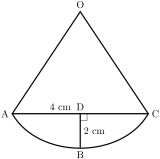
In the figure below, ADC is a chord of a circle with centre O passing through A, B and C. BD is a perpendicular bisector of AC. AD \(=
4\) cm and BD \(= 2\) cm.
Calculate the following:
-
The radius OA of the circle.
-
The area of the sector OABC.
-
The area of the segment ABCD.
2.
A circular table has a radius of \(15 \,cm\text{.}\) A slice of cake is cut out, forming a \(75^\circ \) segment. Find the area of the cake slice not covered by the straight cut
3.
A wheel of a car has a radius of \(30\) cm. A mudguard covers a \(60^\circ\) segment of the wheel. Find the area of the covered segment.
4.
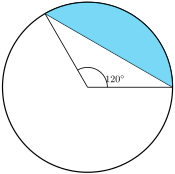
A circular park has a radius of \(20\) meters. A walking path cuts across the park, forming a chord that subtends an angle of \(120^\circ\) at the center as shown below.
Determine the area of the segment formed
5.
A chord XY subtends an angle of \(120^\circ\) at the centre of a circle of radius \(13\, cm\text{.}\) Calculate the area of the minor segment.