To assist your teaching, we have prepared lesson resources, aligned with this textbook and the CBC. The Lesson Plan links to syllabus learning outcomes and provides suggest time allocations. The Step-by-Step Guide provides more detailed guidance on how to teach the content, including suggested questions to ask learners, and possible answers.
Exploration2.4.61.Relationship of Complementary Ratios.
In a right triangle, the two acute angles are always complementary. But how are the trigonometric ratios of one angle related to those of its complement?
In a right-angled triangle, the two acute angles always sum to \(90^\circ\text{.}\) Use the slider to change the angle \(\theta\) and observe the results:
Observe the Angles: As you increase \(\theta\) (the blue angle), what happens to the size of its complement, \(\phi\) (the green angle)? What is their sum at any given point?
Track the Sides: Look at the side \(BC\text{.}\) Relative to the blue angle (\(\theta\)), is this the "Opposite" or "Adjacent" side? Now, look at it relative to the green angle (\(\phi\)). What role does it play there?
Compare the Ratios: Compare the value of \(\sin(\theta)\) in the left column to \(\cos(\phi)\) in the right column. Why do you think these two different trigonometric functions result in the exact same decimal value?
Find the Crossing Point: Move the slider until \(\theta\) is exactly \(45^\circ\text{.}\) What do you notice about all four ratios (Sine and Cosine for both angles) at this specific position?
\(\textbf{Complementary angles}\) are two angles whose sum is \(90^\circ\) (or \(\frac{\pi}{2}\)radians). The sine and cosine functions of complementary angles have a special relationship:
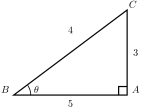
In the right-angled triangle, \(\sin \theta = \frac{\text{opposite}}{\text{hypotenuse}} = \frac{3}{5}\) and \(\cos \theta = \frac{\text{adjacent}}{\text{hypotenuse}} = \frac{4}{5}\text{.}\) Since \(\sin \theta = \frac{3}{5}\) and \(\cos \theta = \frac{4}{5}\text{,}\) we observe that \(\sin \theta \neq \cos \theta\text{.}\)
A ladder leans against a wall, making a \(65^\circ\) angle with the ground. Find the height at which the ladder touches the wall if the ladder is \(10\,m\) long.