Subsection 2.9.5 Manipulating Vectors
Manipulating vectors involves performing operations such as addition, scalar multiplication, and translation. These operations allow us to combine and transform vectors in various ways. Some of the key methods for manipulating vectors are graphical addition and subtraction, algebraic addition and subtraction, scalar multiplication, and translation.
Subsubsection 2.9.5.1 Adding Vectors
Teacher Resource 2.9.46.
To assist your teaching, we have prepared lesson resources, aligned with this textbook and the CBC. The Lesson Plan links to syllabus learning outcomes and provides suggest time allocations. The Step-by-Step Guide provides more detailed guidance on how to teach the content, including suggested questions to ask learners, and possible answers.
Learner Experience 2.9.7.
(a)
(b)
(c)
(d)
Count the number of units moved horizontally (along the \(x\) axis) from the starting point \(A\) to the final point \(C\text{.}\)
(e)
Similarly, count the number of units moved vertically (along the \(y\) axis) from point \(A\) to point \(C\text{.}\)
(f)
Write the resultant displacement in coordinate form \(\begin{pmatrix} x \\ y \end{pmatrix}\text{,}\) where \(x\) represents displacement along the \(x\) axis and \(y\) represents displacement along the \(y\) axis.
(g)
Discuss and share your findings with the rest of the class.
Key Takeaway 2.9.47.
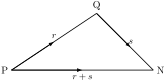
Consider a displacement from point \(P\) to point \(Q\text{,}\) followed by another displacement from point \(Q\) to point \(N\text{.}\) The total resultant displacement from \(P\) to \(N\) is obtained by adding the two vectors sequentially.
This can be expressed as:
\begin{align*}
\mathbf{PN} \amp = \mathbf{PQ} + \mathbf{QN}
\end{align*}
where:
-
\(\mathbf{PQ} = \mathbf{r}\) represents the first displacement.
-
\(\mathbf{QN} = \mathbf{s}\) represents the second displacement.
Therefore, \(\mathbf{PN} = \mathbf{r} + \mathbf{s}\)
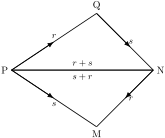
We can also re-arrange the two vectors and add them together as shown in FigureΒ 2.9.49 below.
Example 2.9.50.
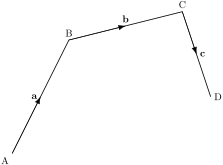
In FigureΒ 2.9.51 below, find vector \(\mathbf{AD}\) in terms of \(\mathbf{a}\) and \(\mathbf{b}\text{.}\)
Exercises Exercises
1.
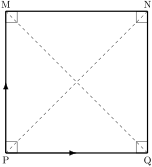
\(PQNM\) is a square with vectors \(\mathbf{PQ}\) and \(\mathbf{PM}\) given as \(\mathbf{a} \text{ and } \mathbf{b}\) respectively, as shown in FigureΒ 2.9.52 . Express the \(\mathbf{PN}\) and \(\mathbf{MQ}\) vectors in terms of \(\mathbf{a}\) and \(\mathbf{b}\)
2.
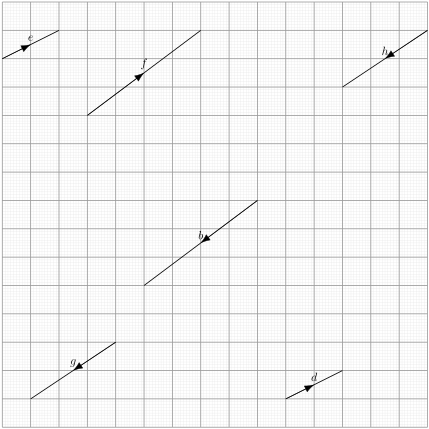
Use FigureΒ 2.9.53 to answer the questions below:
-
List pairs of equal vectors.
-
Name pairs of vectors with equal magnitude but opposite directions.
Answer.
-
Pairs of equal vectors
-
Equal magnitude, opposite direction
3.
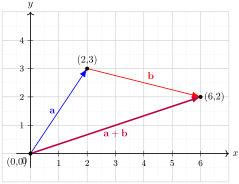
Given the vectors \(\mathbf{a} = \binom{2}{3}\) and \(\mathbf{b} = \binom{4}{-1}\text{,}\) find \(\mathbf{a} + \mathbf{b}\) and illustrate the solution graphically.
Checkpoint 2.9.55.
Checkpoint 2.9.56.
Checkpoint 2.9.57.
Subsection 2.9.5.1 Multiplying Vectors by Scalars
Curriculum Alignment
Teacher Resource 2.9.58.
To assist your teaching, we have prepared lesson resources, aligned with this textbook and the CBC. The Lesson Plan links to syllabus learning outcomes and provides suggest time allocations. The Step-by-Step Guide provides more detailed guidance on how to teach the content, including suggested questions to ask learners, and possible answers.
Learner Experience 2.9.8.
Work in groups
(a)
(b)
(c)
(d)
Determine the coordinate representations of \(\overrightarrow{AB}\) and \(\overrightarrow{AC}\text{..}\)
(e)
(f)
Discuss and share your findings with the rest of the class.
\(\textbf{Key Takeaway}\)
Positive Scalar
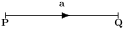
In FigureΒ 2.9.59, the vector \(\mathbf{PQ}\) is represented as \(\mathbf{a}\text{.}\) When we multiply \(\mathbf{a}\) by a positive scalar, say \(2\text{,}\) the length of the vector doubles, making it \(\mathbf{2a}\) as shown in FigureΒ 2.9.60. The direction of the vector remains unchanged, but its magnitude increases.
In FigureΒ 2.9.60, the vector \(\mathbf{PN}\) is given by: \(\mathbf{PN} = \mathbf{a} + \mathbf{a} = 2\mathbf{a}\text{.}\) This means \(\mathbf{PN}\) has the same direction as \(\mathbf{PQ}\text{,}\) but its magnitude twice that of \(\mathbf{PQ}.\)
Negative Scalar
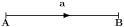
Consider the vector \(\mathbf{AB}\text{,}\)denoted as \(\mathbf{a}\text{,}\) in FigureΒ 2.9.61 The vector points to the right and has a magnitude of \(\mathbf{a}\text{.}\)
In FigureΒ 2.9.62, the vector \(\mathbf{AB}\) is obtained by multiplying \(\mathbf{AB}\) by \(-2\text{,}\) giving:
\begin{equation*}
\mathbf{AC} = \mathbf{-2} \times \mathbf{a} = \mathbf{-2a}
\end{equation*}
This means that \(\mathbf{AC}\) has twice the magnitude of \(\mathbf{AB}\text{,}\) but its direction is reversed.
Multiplying a vector by a negative scalar reverses its direction, making it point in the opposite direction.
Zero Scalar
When a vector \(\mathbf{a}\text{,}\) as shown in FigureΒ 2.9.63, is multiplied by \(0\text{,}\) its magnitude becomes \(0\text{,}\) resulting in a zero vector.
\begin{equation*}
\mathbf{a} \cdot 0 = 0
\end{equation*}
Example 2.9.64.
Consider the vector \(\vec{v} = \langle 3, -4, 5 \rangle\text{.}\)
-
Multiply the vector by the scalar \(k = 2\text{.}\)
-
Multiply the vector by the scalar \(k = -\frac{1}{2}\text{.}\)
-
Explain the geometric effect of multiplying a vector by a scalar.
Solution.
-
Multiplying by \(k = 2\text{:}\)\(2 \vec{v} = 2 \langle 3, -4, 5 \rangle = \langle 6, -8, 10 \rangle\)
-
Multiplying by \(k = -\frac{1}{2}\text{:}\)\(-\frac{1}{2} \vec{v} = -\frac{1}{2} \langle 3, -4, 5 \rangle = \langle -\frac{3}{2}, 2, -\frac{5}{2} \rangle\)
-
Geometric effect:
-
Multiplying a vector by a positive scalar \(k > 1\) stretches the vector in the same direction.
-
Multiplying by a scalar \(0 < k < 1\) shrinks the vector.
-
Multiplying by a negative scalar \(k < 0\) reverses the direction of the vector and scales its magnitude by the absolute value of the scalar.
-
Example 2.9.65.
Given the vectors \(u = 2p + 5q\) and \(v = p - 3q\text{,}\) express \(3u + 2v \) in terms of \(p\) and \(q:\)
Solution.
Exercises Exercises
1.
Simplify the following:
-
\(\displaystyle 5x + 3y - z + 2(3x - z) + (8x - 6y)\)
-
\(\displaystyle (\mathbf{a} - \mathbf{b}) + (c - \mathbf{a}) + (\mathbf{b} - c)\)
-
\(\displaystyle 4m - 2n + 5(k - m) + 2(m + n)\)
2.
Given that \(x = 3m - n\) and \(y = n +4m\text{,}\) express the following vectors in terms of \(m\) and \(n:\)
-
\(\displaystyle 3x\)
-
\(\displaystyle \frac{2}{3} y\)
-
\(\displaystyle 6x - 9y\)
-
\(\displaystyle 3y - x\)
3.
A pentagon \(ABCDE\) with \(\overrightarrow{AB} = m\text{,}\) \(\overrightarrow{BC} = n\text{,}\) and \(\overrightarrow{CD} = k\text{.}\) Express the following vectors in terms of \(m\text{,}\) \(n\text{,}\) and \(k:\)
Checkpoint 2.9.66.
Checkpoint 2.9.67.
Subsubsection 2.9.5.2 Translating Vectors
Curriculum Alignment
Teacher Resource 2.9.68.
To assist your teaching, we have prepared lesson resources, aligned with this textbook and the CBC. The Lesson Plan links to syllabus learning outcomes and provides suggest time allocations. The Step-by-Step Guide provides more detailed guidance on how to teach the content, including suggested questions to ask learners, and possible answers.
Learner Experience 2.9.9.
(a)
(b)
(c)
Translate each point by moving \(2\) units to the right parallel to the \(x\) axis and \(3\) units up in the \(y\) axis. Label the new points as \(A', B',\) and \(C'\text{.}\)
(d)
Draw the new triangle \(A'B'C'\) on the graph.
(e)
Use dotted lines to connect each original point to its corresponding translated point \((A \text{ to } A', B \text{ to } B', C \text{ to } C')\text{,}\) add arrows to indicate the direction.
(f)
(g)
Analyze the distance each point moved.
(h)
Discuss and share your findings with your classmates in the class.
Key Takeaway 2.9.69.
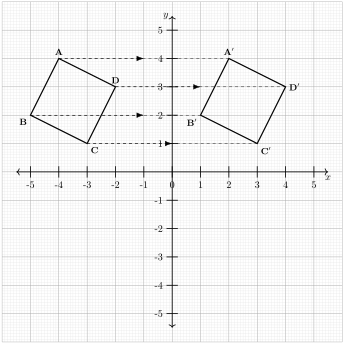
A square \(\mathbf{ABCD}\) undergoes a translation when each of its vertices (\(\mathbf{A}\text{,}\)\(\mathbf{B}\text{,}\)\(\mathbf{C}\) and \(\mathbf{D}\)) is moved the same distance and in the same direction. A translation vector, denoted by \(\mathbf{T}\text{,}\) describes this movement.
Using \(\mathbf{T}\) to represent a translation, the notation \(\mathbf{T}(\mathbf{P})\) indicates the application of the translation \(\mathbf{T}\) on \(\mathbf{P}\text{.}\) In FigureΒ 2.9.70, shows \(\mathbf{A'B'C'D'}\) is the image of \(\mathbf{ABCD}\) under a translation.
Example 2.9.71.
The position vector of point \(P\) is \(\vec{OP} = \langle 2, 3 \rangle\) in the plane. A translation is represented by the vector \(\vec{v} = \langle 5, -2 \rangle\text{.}\)
Solution.
Translation of a point by a vector is performed by adding the translation vector to the original position vector:
\(\vec{OQ} = \vec{OP} + \vec{v}\)
Substitute the values:
\begin{align*}
\vec{OQ} = \langle 2, 3 \rangle + \langle 5, -2 \rangle = \langle 2+5, 3+(-2) \rangle \amp \\
= \amp \langle 7, 1 \rangle
\end{align*}
Geometric interpretation: The point moves \(5\) units to the right and \(2\) units down along the plane.
Example 2.9.72.
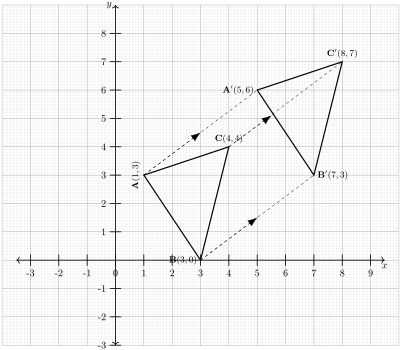
Triangle \(\mathbf{ABC}\) has vertices \(\mathbf{A}(1,3)\text{,}\) \(\mathbf{B}(3,0)\) and \(\mathbf{C}(4,4)\text{.}\)The triangle undergoes a translation \(\mathbf{T}\) defined by the vector \(\begin{pmatrix} 4 \\ 3 \end{pmatrix}\text{.}\)
-
Determine the coordinates of the translated vertices \(\mathbf{A'}\text{,}\) \(\mathbf{B'}\) , and \(\mathbf{C'}\) β.
Solution.
To find the coordinates of the translated vertices, we apply the translation \(\mathbf{T}\) to each original vertex.
\begin{align*}
\mathbf{OA'} \amp = \mathbf{OA} + \mathbf{T}\\
\mathbf{OB'} \amp = \mathbf{OB} + \mathbf{T}\\
\mathbf{OC'} \amp = \mathbf{OC} + \mathbf{T}
\end{align*}
\begin{align*}
\mathbf{OA'} \amp = \binom{1}{3} + \binom{4}{3} = \binom{1+4}{3+3} = \binom{5}{6} \\
\mathbf{OB'} \amp = \binom{3}{0} + \binom{4}{3} = \binom{3+4}{0+3} = \binom{7}{3} \\
\mathbf{OC'} \amp = \binom{4}{4} + \binom{4}{3} = \binom{4+4}{4+3} = \binom{8}{7}
\end{align*}
Exercises Exercises
1.
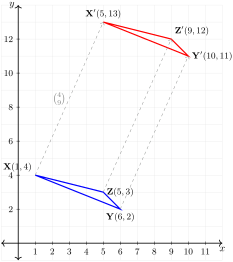
Draw triangle \(\mathbf{XYZ}\) with vertices \(\mathbf{X(1, 4)}\text{,}\) \(\mathbf{Y(6, 2)}\text{,}\) and \(\mathbf{Z(5, 3)}\text{.}\) On the same axes, plot \(\mathbf{X'Y'Z'}\text{,}\) the image of triangle \(\mathbf{XYZ}\) under a translation given by \(\binom{4}{9}.\)
2.
The following points have been translated using the given vectors. Determine their original positions:
-
\(\displaystyle (4,-1); \, \, \binom{2}{3}\)
-
\(\displaystyle (0,-3); \, \, \binom{1}{3}\)
-
\(\displaystyle (-3,8); \, \, \binom{-2}{7}\)
-
\(\displaystyle (11,-5); \,\, \binom{5}{-1}\)
-
\(\displaystyle (-12,5); \,\, \binom{3}{-10}\)
-
\(\displaystyle (2,-7); \,\, \binom{-10}{15}\)
3.
A point \(\mathbf{P(5, -3)}\) is mapped to a new position after a translation. If the new coordinates are \(\mathbf{(9, 1)}\text{,}\) determine the translation vector used.
4.
A point \(\mathbf{M(1, -4)}\) undergoes a translation by \(\binom{3}{5}.\) Determine the coordinates of \(\mathbf{M'}\text{,}\) the transformed point. If \(\mathbf{M'}\) is then translated by \(\binom{-4}{2},\) find the final position \(\mathbf{M''}\text{.}\) What is the single translation vector that maps \(\mathbf{M'}\) to \(\mathbf{M''}\) directly?
5.
Translate each of the following points using the given vector:
-
\(\displaystyle (10,1); \, \, \binom{-11}{2}\)
-
\(\displaystyle (-2,-5); \, \, \binom{6}{14}\)
-
\(\displaystyle (3,-15); \, \, \binom{-16}{11}\)
-
\(\displaystyle (-11,4); \, \, \binom{-15}{10}\)
-
\(\displaystyle (1,10); \, \, \binom{7}{2}\)
-
\(\displaystyle (4,-9); \, \, \binom{5}{-8}\)
-
\(\displaystyle (-2,13); \, \, \binom{-3}{1}\)
-
\(\displaystyle (-6,5); \, \, \binom{-1}{2}\)
Answer.
Checkpoint 2.9.75.
Checkpoint 2.9.76.
Subsubsection 2.9.5.3 Equivalent Vectors
Curriculum Alignment
Teacher Resource 2.9.77.
To assist your teaching, we have prepared lesson resources, aligned with this textbook and the CBC. The Lesson Plan links to syllabus learning outcomes and provides suggest time allocations. The Step-by-Step Guide provides more detailed guidance on how to teach the content, including suggested questions to ask learners, and possible answers.
Now that you understand how to represent vectors using magnitude and direction, we can explore how to compare them. Is it possible for two vectors to be considered βequalβ even if they are located in different places on a graph? In this section, you will examine the specific conditions regarding length and direction that must be met for two vectors to be called equivalent.
Learner Experience 2.9.10.
(a)
(b)
(c)
(d)
(e)
Look at the two arrows you have drawn. Do they look like "clones" (exact copies) of each other?
(f)
Imagine sliding the vector \(\mathbf{AB}\) straight down without turning it.
-
If you move point \(A\) so it sits exactly on top of point \(C\text{,}\) where does point \(B\) land?
-
Does it land exactly on point \(D\text{?}\)
(g)
Calculate the length of both vectors and compare the direction they are pointing. What two properties do vector \(\mathbf{AB}\) and vector \(\mathbf{CD}\) have in common?
(h)
Since these vectors share the exact same properties, discuss with your group what relationship exists between them.
Key Takeaway 2.9.78.
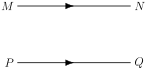
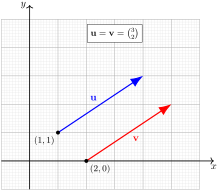
Two or more vectors are said to be equivalent if they satisfy the following conditions:
In FigureΒ 2.9.79 above, \(\textbf{MN} = \textbf{PQ}\) since they have same direction and equal magnitude.
Example 2.9.80.
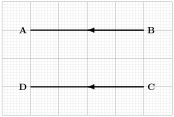
Using FigureΒ 2.9.81 below, determine whether vector \(\mathbf{AB}\) and \(\mathbf{DC}\) are equivalent.
Exercises Exercises
1.
Is it possible for two vectors to have the same direction but not to be equivalent? Explain your answer.
2.
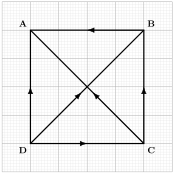
In FigureΒ 2.9.82, identify pairs of equivalent vectors and non-equivalent vectors.
Answer.
-
Equivalent Pairs\(\overrightarrow{DA}\) and \(\overrightarrow{CB}\text{:}\) Both point directly upward and have the same length (sides of the square).\(\overrightarrow{DC}\) and \(\overrightarrow{AB}\text{:}\) Both point directly to the right and have the same length.\(\overrightarrow{DO}\) and \(\overrightarrow{OB}\) Both point in the same direction along the diagonal and have the same length.
-
Non-Equivalent Pairs\(\overrightarrow{DA}\) and \(\overrightarrow{BC}\text{:}\) While they have the same length, they point in opposite directions (up vs. down).\(\overrightarrow{DC}\) and \(\overrightarrow{DA}\text{:}\) These have the same length but different directions (horizontal vs. vertical).\(\overrightarrow{DB}\) and \(\overrightarrow{AC}\text{:}\) These are the diagonals; they have the same length but different directions.
3.
Draw two vectors that have the same magnitude and direction but start at different points.