Skip to main content
Contents
Search Book
Search Results:
No results.
Read aloud Readability settings Prev Up Next \(\newcommand{\N}{\mathbb N} \newcommand{\Z}{\mathbb Z} \newcommand{\Q}{\mathbb Q} \newcommand{\R}{\mathbb R}
\newcommand{\lt}{<}
\newcommand{\gt}{>}
\newcommand{\amp}{&}
\definecolor{fillinmathshade}{gray}{0.9}
\newcommand{\fillinmath}[1]{\mathchoice{\colorbox{fillinmathshade}{$\displaystyle \phantom{\,#1\,}$}}{\colorbox{fillinmathshade}{$\textstyle \phantom{\,#1\,}$}}{\colorbox{fillinmathshade}{$\scriptstyle \phantom{\,#1\,}$}}{\colorbox{fillinmathshade}{$\scriptscriptstyle\phantom{\,#1\,}$}}}
\)
Subsection 2.10.6 Velocity-Time Graphs
Curriculum Alignment
Strand
2.0 Measurements and Geometry
Sub-Strand
Specific Learning Outcomes
Draw a velocity-time graph from given tables in different situations and interpret velocity-time graphs in different situations.
Teacher Resource 2.10.69 .
To assist your teaching, we have prepared lesson resources, aligned with this textbook and the CBC. The Lesson Plan links to syllabus learning outcomes and provides suggest time allocations. The Step-by-Step Guide provides more detailed guidance on how to teach the content, including suggested questions to ask learners, and possible answers.
Learner Experience 2.10.70 .
A train moving at
\(40 \,\text{ m/s}\) along a North-South railway track passes through a station R at
\(5:30\, \text{ PM}\text{.}\) The train is decelerating at
\(4 \,\text{ m/s²}\) northward.
Find the velocity of the train:
\(3\) seconds after
\(5:30\, \text{ PM}\)
\(6\) seconds after
\(5:30\, \text{ PM}\)
\(2\) seconds after
\(5:30\, \text{ PM}\)
Determine the average velocity of the train:
In the first
\(5 \,\text{ seconds}\) after
\(5:30\, \text{ PM}\)
In the first
\(10 \,\text{ seconds}\) after
\(5:30\, \text{ PM}\)
Draw a velocity-time graph, find the distance of the train from R at
\(12\) seconds past
\(5:30\, \text{ PM}\)
Example 2.10.72 .
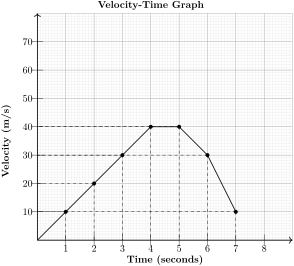
Table 2.10.73. Draw the velocity-time graph to represent the data.
Solution .
This is a velocity-time graph that shows Acceleration, Constant Speed, and Deceleration.
Example 2.10.74 .
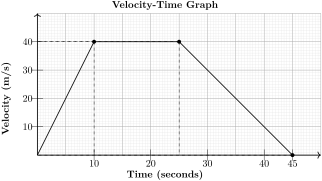
A car starts from rest and accelerates to a velocity of
\(40 \, \text{ m/s}\) in
\(10 \,\text{ seconds}\) . It then maintains this velocity for
\(15 \,\text{ seconds}\) before decelerating to rest, with the total time of motion being
\(45 \,\text{ seconds}\)
Draw the velocity-time graph to represent its motion.
Find the total distance covered.
Determine the average velocity.
Calculate the acceleration and deceleration.
Solution .
The total distance is the area under the velocity-time graph, which consists of a trapezium.
Distance during acceleration (triangle).
\begin{align*}
\text{Area} = \amp \frac{1}{2}\times \text{ base}\times \text{ height}\\
\amp \frac{1}{2} \times 10 \times 40\\
= \amp 200 \,\text{ m}
\end{align*}
Distance during constant velocity (rectangle)
\begin{align*}
\text{Area} = \text{base} \times \text{ height}\amp \\
\amp 15 \times 40\\
= \amp 600 \,\text{ m}
\end{align*}
Distance during deceleration (triangle)
\begin{align*}
\text{Area} = \amp \frac{1}{2}\times \text{ base}\times \text{ height}\\
\amp 20 \times 40\\
= \amp 400\,\text{ m}
\end{align*}
\(200+600+400\) =
\(1200\,\text{ m}\)
Therefore, the total distance is
\(1200\,\text{ m}\)
\begin{align*}
\text{Average velocity} = \amp \frac{\text{Total distance}}{\text{ Total time}}\\
= \amp \frac{1200}{45}\\
\amp = 26.67\,\text{ m/s}
\end{align*}
Therefore, the average velocity is
\(26.67\,\text{ m/s}\)
Acceleration and Deceleration
\begin{align*}
\text{a} = \amp \frac{\text{v - u}}{\text{t}}
\end{align*}
\(\text{v}\) = is the final velocity (
\(40 \, \text{ m/s}\text{,}\) from the graph)
\(\text{u}\) = is the initial velocity (
\(0 \, \text{ m/s}\) )
\(\text{t}\) = is the time taken during acceleration (
\(10 \, \text{ seconds}\) ).
\begin{align*}
\amp \frac{40 - 0}{10}\\
= \amp 4 \,\text{ m/s²}
\end{align*}
Therefore, acceleration is
\(4 \,\text{ m/s²}\)
\(\text{v}\) is the final velocity (
\(0 \, \text{ m/s}\text{,}\) since the car comes to rest),
\(\text{u}\) is the initial velocity (
\(40 \, \text{ m/s}\text{,}\) from the graph)
\(\text{t}\) is the time taken during deceleration (
\(10 \, \text{ seconds}\) ).
\begin{align*}
\amp \frac{0 - 40}{10}\\
= \amp -4 \,\text{ m/s²}
\end{align*}
Therefore, the object is decelerating at
\(4 \,\text{ m/s²}\)
Checkpoint 2.10.75 .
Checkpoint 2.10.76 .
Exercises Exercises
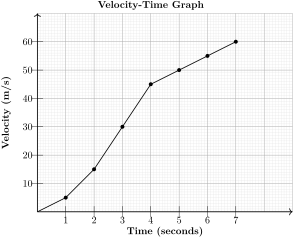
1. Table 2.10.77.
Draw the velocity time graph to represent the data
Use the graph to describe the motion of the vehicle. Is the velocity constant, increasing, or decreasing? Explain your answer.
Calculate the average velocity of the vehicle between
\(\text{t}\) =
\(0 \text{ s}\) and
\(\text{t}\) =
\(3 \text{ s}\)
Answer .
The motion of the vehicle is increasing as the velocity is increasing with time.
Average Velocity from t =
\(0 \text{ s}\) to
\(\text{t}\) =
\(3 \text{ s}\)
\begin{align*}
= \amp \frac{(2.5+10+22.5)}{3}\\
\amp = 11.67 \,\text{ m/s}
\end{align*}
Therefore, the average velocity is
\(11.67\,\text{ m/s}\)
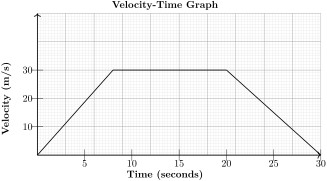
2. A motorcycle starts from rest and accelerates uniformly to a speed of
\(30 \,\text{ m/s}\) in
\(8 \, \text{ seconds}\text{.}\) It then continues at this speed for
\(12 \, \text{ seconds}\) before decelerating uniformly to rest in
\(10 \, \text{ seconds}\text{.}\)
Draw the velocity-time graph to represent its motion.
Find the total distance covered.
Determine the average velocity.
Calculate the acceleration and deceleration.
Answer .
The total distance is the area under the velocity-time graph, which consists of a trapezium.
\begin{gather*}
= \frac{1}{2} \times 8 \times 30\\
= 120 \,\text{m}\\
= 30 \times 12\\
= 360 \,\text{ m}\\
= \frac{1}{2} \times 10 \times 30\\
= 150\,\text{ m}
\end{gather*}
Total distance =
\(120+360+150\) =
\(630\,\text{ m}\)
Average Velocity
\(= 21 \, \text{ m/s}\)
The acceleration is calculated as:
\(a = \frac{30 - 0}{8} = 3.75 \, \text{ m/s}^2\text{.}\)
The deceleration is calculated as:
\(\frac{0 - 30}{10} = -3 \, \text{ m/s}^2\text{.}\)
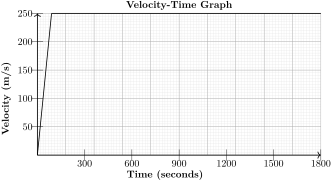
3. After takeoff, an airplane reaches a cruising speed of
\(250 \,\text{ m/s}\) and maintains it for
\(30 \, \text{ minutes}\text{.}\) Draw a velocity-time graph representing the motion of the airplane from
\(\text{t}\) =
\(0\) to
\(\text{t}\) =
\(1800 \,\text{ seconds}\text{.}\)
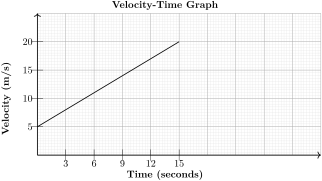
4. A cyclist starts at
\(5 \,\text{ m/s}\) and increases speed to
\(20 \,\text{ m/s}\) in
\(15 \,\text{ seconds}\text{.}\)
Draw the Velocity-Time Graph.
Calculate the acceleration of the cyclist.
What type of motion is represented by the velocity-time graph you drew?
Answer .
The acceleration is calculated as:
\(a = \frac{20 - 5}{15} = 1 \, \text{ m/s}^2\text{.}\)
The motion represented by the velocity-time graph is uniformly accelerated motion since the cyclist’s velocity increases at a constant rate over time.