Subsection 2.1.2 Enlargements of Objects
Enlargements of objects preserve their shape, but shrink and expand them.
Subsubsection 2.1.2.1 Positive Enlargements
Teacher Resource 2.1.13.
To assist your teaching, we have prepared lesson resources, aligned with this textbook and the CBC. The Lesson Plan links to syllabus learning outcomes and provides suggest time allocations. The Step-by-Step Guide provides more detailed guidance on how to teach the content, including suggested questions to ask learners, and possible answers.
Learner Experience 2.1.3.
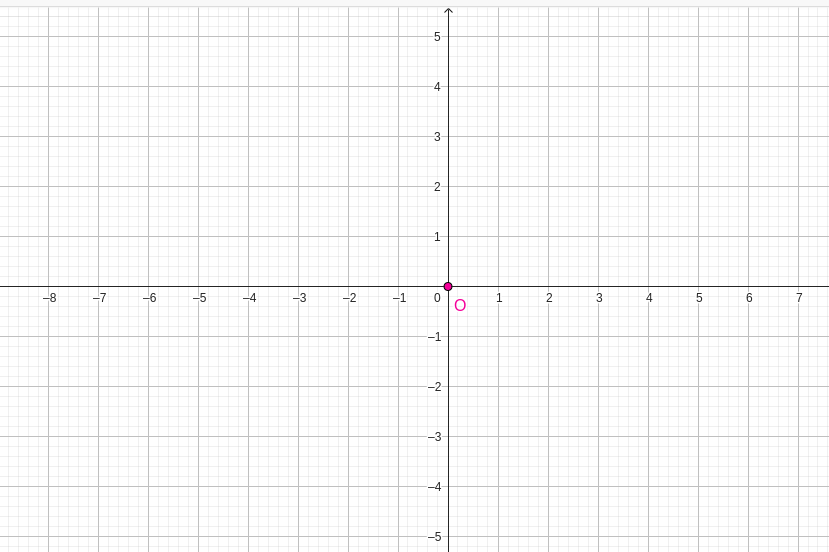
Work in pairs
(a)

(b)

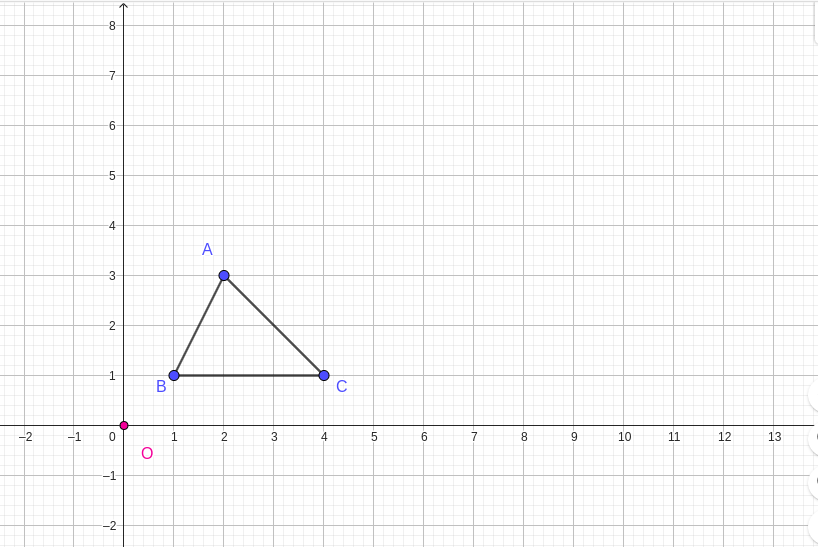
(c)
(d)
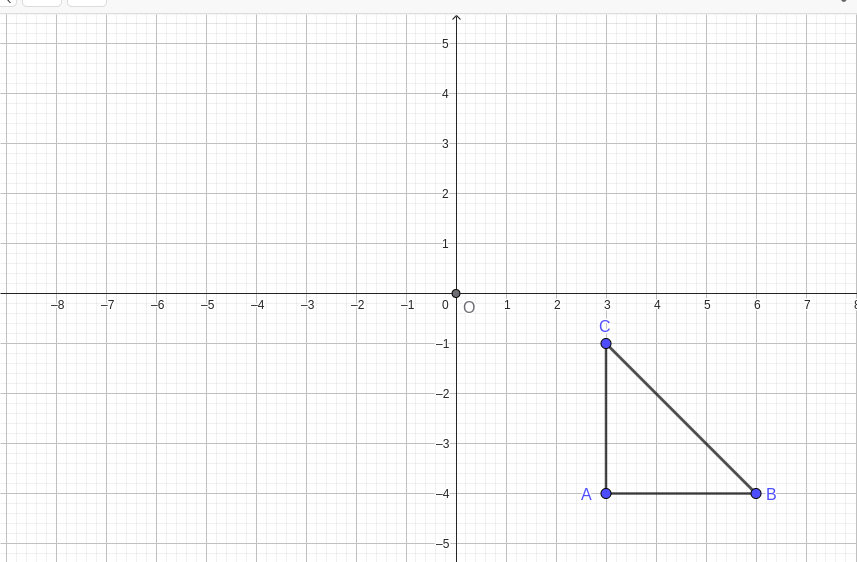
Connect points \(A\text{,}\) \(B\text{,}\) and \(C\) with straight lines to form triangle \(ABC\text{.}\)

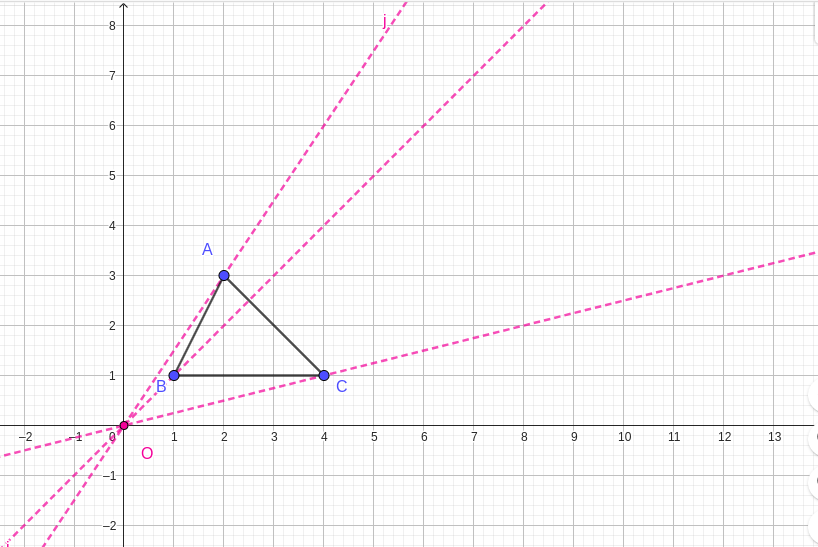
(e)
(f)

(g)
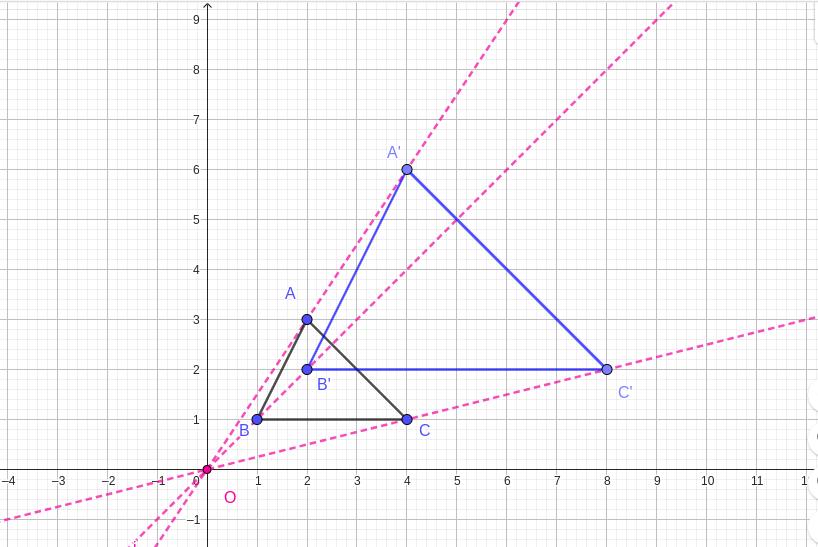
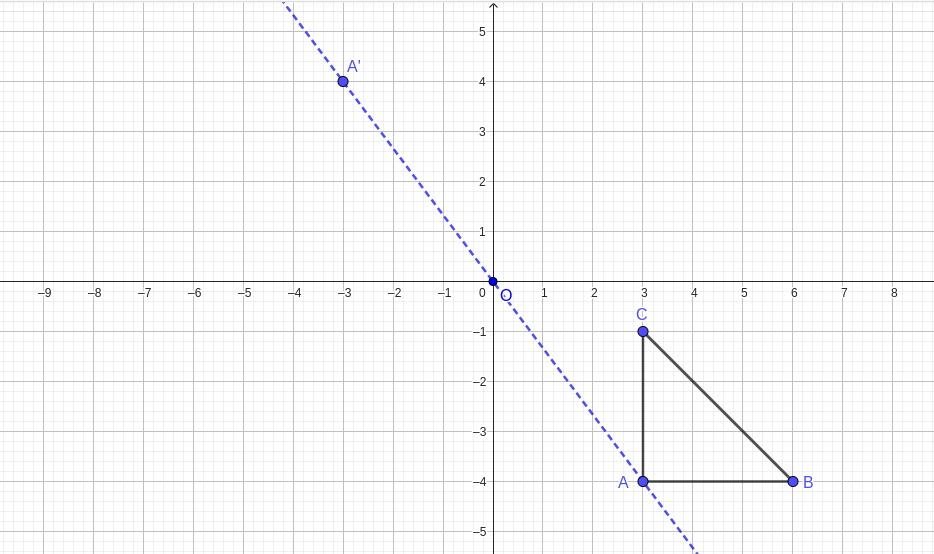
Extend each line to twice its original length and mark the new points as \(A'\text{,}\) \(B'\text{,}\) and \(C'\text{.}\)
(h)
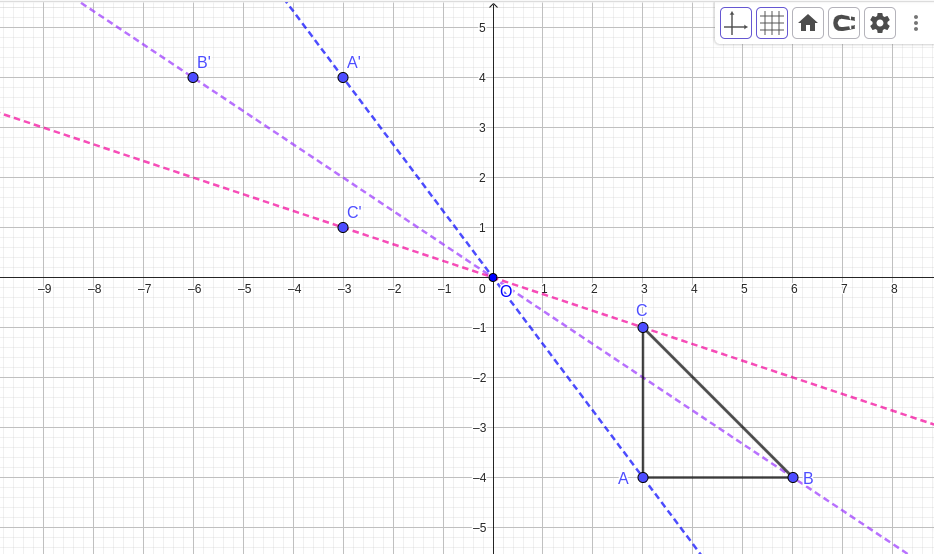
Connect \(A'\text{,}\) \(B'\text{,}\) and \(C'\) to form the enlarged triangle \(A'B'C'\text{.}\)

(i)
Compare the two triangles and note any similarities.
(j)
Calculate the ratios \(\frac{OA'}{OA}\text{,}\) \(\frac{OB'}{OB}\text{,}\) and \(\frac{OC'}{OC}\text{,}\) what do you notice between the three ratios.
(k)
Discuss your findings with the rest of the class.
Exploration 2.1.4. Trying Out Positive Enlargement.
Instructions.
Use the scale factor slider at the top to vary the scale factor from \(0\) to \(4\text{.}\) Observe how the enlarged triangle changes size relative to the original. You can also click and drag the center of enlargement (point \(O\)) or any of the vertices on the original triangle (\(A\text{,}\) \(B\text{,}\) and \(C\)) to explore how the transformation responds.
Key Takeaway 2.1.15.
-
Definition: The process of obtaining \(\triangle A'B'C'\) from \(\triangle ABC\) is called enlargement. \(\triangle ABC\) is the object and \(\triangle A'B'C'\) is the image. The point \(O\) is the centre of enlargement.
-
Scale Factor: To determine the scale factor, divide the length of the enlarged image by the corresponding length of the original object.\begin{align*} \text{Scale Factor (SF)}\amp = \frac{OA'}{OA} = \frac{OB'}{OB} = \frac{OC'}{OC}\\ \amp = \frac{A'B'}{AB} = \frac{A'C'}{AC} = \frac{B'C'}{BC} \end{align*}
-
Properties: If \(\text{Scale Factor} \gt 1\text{,}\) the image is larger. If \(0 \lt \text{Scale Factor} \lt 1\text{,}\) the image is smaller (a reduction). Object and image remain similar.
-
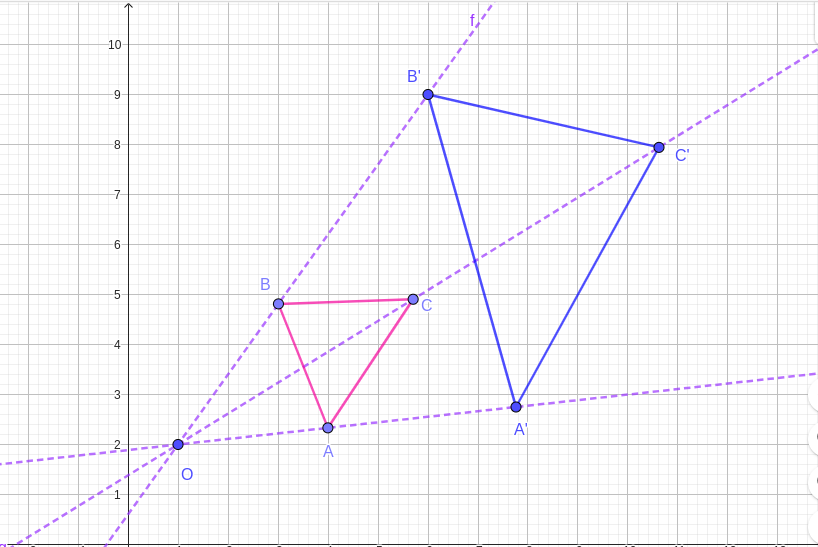
Lines connecting object points to their corresponding image points intersect at the center of enlargement. This property helps in determining the center of enlargement when both the object and its image are given.
Example 2.1.16.
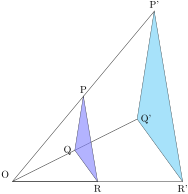
In the figure below, Triangle \(P'Q'R'\) is the enlarged image of triangle \(PQR\text{,}\) with center \(O\)
-
Given that \(OP=6\) \(cm\) and \(PP'=9\) \(cm\text{,}\) determine the linear scale factor of the enlargement.
Solution.
-
The linear scale factor is:\begin{align*} \frac {OP'}{OP} =\amp \frac{(6+9)}{6}\\ = \amp \frac{15}{6}\\ = \amp \frac {5}{2} \end{align*}
-
We know the linear scale factor is \(\frac{5}{2}\text{,}\) therefore:\begin{align*} \frac {Q'R'}{QR}= \amp \frac {5}{2}\\ Q'P' =\amp \frac{(4 \times 5)}{2} \\ = \amp \frac{20}{2}\\ Q'P' = \amp 10\, cm \end{align*}
Example 2.1.18.
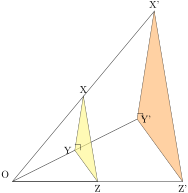
Construct any triangle \(XYZ\) and choose a point \(O\) outside the triangle. Using \(O\) as the center of enlargement and a scale factor of \(4\text{,}\) construct the enlarged image of triangle \(XYZ\) under the enlargement.
Solution.
By measurement;
\begin{align*}
\text{To determine X', the image of X, We follow these steps:} \amp \\
OX= \amp 1.8\, cm\\
\frac {OX'}{OX}= \amp \text{scale factor}\\
\frac{OX'}{1.8} =4\amp \\
OX'= \amp 4 \times 1.8\, cm\\
= \amp 7.2\, cm
\end{align*}
\begin{align*}
\text{To determine Y', the image of Y, We follow these steps:} \amp \\
OY= \amp 3.2\, cm\\
\frac {OY'}{OY}= \amp \text{scale factor}\\
\frac{OY'}{3.2} =4\amp \\
OX'= \amp 4 \times 3.2\, cm\\
= \amp 12.8\, cm
\end{align*}
\begin{align*}
\text{To determine Z', the image of Z, We follow these steps:} \amp \\
OZ= \amp 2.7\, cm\\
\frac {OZ'}{OZ}= \amp \text{scale factor}\\
\frac{OZ'}{2.7} =4\amp \\
OX'= \amp 4 \times 2.7\, cm\\
= \amp 10.8\, cm
\end{align*}
Example 2.1.20.
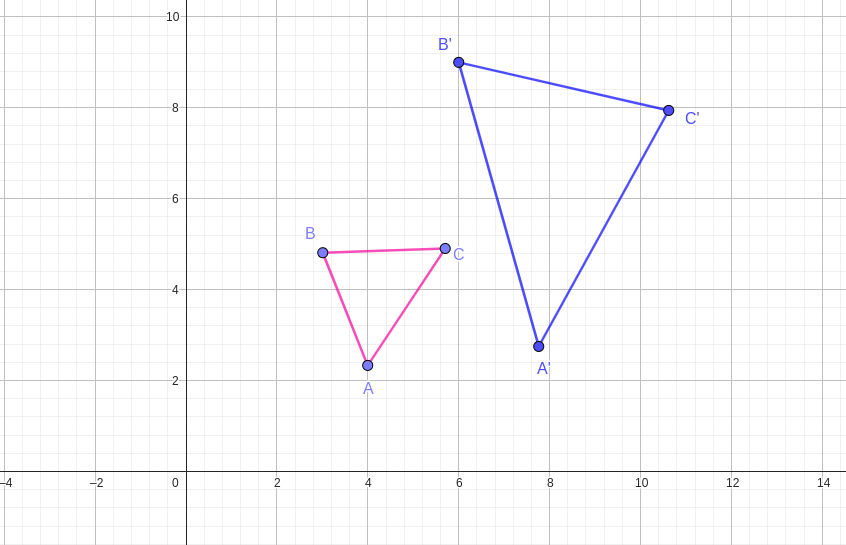
Triangle \(A'B'C'\) is the image of triangle \(ABC\) under an enlargement.Locate the centre of the enlargement.

Example 2.1.21.
Given that \(A\, (6,8)\text{,}\) \(B\, (8,8)\text{,}\) \(C\, (12,8)\text{,}\) \(D\, (14,2)\) and \(E\, (10,0)\) are the Vertices of the pentagon, find the vertices of its image after an enlargement with origin as the centre and scale factor of:
Solution.
Given the centre of enlargement is \((0,0)\) and the scale factor \(k\text{,}\)We find the coordinates of the image as follows;
Applying this to the given co-odinates we get;
(a) for a scale factor of \(2\)
\begin{align*}
A'=\amp(2\times 6), (2 \times 8)=(12,16) \\
B'=\amp(2\times 8), (2 \times 8)=(16,16) \\
C'=\amp(2\times 12), (2 \times 2)=(24,16) \\
D'=\amp(2\times 14), (2 \times 8)=(28,4) \\
E'=\amp(2\times 10), (2 \times 0)=(20,0)
\end{align*}
So the vertices of the image are \(A' (12,16)\text{,}\) \(B'(16,16)\text{,}\) \(C' (24,16)\text{,}\) \(D' (28,4)\) and \(E' (20,0)\text{.}\)
(b) for a scale factor of \(\frac{1}{2}\)
\begin{align*}
A'=\amp\left(\frac{1}{2}\times 6\right), \left(\frac{1}{2} \times 8\right)=(3,4) \\
B'=\amp\left(\frac{1}{2}\times 8\right), \left(\frac{1}{2} \times 8\right)=(4,4) \\
C'=\amp\left(\frac{1}{2}\times 12\right), \left(\frac{1}{2} \times 2\right)=(6,4) \\
D'=\amp\left(\frac{1}{2}\times 14\right), \left(\frac{1}{2} \times 8\right)=(7,1) \\
E'=\amp\left(\frac{1}{2}\times 10\right), \left(\frac{1}{2} \times 0\right)=(5,0)
\end{align*}
So the vertices of the image are \(A' (3,4)\text{,}\) \(B'(4,4)\text{,}\) \(C' (6,4)\text{,}\) \(D' (7,1)\) and \(E' (5,0)\text{.}\)
Checkpoint 2.1.22.
Checkpoint 2.1.23.
Checkpoint 2.1.24.
Checkpoint 2.1.25.
Checkpoint 2.1.26.
Exercises Exercises
1.
A triangle with the verticies \(X\, (4,0)\text{,}\) \(Y\, (6,3)\) and \(Z\, (5,4)\) is enlarged.If the centre of enlargment is \((1,1)\text{,}\) find the co-ordinates of the image of the triangle when the scale factor is:
Answer.
-
\begin{gather*} X': (1 + (-2)(4-1), 1 + (-2)(0-1)) = (1-6, 1+2) = (-5,3)\\ Y': (1 + (-2)(6-1), 1 + (-2)(3-1)) = (1-10, 1-4) = (-9,-3)\\ Z': (1 + (-2)(5-1), 1 + (-2)(4-1)) = (1-8, 1-6) = (-7,-5) \end{gather*}
-
\begin{gather*} X': (1 + 0.5(4-1), 1 + 0.5(0-1)) = (1+1.5, 1-0.5) = (2.5,0.5)\\ Y': (1 + 0.5(6-1), 1 + 0.5(3-1)) = (1+2.5, 1+1) = (3.5,2)\\ Z': (1 + 0.5(5-1), 1 + 0.5(4-1)) = (1+2, 1+1.5) = (3,2.5) \end{gather*}
2.
Points \(A\, (2,6)\text{,}\) \(B\, (4,6)\text{,}\) and \(C\, (4,2)\) are the vertices of a triangle. Taking point \((0,2)\) as the centre of enlargement, find the coordinates of its image when the scale factor is \(-1\text{.}\)
3.
Points \(P\,(1,4)\text{,}\) \(Q\, (3,4)\) and \(R\, (3,1)\) are verticies of a triangle. Taking the origin as the centre of enlargement, find the image when the scale factor is;
Answer.
-
\begin{gather*} P': (0 + (-1/4)\times(1-0), 0 + (-1/4)\times(4-0)) = (-0.25, -1)\\ Q': (0 + (-1/4)\times(3-0), 0 + (-1/4)\times(4-0)) = (-0.75, -1)\\ R': (0 + (-1/4)\times(3-0), 0 + (-1/4)\times(1-0)) = (-0.75, -0.25) \end{gather*}
-
\begin{gather*} P': (-3, -12)\\ Q': (-9, -12)\\ R': (-9, -3) \end{gather*}
-
\begin{gather*} P': (2, 8)\\ Q': (6, 8)\\ R': (6, 2) \end{gather*}
4.
A square measures \(5\) cm by \(9\) cm. Find the corresponding measurements of the image of the square after an enlargement with scale factor of \(-2.\)
5.
A photograph is enlarged so that its width increases from \(10\) cm to \(25\) cm. If the original height is \(15\) cm, find the new height.
6.
A map has a scale of \(1:50,000\text{.}\) If the distance between two cities on the map is \(8\) cm, find the actual distance.
Subsubsection 2.1.2.2 Negative Enlargements
Curriculum Alignment
Teacher Resource 2.1.27.
To assist your teaching, we have prepared lesson resources, aligned with this textbook and the CBC. The Lesson Plan links to syllabus learning outcomes and provides suggest time allocations. The Step-by-Step Guide provides more detailed guidance on how to teach the content, including suggested questions to ask learners, and possible answers.
Learner Experience 2.1.5.
Work in pairs
(a)

(b)
Mark the origin at \((0,0)\) and label it \(\textbf{O}\text{.}\) This point will be the centre of enlargement.
(c)
(d)
Join \(A\text{,}\) \(B\text{,}\) and \(C\) using straight lines to form triangle \(ABC\text{.}\)
(e)
Draw straight lines from the centre \(O\) through each vertex \(A\text{,}\) \(B\text{,}\) and \(C\text{.}\) Extend each line beyond the centre to the opposite side.
(f)
(g)
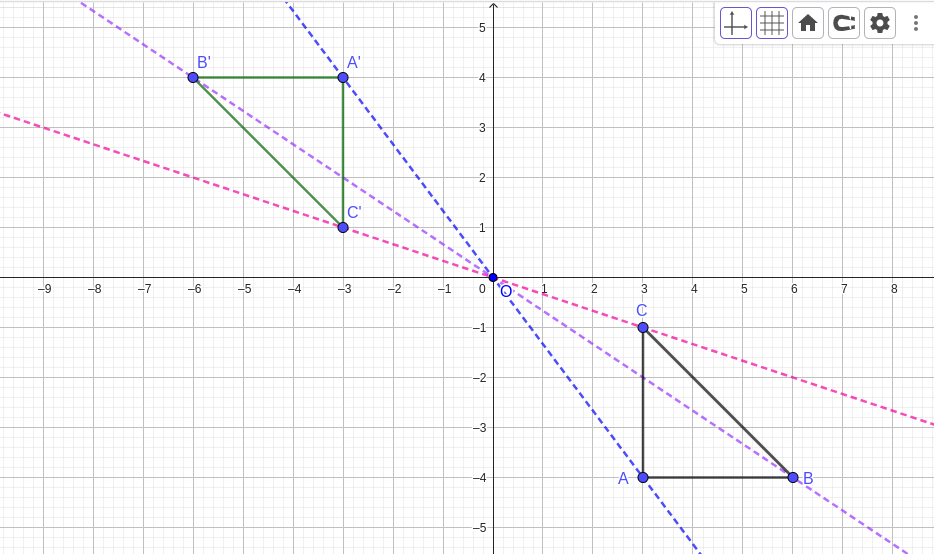
Using a scale factor of \(-2\text{,}\) mark new points on the opposite side of the centre along the same straight lines such that:
(h)
Join \(A'\text{,}\) \(B'\text{,}\) and \(C'\) to form triangle \(A'B'C'\text{,}\) the image of triangle \(ABC\) under a negative enlargement.
(i)
-
Their shapes?
-
Their sizes?
-
Their orientation?
-
Their positions relative to the centre?
(j)
Discuss your findings with the rest of the class.
Exploration 2.1.6. Trying Out Negative Enlargements.
Instructions.
Use the scale factor slider at the top left to vary the scale factor \(k\) between \(-3\) and \(3\text{.}\) Observe how a negative scale factor inverts the rectangle across the center of enlargement \(O\text{,}\) appearing on the opposite side of the dashed construction lines. You can drag the center \(O\text{,}\) or the diagonal vertices \(A\) and \(C\) to resize the original rectangle.
Key Takeaway 2.1.29.
-
A negative enlargement is a transformation where the image is produced on the \(\textbf{opposite side}\) of the center of enlargement from the original shape. The scale factor is negative, indicating a change in orientation.
-
When the scale factor is negative (e.g., \(-2\)), both the size and position of the shape change. The image is enlarged (or reduced) and rotated \(180^\circ\) about the center of enlargement. The magnitude of the scale factor determines how much larger or smaller the image becomes.
-
-
The distance from center to image point is \(|k|\) times the distance from center to object point
-
The image point lies on the opposite side of the center along the same line
-
All corresponding sides are proportional: \(\frac{OA'}{OA} = \frac{OB'}{OB} = \frac{OC'}{OC} = k\)
-
The shapes remain similar but with opposite orientation
-
-
Negative enlargements are useful in real-world applications such as reflections in optics, creating mirror images, and understanding symmetry transformations in geometry.
Table 2.1.30. Comparison of Positive and Negative Scale Factor Property Positive SF Negative SF Position Same side of centre Opposite side of centre Orientation Same as object Inverted (rotated \(180^\circ\)) \(|k| \gt 1\) Larger Larger AND inverted \(|k| \lt 1\) Smaller Smaller AND inverted
Negative scale factor.
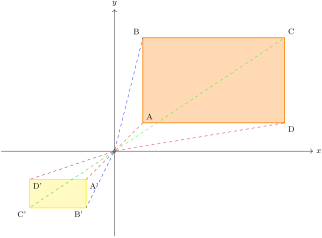
In the provided diagram, rectangle \(ABCD\) has been enlarged to form rectangle \(A'B'C'D'\text{,}\) with point \(O\) as the center of the enlargement.
Note 2.1.32.
If an enlargement has a negative scale factor, the image is formed on the opposite side of the center and is inverted (Upside down).
Example 2.1.33.
Triangle \(PQR\) has vertices at \(P(4, 2)\text{,}\) \(Q(2, 4)\text{,}\) and \(R(6, 4)\text{.}\) Find the vertices of the image triangle \(P'Q'R'\) after a negative enlargement with center at the origin \(O(0, 0)\) and scale factor \(-2\text{.}\)
Solution.
For a negative enlargement with center at the origin and scale factor \(k = -2\text{,}\) the image of a point \((x, y)\) is \((kx, ky) = (-2x, -2y)\text{.}\)
Applying this transformation to each vertex:
\begin{align*}
P(4, 2) \longrightarrow P'(-2 \times 4, -2 \times 2) &= P'(-8, -4)\\
Q(2, 4) \longrightarrow Q'(-2 \times 2, -2 \times 4) &= Q'(-4, -8)\\
R(6, 4) \longrightarrow R'(-2 \times 6, -2 \times 4) &= R'(-12, -8)
\end{align*}
The image triangle \(P'Q'R'\) has vertices at \(P'(-8, -4)\text{,}\) \(Q'(-4, -8)\text{,}\) and \(R'(-12, -8)\text{.}\)
Note: The negative scale factor causes the image to appear on the opposite side of the center of enlargement. Triangle \(P'Q'R'\) is twice the size of triangle \(PQR\) (since \(|k| = 2\)) and is rotated \(180Β°\) about the origin.
Example 2.1.34.
Given rectangle \(ABCD\) with vertices at \(A(3, 2)\text{,}\) \(B(6, 2)\text{,}\) \(C(6, 4)\text{,}\) and \(D(3, 4)\text{,}\) find the image \(A'B'C'D'\) after a negative enlargement with center at point \(O(0, 0)\) and scale factor \(-\frac{1}{2}\text{.}\)
Solution.
For a negative enlargement with scale factor \(k = -\frac{1}{2}\text{,}\) the image of a point \((x, y)\) is \(\left(-\frac{1}{2}x, -\frac{1}{2}y\right)\text{.}\)
Applying this transformation to each vertex:
\begin{align*}
A(3, 2) \longrightarrow A'\left(-\frac{1}{2} \times 3, -\frac{1}{2} \times 2\right) &= A'\left(-\frac{3}{2}, -1\right)\\
B(6, 2) \longrightarrow B'\left(-\frac{1}{2} \times 6, -\frac{1}{2} \times 2\right) &= B'(-3, -1)\\
C(6, 4) \longrightarrow C'\left(-\frac{1}{2} \times 6, -\frac{1}{2} \times 4\right) &= C'(-3, -2)\\
D(3, 4) \longrightarrow D'\left(-\frac{1}{2} \times 3, -\frac{1}{2} \times 4\right) &= D'\left(-\frac{3}{2}, -2\right)
\end{align*}
The image rectangle \(A'B'C'D'\) has vertices at \(A'\left(-\frac{3}{2}, -1\right)\text{,}\) \(B'(-3, -1)\text{,}\) \(C'(-3, -2)\text{,}\) and \(D'\left(-\frac{3}{2}, -2\right)\text{.}\)
Note: The scale factor of \(-\frac{1}{2}\) means:
-
The image is half the size of the original (linear scale factor magnitude = \(\frac{1}{2}\))
-
The image is positioned on the opposite side of the center (negative sign)
-
The rectangle is rotated \(180Β°\) about the origin
Example 2.1.35.
Given that triangle \(ABC\) has vertices \(A(4, 6)\text{,}\) \(B(6, 2)\text{,}\) and \(C(2, 2)\text{,}\) find the vertices of its image after a negative enlargement with origin as the center and the following scale factors:
Solution.
Given the center of enlargement is \(O(0,0)\) and scale factor \(k\text{,}\) we find the coordinates of the image using \((x',y') = (kx, ky)\text{.}\)
\(\textbf{(a) For a scale factor of } k = -2:\)
\begin{align*}
A(4, 6) \longrightarrow A' &= (-2 \times 4, -2 \times 6) = (-8, -12)\\
B(6, 2) \longrightarrow B' &= (-2 \times 6, -2 \times 2) = (-12, -4)\\
C(2, 2) \longrightarrow C' &= (-2 \times 2, -2 \times 2) = (-4, -4)
\end{align*}
Observations: The scale factor of \(-2\) means the image triangle is:
-
Twice as large as the original (linear scale factor magnitude = \(2\))
-
Positioned on the opposite side of the center (negative sign)
-
Rotated \(180Β°\) about the origin
\(\textbf{(b) For a scale factor of } k = -\frac{1}{3}:\)
\begin{align*}
A(4, 6) \longrightarrow A' &= \left(-\frac{1}{3} \times 4, -\frac{1}{3} \times 6\right) = \left(-\frac{4}{3}, -2\right)\\
B(6, 2) \longrightarrow B' &= \left(-\frac{1}{3} \times 6, -\frac{1}{3} \times 2\right) = \left(-2, -\frac{2}{3}\right)\\
C(2, 2) \longrightarrow C' &= \left(-\frac{1}{3} \times 2, -\frac{1}{3} \times 2\right) = \left(-\frac{2}{3}, -\frac{2}{3}\right)
\end{align*}
Observations: The scale factor of \(-\frac{1}{3}\) means the image triangle is:
-
One-third the size of the original (linear scale factor magnitude = \(\frac{1}{3}\))
-
Positioned on the opposite side of the center (negative sign)
-
Rotated \(180Β°\) about the origin
Example 2.1.36.

Solution.
The centre of enlargement is \(O\text{,}\) the origin.
Draw a line from point \(A\) through \(O\) and extend the line upwards through the centre of enlargement.
Measure the distance from point \(O\) to point \(A\text{.}\) Since the scale factor is \(-1\text{,}\) and the distance from \(OA=5\text{,}\) then \(OA'=-1\times 5=-5\)

Similarly draw the lines from point \(B\) through \(O\) and \(C\) through \(O\) and extend the line upwards through the centre of enlargement. Measure the distance from point \(O\) to point \(B'\) and \(O\) to point \(C'\) and multipy by the scale factor \(-1\) to get the new distance from \(O\) to point \(B\) and \(O\) to point \(C\)

Join up the points to make the new triangle \(A'B'C'\)

Exercises Exercises
1.
A triangle with vertices \(X(4, 0)\text{,}\) \(Y(6, 3)\text{,}\) and \(Z(5, 4)\) is enlarged. If the centre of enlargement is \((1, 1)\text{,}\) find the coordinates of the image of the triangle when the scale factor is \(-2\text{.}\)
2.
Points \(A(2, 6)\text{,}\) \(B(4, 6)\text{,}\) and \(C(4, 2)\) are the vertices of a triangle. Taking point \((0, 2)\) as the centre of enlargement, find the coordinates of its image when the scale factor is \(-1\text{.}\)
3.
Points \(P(1, 4)\text{,}\) \(Q(3, 4)\text{,}\) and \(R(3, 1)\) are vertices of a triangle. Taking the origin as the centre of enlargement, find the image when the scale factor is:
-
\(\displaystyle -\frac{1}{4}\)
-
\(\displaystyle -3\)
Answer.
(a) The coordinates of the image triangle are \(P'\left(-\frac{1}{4}, -1\right)\text{,}\) \(Q'\left(-\frac{3}{4}, -1\right)\text{,}\) and \(R'\left(-\frac{3}{4}, -\frac{1}{4}\right)\text{.}\)
(b) The coordinates of the image triangle are \(P'(-3, -12)\text{,}\) \(Q'(-9, -12)\text{,}\) and \(R'(-9, -3)\text{.}\)
4.
A square measures \(5 \text{ cm}\) by \(5 \text{ cm}\text{.}\) Find the corresponding measurements of the image of the square after an enlargement with scale factor \(-2\text{.}\)
5.
Triangle \(ABC\) has sides \(AB = 6 \text{ cm}\text{,}\) \(BC = 8 \text{ cm}\text{,}\) and \(AC = 10 \text{ cm}\text{.}\) Find the sides of the image triangle after a negative enlargement with scale factor \(-\frac{1}{2}\text{.}\)