To assist your teaching, we have prepared lesson resources, aligned with this textbook and the CBC. The Lesson Plan links to syllabus learning outcomes and provides suggest time allocations. The Step-by-Step Guide provides more detailed guidance on how to teach the content, including suggested questions to ask learners, and possible answers.
work with a printed or drawn irregular polygon. The task is to divide the irregular polygon into smaller shapes whose areas are easier to calculate (like triangles, rectangles, or trapeziums). Tip: Use straight lines to cut along the diagonals or through the middle of the shape to create triangles or rectangles.
Calculate the Area of Each Shape: Once the polygon is broken into smaller shapes, students can calculate the area of each shape using appropriate formulas
Add the Areas: Once the area of each smaller shape has been calculated, students should add up all the areas to find the total area of the original irregular polygo
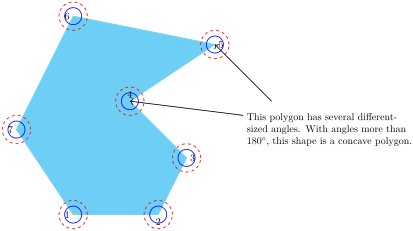
Regardless of shape, all polygons are made up of the same parts, sides, vertices, interior angles and exterior angles which may varry in size thus describing why we have irregular polygons versus regular polygons.
An irregular polgon has a set of atleast two sides or angles that are not the same. This heptagon has many different size angles , making it irregular.
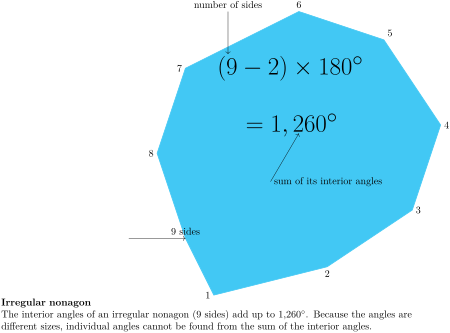
The interior angles of an irregular nenagon (9 sides) add up to \(1,260^\circ\text{.}\) Because angles are different sizes, individual angles cannot be found the sum of the interior angle.
Regardless of shape, all polygons are made up of the same parts: sides, vertices, interior angles and exterior angles which may vary in size thus describing why we have irregular polygons versus regular polygons.
An irregular polygon has a set of at least two sides or angles that are not the same. This heptagon has many different size angles, making it irregular.
The interior angles of an irregular nonagon (9 sides) add up to 1,260 degrees. Because angles are different sizes, individual angles cannot be found from the sum of the interior angles.
An irregular pentagon has the following side lengths: \(5 \;\text{cm}, 7\; \text{cm}, 6 \;\text{cm}, 8\; \text{cm} \text{ and } 4\; \text{cm}\text{.}\) When triangulated from one vertex, the pentagon forms three triangles with bases \(5\; \text{cm}, 7\; \text{cm}\) and \(6\; \text{cm}\text{.}\) Their perpendicular heights are \(4 \;\text{cm}, 5 \;\text{cm}\) and \(3 \;\text{cm}\) respectively. Estimate the area.
A garden is shaped like an irregular hexagon with side lengths \(4\; \text{m}, 6\; \text{m}, 5 \;\text{m}, 7\; \text{m}, 8\; \text{m} \text{ and } 3 \;\text{m}\text{.}\) When divided into four triangles, the bases are \(4\; \text{m}, 6\; \text{m}, 5\; \text{m}, 7\; \text{m}\) and the corresponding heights are \(3\; \text{m}, 4 \;\text{m}, 3\; \text{m}, 5\; \text{m}\text{.}\) Calculate the area.
A farmer’s land is shaped like an irregular quadrilateral with sides \(50 \;\text{m}, 60\; \text{m}, 40\; \text{m} \text{ and } 30\; \text{m}\text{.}\) A diagonal divides the land into two triangles with bases \(50\; \text{m}\) and \(40 \;\text{m}\text{.}\) Their perpendicular heights are \(24\; \text{m}\) and \(30\; \text{m}\text{.}\) Estimate the total area.
A city park is designed in the shape of an irregular hexagon with sides \(20 \;\text{m}\text{,}\)\(25 \;\text{m}\text{,}\)\(30 \;\text{m}\text{,}\)\(28\; \text{m}\text{,}\)\(22\; \text{m}\) and \(18 \;\text{m}\text{.}\) When split into four triangles, the bases are \(20 \;\text{m}\text{,}\)\(25\; \text{m}\text{,}\)\(30 \;\text{m}\text{,}\)\(28\; \text{m}\) and their heights are \(15\; \text{m}\text{,}\)\(18\; \text{m}\text{,}\)\(16\; \text{m}\text{,}\)\(14 \;\text{m}\text{.}\) Find the total area.
A heptagonal garden has side lengths \(5\; \text{m}\text{,}\)\(7 \;\text{m}\text{,}\)\(6 \;\text{m}\text{,}\)\(8\; \text{m}\text{,}\)\(9\; \text{m}\text{,}\)\(6\; \text{m}\) and \(10\; \text{m}\text{.}\) When triangulated it forms five triangles with bases \(5,7,6,8,9\) metres and heights \(4,5,3,6,4\) metres. Find the area.
A heptagonal plot of land has side lengths \(8 \;\text{m}\text{,}\)\(10 \;\text{m}\text{,}\)\(12\; \text{m}\text{,}\)\(9 \;\text{m}\text{,}\)\(11 \;\text{m}\text{,}\)\(13 \;\text{m}\text{,}\) and \(7\; \text{m}\text{.}\) When divided into five triangles the bases are \(8,10,12,9,11\) metres and their heights are \(6,7,5,6,4\) metres. Estimate the total area.
"We used to measure with rulers, now we measure with tools that reveal more than the eye can see. Technology is here, not to replace thinking but empower it." Kindly use the links below and explore in these interactive exercises.