Subsection 1.2.1 Indices

Introduction.

Mathematics involves working with very large and very small numbers, which can be simplified using indices. An \(index\) (plural, \(indices\)) also called \(exponent\) or \(power\) is a way of writing repeated multiplication of the same number.
Why Are Indices Important?
Indices are widely used in:
  • Scientific notation writing, where numbers are sometimes very large and sometimes very small, such as the speed of light or the size of an atom.
  • Physics and Engineering to understand exponential growth and decay rates, such as radioactive decay and population growth.
  • Finance and money in calculating compound interest.

Subsubsection 1.2.1.1 Expressing Numbers in Index Form

Numbers can be written in different ways. One useful way is index notation also called exponential notation. Index notation, is a way of writing repeated multiplication of the same number.
Exponent is commonly known as the power.

Activity 1.2.1.

Work in groups:
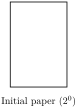
Materials Needed: One \(A4\) sheet of paper per student. A piece of paper is approimately. \(0.1\) mm thick
Instruction:
Form groups of \(2\) or \(-3\) students.
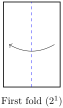
  • Take a piece of paper and fold it in half once. Count the number of layers.
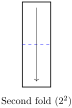
  • Fold it in half again and count the number of layers.
  • Continue folding and record your observations in a table.
  • Express the number of layers using index notation.
Figure 1.2.1. Illustrating the folding of paper to represent indices
Table 1.2.2. Table Showing the Growth of Paper Thickness with Each Fold
Number of Folds Thickness (mm) Index Notation
0 (no fold) 0.1 mm \(2^0 \times 0.1\)
1 fold 0.2 mm \(2^1 \times 0.1\)
2 folds 0.4 mm \(2^2 \times 0.1\)
3 folds ? ?
4 folds ? ?
5 folds ? ?
  1. What pattern do you observe in the numbers of layers?
  2. Can you express the pattern using indices?
  3. If you could fold the paper 10 times, how thick would it be?
  4. Can you think of other situations where things double repeatedly?
When writing Index Notation we represent it as:
\begin{equation*} a^n \end{equation*}
Where:
\(a\) is the base (the number being multiplied).
\(n\) is the \(exponent/ index /power\) (the number of times the base is multiplied by itself).
Therefore given \(x\) as a whole number;
\(x^a = x \times x \times x\) .......(\(a \) is the number of times \(x\) is repeated)
Example:
\(a^2\) = \(a \times a\) (\(a\) repeated twice)
\(2^3\) = \(2 \times 2 \times 2\) (\(2\) repeated thrice)
\(= 8\)
\(5^4\) = \(5 \times 5 \times 5 \times 5\) (\(5\) repeated four times)
\(= 625\)

Checkpoint 1.2.3. Expressing Whole Numbers in Index Form.

Load the question by clicking the button below.

Checkpoint 1.2.4. Expressing Cube Power Results in Index Form.

Load the question by clicking the button below.

Subsubsection 1.2.1.2 Laws of Indices

When we need to work with indices efficiently, we use a set of rules called the Laws of Indices. They are useful in carrying out operations involving indices.
a) Product Law
When multiplying numbers with the same base, add their powers.
i.e \(a^m \times a^n = a^{m + n}\)
Example:
\begin{equation*} 3^2 \times 3^4 = 3^{2 + 4} \end{equation*}
\begin{equation*} = 3^6 \end{equation*}
b) Quotient Law
When dividing numbers with the same base, subtract their powers.
i.e \(\frac {a^m}{a^n}\) = \(a^{m-n}\)
Example:
\begin{equation*} 5^7 \div 5^3 = \frac {5^7}{5^3} = \frac {5 \times 5 \times 5 \times 5 \times 5 \times 5 \times 5}{5 \times 5 \times 5} \end{equation*}
\begin{equation*} = 5^{(7 - 3)} \end{equation*}
\begin{equation*} = 5^4 \end{equation*}
c) Power of a Power Law
When raising a power to another power, multiply the powers.
i.e \((a^m)^n\) = \(a^{(m \times n)}\)
Example:
\begin{equation*} {(3^2)}^3 = (3 \times 3) \times (3 \times 3) \times (3 \times 3) \end{equation*}
\begin{equation*} =3^{(2 \times 3)} \end{equation*}
\begin{equation*} = 3^6 \end{equation*}
d) Power of a Product Law
When raising a power to a product factor, multiply the power to all factors inside the bracket.
i.e \((ab)^n\) = \(a^n \times b^n\)
Example:
\begin{equation*} (2 \times 3)^3 = 2^3 \times 3^3 \end{equation*}
\begin{equation*} = 8 \times 27 \end{equation*}
\begin{equation*} = 216 \end{equation*}
e) Fractional Powers
A fractional power represents a root.
i.e \((a^{\frac {m}{n}})\)
\begin{equation*} (a^m)^{\frac {1}{n}} = \sqrt [n]{a^m} \end{equation*}
Example:
Solve:
  1. \(8^{\frac {1}{3}}\)
    \begin{equation*} = \sqrt [3]{8^1} \end{equation*}
    \begin{equation*} =2 \end{equation*}
    Similarly we can say,
    \begin{equation*} 8 = 2 \times 2 \times 2 = 2^3 \end{equation*}
    \begin{equation*} 8^{\frac {1}{3}} = {(2^3)}^{\frac {1}{3}} \end{equation*}
    \begin{equation*} = 2^{(3 \times \frac {1}{3})} \end{equation*}
    \begin{equation*} = 2 \end{equation*}
  2. \((\frac {4}{5})^3\)
    \begin{equation*} (\frac {a}{b})^3 = \frac {a^3}{b^3} \end{equation*}
    \begin{equation*} (\frac {4}{5})^3 = \frac {4^3}{5^3} \end{equation*}
    \begin{equation*} = \frac {64}{125} \end{equation*}
Table 1.2.5. Summary of the Laws of Indices
Law \(Expression\) \(Example\)
Product Law \(a^m \times a^n = a^{(m + n)}\) \(2^3 \times 2^4 = 2^{(3 + 4)} = 2^7 = 128\)
Quotient Law \(a^m \div a^n = a^{(m - n)}\) \(5^7 \div 5^3 = 5^{(7 - 3)} = 5^4\)
Power of a Power Law \((a^m)^n = a^{(m \times n)}\) \((3^2)^3 = 3^{(2 \times 3)} = 3^6\)
Power of a Product Law \((a \times b)^n = a^n \times b^n\) \((2 \times 3)^3 = 2^3 \times 3^3 = 216\)
Fractional Powers \(a^{(\frac {m}{n})} = n\sqrt {(a^m)}\) \(8^{(\frac {1}{3})} = \sqrt[3]{8} = 2\)
Important
  • The laws apply only when the bases are the same

Activity 1.2.2.

Work in groups:
Materials Needed: A pen and a notebook
Instructions:
  • Form groups of three
  • Each group gets a set of index question (on flashcards or written on the board).
  • Write the question on your notebook
  • Simplify using the laws of indices that applies to your question.
  • Each group to present their working to the class.

Example 1.2.6.

Simplify the expression:
\(2^3 \times 2^4\)
Solution.
Expand each power:
\begin{equation*} 2^3 = ( 2 \times 2 \times 2 ) \end{equation*}
\begin{equation*} 2^4 = ( 2 \times 2 \times 2 \times 2 ) \end{equation*}
\begin{equation*} ( 2 \times 2 \times 2 ) \times ( 2 \times 2 \times 2 \times 2 ) \end{equation*}
Count the total number of factors
\begin{equation*} 2^{(3+4)} = 2^7 \end{equation*}
\begin{equation*} = 128 \end{equation*}

Checkpoint 1.2.7. Applying the Product Law of Indices.

Load the question by clicking the button below.

Checkpoint 1.2.8. Simplify Indices.

Load the question by clicking the button below.

Checkpoint 1.2.9. Applying Mixed Laws of Indices.

Load the question by clicking the button below.

Checkpoint 1.2.10. Algebraic Simplification of Indices.

Load the question by clicking the button below.

Exercises Exercises

1.
Apply the index laws in solving the following expressions:
  1. \(\displaystyle 2^6 \times 2^4 \qquad \qquad \qquad \qquad \text{e)}\,\, 8^3 \times 8^2 \div 8^4\)
  2. \(\displaystyle 5^7 \div 5^3 \qquad \qquad \qquad \qquad \text{f)}\,\, (6^2 \times 6^3) \div 6^4\)
  3. \(\displaystyle {(4^3)}^2 \qquad \qquad \qquad \qquad \qquad \text{g)}\,\, {(x^3y^2)}^4\)
  4. \(\displaystyle \frac {9^5}{9^2} \times 9^3 \qquad \qquad \qquad \qquad \text{h)}\,\, \frac {m^8}{m^5} \times {(m^2)}^3\)
2.
Mr. Gitonga is a farmer. He divides his rectangular field into smaller equal plots. The total area of the field is \(5^8 \, \, m^2\text{,}\) and each small plot has an area of \(5^3 \,\, m^2\text{.}\) How many smaller plots does Mr. Gitonga get? Express your answer using indices.
3.
Mkurugenzi Company investments grows exponentially. It was initially worth \(4^5\) Kenyan shillings, but after two years, it was multiplied by \(4^3\text{.}\) Use indices to represent the total investment value after the two years.
4.
Mathematics department has \(2^6\) books that can be borrowed and the science section has \(2^4\) books. Write an index expression for the total number of books in both sections if they were combined into a single shelf.
5.
A carpenter is building square tables of different sizes. The first table he makes has an area of \(3^2\) square metres. Each new table he builds is twice the length of the previous one.
  1. Express the area of the second and third tables in index form.
  2. Using the Laws of Indices, find the total area of the first three tables combined.
  3. If the carpenter continues doubling the table size, what will be the area of the \(5^{th}\) table?

Subsubsection 1.2.1.3 Zero and Negative Indices

Indices help us simplify repeated multiplication of the same number. But what happens when the exponent is zero or negative?
Zero Indices (Zero Exponent/Power Zero Law)

Activity 1.2.3.

Material needed:
Instructions:
Look at the pattern below and complete the missing values:
\begin{equation*} 2^4 = 16 \end{equation*}
\begin{equation*} 2^3 = 8 \end{equation*}
\begin{equation*} 2^2 = 4 \end{equation*}
\begin{equation*} 2^1 = 2 \end{equation*}
\begin{equation*} 2^0 = ? \end{equation*}
From the activity;
  • What pattern do you notice as the exponent decreases by \(1\text{?}\)
  • What happens when the exponent reaches zero?
  • Can you try the same pattern with \(3^n\text{?}\)
Key Takeaway:
Any non-zero number raised to power zero is always \(1\text{.}\)
i.e \(a^0\) = \(1\)
Negative Indices

Activity 1.2.4.

Look at the pattern below and complete the missing values:
\begin{equation*} 3^3 = 27 \end{equation*}
\begin{equation*} 3^2 = 9 \end{equation*}
\begin{equation*} 3^1 = 3 \end{equation*}
\begin{equation*} 3^0 = 1 \end{equation*}
\begin{equation*} 3^{-1} = ? \end{equation*}
\begin{equation*} 3^{-2} = ? \end{equation*}
  • Write the answers as fractions and decimal values.
  • What do you notice about the negative exponents?
  • Can you try the same pattern using \(5^n\text{?}\)
Key Takeaway:
A negative exponent means taking the reciprocal of the base.
i.e \(a^{-n}\) = \(\frac {1}{a^n}\)
Discussion:
  • What do zero and negative indices represent, and how do they simplify expressions?
  • How do negative exponents help express very small values and simplify small numbers?
  • Why does any nonzero number raised to power zero equal \(1\text{?}\) What happens when the base is zero?
  • Where do we see numbers decreasing exponentially or repeated division in real life?

Example 1.2.11.

The school need to make desks for grade \(10\) students. A carpenter is cutting wooden planks for the desks. The length of each plank decreases by half as he cuts smaller sections.
Table 1.2.12. Plank Lengths and Index Notation
Cut Number Plank Length (metres) Index Notation
Original Plank \(1\) \(2^0 = 1\)
First Cut __ \(2^{-1}\)
Second Cut __ \(2^{-2}\)
Third Cut __ \(2^{-3}\)
Hint: The negative exponent represents how many times the length has been halved.
Solution.
Each cut divides the plank by \(2\text{:}\)
  • The original plank is \(2^0 = 1\) metre
  • The first cut halves the plank:
    \begin{equation*} 2^{-1} = \frac {1}{2} metres \end{equation*}
  • The second cut halves it again:
    \begin{equation*} 2^{-2} = \frac {1}{2^2} = \frac {1}{4} metres \end{equation*}
  • The third cut follows the same pattern:
    \begin{equation*} 2^{-3} = \frac {1}{2^3} = \frac {1}{8} metres \end{equation*}
    If \(n\) represents the number of cuts, the remaining plank length \(L\) follows a trend which can bw represented as:
    \begin{equation*} L = 2^{-n} \end{equation*}
    where:
    \(n\) = number of cuts
    \(L\) = remaining length after \(n\) cuts
Using this formula, let’s calculate the length after \(4\) cuts:
\begin{equation*} L = 2^{-4} = \frac {1}{2^4}= \frac {1}{16} metres \end{equation*}
After \(4\) cuts, the remaining plank length is \(\frac {1}{16}\) metres
Key Takeaway
✔ Negative indices represent repeated division.
✔ This pattern appears in real-life situations like paper folding, battery energy life, and population decay.

Checkpoint 1.2.13. Simplifying Zero Index.

Load the question by clicking the button below.

Checkpoint 1.2.14. Applying Negative Index Laws.

Load the question by clicking the button below.

Exercises Exercises

1.
Fill in the missing values following the same halving pattern:
Table 1.2.15. Plank Lengths and Index Notation
Cut Number Plank Length (meters) Index Notation
0 (Original Plank) 1 \(2^0\)
1 1/2 \(2^{-1}\)
2 __ \(2^{-2}\)
3 __ __
\(4\) __ __
2.
In the \(Msomii\) Community Library, the maths-book shelf has \(64\) books. The librarian organizes the books by removing half of them every day.
  1. Express the number of books left after \(3\) days using indices.
  2. How many books remain after \(5\) days?
3.
The Board of Management decided to buy a school van for Maths club in your school. The van costs Ksh \(1,000,000\text{.}\) Its value decreases by half every \(3\) years due to depreciation. Express the van’s value after \(9\) years in index form and find how much the van will be worth after \(15\) years?
4.
A patient takes \(400\) mg of a medicine. Every \(4\) hours, the amount of medicine in the body reduces to \(\frac {1}{2}\) of what was left.
  1. Write an index expression for the medicine remaining after \(12\) hours.
  2. How much medicine remains after \(20\) hours?
5.
A school installs \(100\) energy-saving bulbs. Every year, a quarter of them stop working and need replacement.
  1. Write an index expression for the number of working bulbs after \(4\) years.
  2. How many bulbs are still functional after \(6\) years?

Subsubsection 1.2.1.4 Applications of Indices in Real-Life situations

Example 1.2.16.

Kakamega town’s population doubles every 10 years. If the population today is 50,000 people, what will it’s population be in 30 years time?
Solution.
Since the population doubles every \(10\) years, we observe the following:
  • After \(10\) years → \(50, 000 \times 2\) = \(100, 000\) people
  • After \(20\) years → \(100, 000 \times 2\) = \(200, 000\) people
  • After \(30\) years → \(200, 000 \times 2\) = \(400, 000\) people
Instead of calculating step by step, we can use indices.
Since the population doubles every \(10\) years, we use the exponential growth model:
\begin{equation*} P = P_0 \times P^{\frac {t}{10}} \end{equation*}
Where:
  • \(P\) = population after \(t\) years
  • \(P_0\) = Initial population \((50 000)\)
  • \(t\) = number of years \((30)\) years
  • The base \(2\) represents doubling every \(10\) years
Therefore:
\begin{equation*} P = 50 000 \times 2^{\frac {30}{10}} \end{equation*}
Since \(\frac {30}{10} =3,\) we simplify:
\begin{equation*} P = 50 000 \times 2^3 \end{equation*}
We now calculate \(2^3\) ;
\begin{equation*} 2^3 = 2 \times 2 \times 2 = 8 \end{equation*}
Now,
\begin{equation*} P = 50, 000 \times 8 \end{equation*}
\begin{equation*} = 400, 000 \end{equation*}
In \(30\) years time, the town’s population will be \(400,000\) people
Checkpoint 1.2.17. Population Growth Model Using Indices.

Load the question by clicking the button below.

Checkpoint 1.2.18. Application of Indices in Compound Growth.

Load the question by clicking the button below.

Exercises Exercises

1.
The Science Club of Bidii Secondary School is conducting an experiment on bacteria growth. They place \(1,000\) bacteria in a petri dish and observe that the bacteria triple every \(5\) hours.
  1. How many bacteria will be present after \(10\) hours?
  2. How many bacteria will be present after \(20\) hours?
  3. How long will it take for the bacteria to reach \(243,000\text{?}\)
2.
During the tree planting month in the school, the principal planted \(3\) trees in the first week. Each week, the number of trees planted by the principle triples.
  1. How many trees will be planted by the \(5^{th}\) week?
  2. How long will it take for the principal to plant at least \(2,000\) trees?
3.
Upendo Bank offers compound interest where an investment grows by a factor of \(1.05\) per year. A person invests Ksh \(50,000\text{.}\)
  1. Write an index notation for the amount after \(10\) years.
  2. Find the total amount after \(10\) years.
4.
The storage capacity of computers has been increasing exponentially. The school library computer storage was \(2\) GB in the year \(2000\text{,}\) and its capacity doubles every \(2\) years.
  1. Write an expression using indices for the capacity after \(8\) years.
  2. What will the storage capacity be after \(5\) years?
5.
A doctor prescribes a medicine that reduces to \(\frac {1}{4}\) of its original amount in the body every \(6\) hours.
  1. Express the remaining amount after \(18\) hours in index form.
  2. If the initial dosage was \(200\) mg, calculate the amount left after \(18\) hours.
6.
The intensity of sound is measured in decibels and follows an exponential scale. If a normal conversation is \(10^2\) times louder than a whisper and a jet engine is \(10\) times louder than a whisper:
  1. How many times louder is a jet engine compared to a normal conversation?
  2. Express this in index notation.