Subsection 2.8.4 Addition of Vectors

Activity 2.8.4.

Work in groups
What you require: Graph paper,ruler

(a)

Draw the \(x\) and \(y\) axis on the graph paper.

(b)

Draw vector \(\textbf{AB}\) from point \(A(0,0)\) to point \(B(2,2)\text{.}\)

(c)

Draw vector \(\textbf{BC}\) from point \(B(2,2)\) to point \(C(5,2)\text{.}\)

(d)

Count the number of units moved horizontally (along the \(x\) axis) from the starting point \(A\) to the final point \(C\text{.}\)

(e)

Similarly, count the number of units moved vertically (along the \(y\) axis) from point \(A\) to point \(C\text{.}\)

(f)

Write the resultant displacement in coordinate form \(\begin{pmatrix} x \\ y \end{pmatrix}\text{,}\) where \(x\) represents displacement along the \(x\) axis and \(y\) represents displacement along the \(y\) axis.

(g)

Discuss and share your findings with the rest of the class.
\(\textbf{Key Takeaway}\)
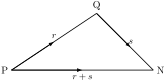
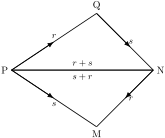
Consider a displacement from point \(P\) to point \(Q\text{,}\) followed by another displacement from point \(Q\) to point \(N\text{.}\) The total resultant displacement from \(P\) to \(N\) is obtained by adding the two vectors sequentially.
This can be expressed as:
\begin{align*} \mathbf{PN} \amp = \mathbf{PQ} + \mathbf{QN} \end{align*}
where:
  1. \(\mathbf{PQ} = \mathbf{r}\) represents the first displacement.
  2. \(\mathbf{QN} = \mathbf{s}\) represents the second displacement.
Therefore, \(\mathbf{PN} = \mathbf{r} + \mathbf{s}\)
Figure 2.8.15.
We can also re-arrange the two vectors and add them together as shown in Figure 2.8.16 below.
Figure 2.8.16.

Example 2.8.17.

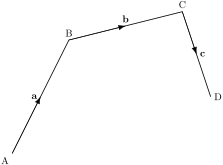
In Figure 2.8.18 below, find vector \(\mathbf{AD}\) in terms of \(\mathbf{a}\) and \(\mathbf{b}\text{.}\)
Figure 2.8.18.
Solution.
\begin{align*} \overrightarrow{AD} \amp = \overrightarrow{AB} + \overrightarrow{BC} + \overrightarrow{CD}\\ \amp = \mathbf{a} + \mathbf{b} + \mathbf{c} \end{align*}
Thus, \(\overrightarrow{AD} = \mathbf{a} + \mathbf{b} + \mathbf{c} \)

Exercises Exercises

1.

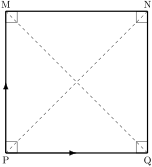
\(PQNM\) is a square with vectors \(\mathbf{PQ}\) and \(\mathbf{PM}\) given as \(\mathbf{a} \text{ and } \mathbf{b}\) respectively, as shown in Figure 2.8.19 . Express the \(\mathbf{PN}\) and \(\mathbf{MQ}\) vectors in terms of \(\mathbf{a}\) and \(\mathbf{b}\)
Figure 2.8.19.

2.

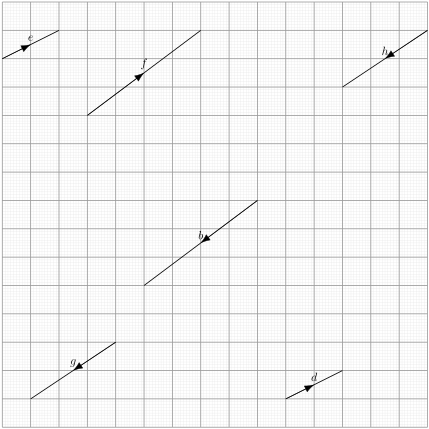
Use Figure 2.8.20 to answer the questions below:
Figure 2.8.20.
  1. List pairs of equal vectors.
  2. Name pairs of vectors with equal magnitude but opposite directions.
  3. illustrate the sums of the following vectors graphically:
    1. \(\displaystyle \mathbf{e} + \mathbf{d}\)
    2. \(\displaystyle \mathbf{f} + \mathbf{g}\)
    3. \(\displaystyle \mathbf{b} + \mathbf{d}\)
    4. \(\displaystyle \mathbf{g} + \mathbf{h}\)

3.

Given the vectors \(\mathbf{a} = \binom{2}{3}\) and \(\mathbf{b} = \binom{4}{-1}\text{,}\) find \(\mathbf{a} + \mathbf{b}\) and illustrate the solution graphically.
Checkpoint 2.8.21.

Checkpoint 2.8.22.

Checkpoint 2.8.23.

Checkpoint 2.8.24.