Skip to main content
Contents Dark Mode Prev Up Next \(\newcommand{\N}{\mathbb N} \newcommand{\Z}{\mathbb Z} \newcommand{\Q}{\mathbb Q} \newcommand{\R}{\mathbb R}
\newcommand{\lt}{<}
\newcommand{\gt}{>}
\newcommand{\amp}{&}
\definecolor{fillinmathshade}{gray}{0.9}
\newcommand{\fillinmath}[1]{\mathchoice{\colorbox{fillinmathshade}{$\displaystyle \phantom{\,#1\,}$}}{\colorbox{fillinmathshade}{$\textstyle \phantom{\,#1\,}$}}{\colorbox{fillinmathshade}{$\scriptstyle \phantom{\,#1\,}$}}{\colorbox{fillinmathshade}{$\scriptscriptstyle\phantom{\,#1\,}$}}}
\)
Subsection 2.6.3 Area of an Annular Sector
Activity 2.6.4 .
\(\textbf{Work in groups}\)
Two circular paper cutouts (one smaller, one larger),
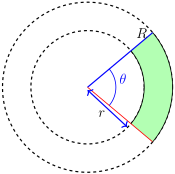
Take two circular cutouts of different sizes but with the same center.
Use a protractor to mark the same central angle
\(\theta\) on both circles.
Cut out the corresponding sectors from both circles.
Place the smaller sector on the larger one and observe the remaining shape.
Measure and calculate the area of each sector using the formula and compare with your actual cutout.
Discuss with other groups how to get the area of the figure you have formed.
\(\textbf{Extended Activity}\)
Activity 2.6.5 .
\(\textbf{Work in groups}\)
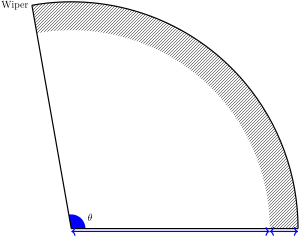
A car wiper blade (or a picture of one) like the one drawn below;
A notebook and calculator
Find the dimensions of the following;
The length of the wiper blade.
The pivot point to the base of the wiper blade.
The angle
\(\theta\) is the angle through which the wiper moves.
\begin{align*}
A= \amp \frac{\theta}{360} \times \pi(R^2-r^2)
\end{align*}
to calculate the area cleaned by the wiper.
Ask students in your group to observe whether the wiper covers all parts of the windshield equally.
\(\textbf{Key Takeaway}\)
An
\(\textbf{annular sector}\) is the region enclosed between two concentric sectors of a circle with different radii but the same central angle. It is similar to a sector but with a smaller sector removed from a larger one.
Having the knowledge of the area of a sector and the area of an annulus it is very easy to identify the area of an annular sector.
\(\textbf{Area of an annular sector}\)
Area of an annular sector is:
\begin{equation*}
A=\frac{\theta}{360} \times \pi(R^2-r^2)
\end{equation*}
Example 2.6.10 .
A wind turbine blade sweeps through a central angle of
\(140^\circ\text{.}\) The length of the blade is
\(50\, m\text{,}\) and the inner radius (distance from the pivot to the base of the blade) is
\(10\, m\text{.}\) Find the swept area.
Solution .
The learger radius (
\(R\) )
\(=50\,m\)
The inner radius (
\(r\) )
\(=10\,m\)
Angle subtended
\(=140^\circ\)
\begin{align*}
A= \amp \frac {140}{360} \times \pi (50^2-10^2)\\
= \amp \frac{7}{18} \times \frac{22}{7} (2\,500-100) \\
=\amp \frac{7}{18} \times \frac{22}{7} \times 2\,400\\
= \amp 2933.333333 \\
≈\amp 2\,933.3 \,m^2
\end{align*}
The turbine sweeps an area of approximately
\(2\,933.3 \,m^2\text{.}\)
Example 2.6.11 .
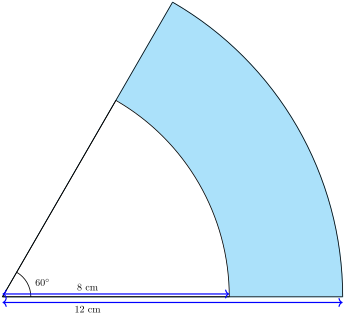
Find the area of the annular sector shown below. (Use
\(\pi= 3.142\) )
Solution .
\(A= \frac{\theta}{360} \times \pi(R^2-r^2)\)
\begin{align*}
A=\amp \frac{60}{360} \times \pi(12^2-8^2) \\
=\amp \frac{60}{360} \times 3.142 (144-64)\\
=\amp \frac{1}{6} \times 3.142\times 80 \\
=\amp \frac{1}{3} \times 3.142 \times 40\\
= \amp 41.89333333 \\
≈\amp 41.89\,cm^2
\end{align*}
A clock’s minute hand moves
\(150^\circ \) in
\(25\) minutes. The minute hand is
\(15 \,cm\) long, and the inner radius is
\(5 \,cm\) Calculate the cleaned area.
A windshield wiper moves through
\(110^\circ\text{.}\) The blade is
\(45 \,cm\) long, and the pivot distance is
\(15\, cm\text{.}\) Calculate the cleaned area.
Outer radius
\(=40 \,cm\)
Inner radius
\(r=10\,cm\)
Central angle
\(=120^\circ\)
Find the area cleaned by the wiper.
A mechanical arm sweeps through 180°. The outer radius is
\(8\, m\text{,}\) and the inner radius is
\(2 \,m\text{.}\) Determine the area covered.
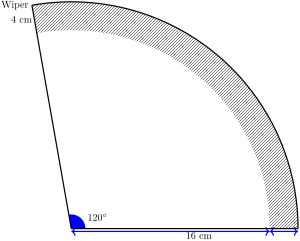
The shaded region in the figure below shows the area swept out on a flat windscreen by a wiper. Calculate the area of this region.
Checkpoint 2.6.12 .
Checkpoint 2.6.13 .