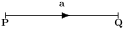
In Figure 2.8.25, the vector \(\mathbf{PQ}\) is represented as \(\mathbf{a}\text{.}\) When we multiply \(\mathbf{a}\) by a positive scalar, say \(2\text{,}\) the length of the vector doubles, making it \(\mathbf{2a}\) as shown in Figure 2.8.26. The direction of the vector remains unchanged, but its magnitude increases.
In Figure 2.8.26, the vector \(\mathbf{PN}\) is given by: \(\mathbf{PN} = \mathbf{a} + \mathbf{a} = 2\mathbf{a}\text{.}\) This means \(\mathbf{PN}\) has the same direction as \(\mathbf{PQ}\text{,}\) but its magnitude twice that of \(\mathbf{PQ}.\)
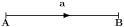
Consider the vector \(\mathbf{AB}\text{,}\)denoted as \(\mathbf{a}\text{,}\) in Figure 2.8.27 The vector points to the right and has a magnitude of \(\mathbf{a}\text{.}\)
When a vector \(\mathbf{a}\text{,}\) as shown in Figure 2.8.29, is multiplied by \(0\text{,}\) its magnitude becomes \(0\text{,}\) resulting in a zero vector.
A pentagon \(ABCDE\) with \(\overrightarrow{AB} = m\text{,}\)\(\overrightarrow{BC} = n\text{,}\) and \(\overrightarrow{CD} = k\text{.}\) Express the following vectors in terms of \(m\text{,}\)\(n\text{,}\) and \(k:\)