Represent vector AB in terms of its components as \(\begin{pmatrix} x \\ y \end{pmatrix}\) where \(x\) is the horizontal displacement and \(y\) is the vertical displacement.
A vector expressed in the form of \(\begin{pmatrix} a \\ b \end{pmatrix}\text{,}\) where \(a\) is the horizontal displacement along the \(x\) axis and \(\mathbf{b}\) is the vertical displacement along the \(y\) axis is known as a column vector.
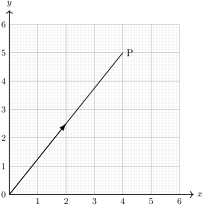
The vector \(\textbf{OP}\) illustrates a displacement from the origin \(O(0,0)\) to the point \(P(4,5)\text{.}\) This consist of a horizontal displacement of \(4\) units along the \(x\) axis and a vertical displacement of \(5\) units in the \(y\) axis.
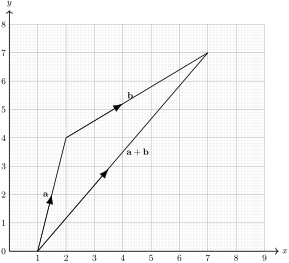
Given that: \(\mathbf{a} = \binom{1}{4}\) and \(\mathbf{b} = \binom{5}{3}\text{.}\) Find \(\mathbf{a} + \mathbf{b}\) and illustrate the solution graphically.
Begin at the point \((1,0)\) on the grid, move \(1\) unit horizontally to the right and move \(4\) units vertically upwards and mark it as end point. Draw a directed line connecting the two points as shown in the Figure 2.8.34.
From the point \((4,0)\) on the grid, move \(5\) units horizontally to the right parallel to the \(x\) axis, and move \(3\) units vertically up and mark it as end point. Draw another directed line to join the two points.
Now, to find the resultant vector \(\mathbf{a} + \mathbf{b}\text{,}\) join the initial point \((1,0)\) with the final point \((7,7)\) and count the total displacements in the \(x\) and \(y\) directions.
To determine \(2\mathbf{a} + 5\mathbf{b}\text{,}\) we multiply vector \(\mathbf{a}\) by \(2\) and vector \(\mathbf{b}\) by \(5\) and finally we add the resulting vectors.