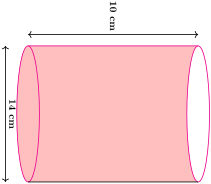
Subsection 2.7.13 Volume of a Cylinder

Activity 2.7.17.

\(\textbf{Work in groups}\)
\(\textbf{What you require:}\) A pair of scissor and a piece of paper.
  1. Make a paper made of a cylinder.
  2. Measure and record the the length of the model.
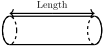
  3. Open the model as illustrated below.
  4. Fold one circular end into two equal parts as shown;
  5. Measure and recod the diameter.
  6. Calculate the circumference of the circular end.
  7. Rotate the width of the rectangular part with the diameter of the circular part.
  8. Find the area of the rectangular part.
  9. Find the area of the circular ends.
  10. Find the surface area of the cylinder.
  11. Discuss and share your answer with other groups
\(\textbf{Key point}\)
The total surface area of a cylinder of radius \(r\) and height \(h\text{,}\) is given by the sum of the areas of the two circular faces and the curves face. Thus,
\begin{align*} \textbf{Total surface area of a cylinder}=\amp 2\pi r^2+2\pi r h \\ = \amp 2\pi r(r+h) \end{align*}
\(\textbf{Note:}\) A cylinder is always considered closed, unless it is specified that it is open.

Example 2.7.44.

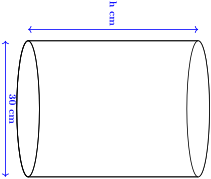
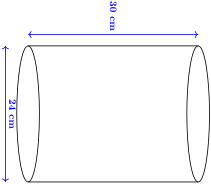
Calculate the surface area of the cylinder shown.
Solution.
Given that, \(h=30\,\text{cm} \quad \text{and} \quad d=24\,\text{cm}\)
We first get the radius of the cylinder which is given by,
\begin{align*} r=\amp\frac{d}{2} \\ =\amp \frac{24}{2} \\ =\amp 12\,\text{cm} \end{align*}
Therefore,
\begin{align*} \text{Surface area}=\amp 2\pi r^2+2\pi r h\\ =\amp 2\pi r(r+h)\\ =\amp 2 \times \pi \times 12\,\text{cm}\,(12\,\text{cm}+30\,\text{cm} ) \\ =\amp 2 \times \pi \times 12\,\text{cm}\,\times 42\,\text{cm} \\ =\amp 2 \times 22 \times 12 \times 6\\ =\amp 3\,168 \,\text{cm}^2 \end{align*}
The surface area of the above cylinder is \(3\,168 \,\text{cm}^2\)

Example 2.7.45.

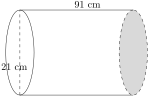
The figure below shows a cylinder. Calculate the surface area of the cylinder to two decimal places.(\(\textbf{Use}\, \pi=\frac{22}{7}\))
Cylindrical prism
Solution.
Given that, \(h=91\,\text{cm} \quad \text{and} \quad d=21\,\text{cm}\)
We first get the radius of the cylinder which is given by,
\begin{align*} r=\amp\frac{d}{2} \\ =\amp \frac{21}{2} \\ =\amp 10.5\,\text{cm} \end{align*}
Therefore,
\begin{align*} \text{Surface area}=\amp 2\pi r(r+h)\\ =\amp 2 \times \pi \times 10.5 \,\text{cm}(10.5\,\text{cm}+91\,\text{cm})\\ = \amp 2 \times \pi \times 10.5 \,\text{cm} \times 101.5 \,\text{cm}\\ =\amp 6\,699.00\,\text{cm}^2 \end{align*}
The surface area of the cylinder\(=6\,699.00\,\text{cm}^2\)

Example 2.7.46.

Calculate the surface area of unsharpened circular pencil in the shape of a cylinder whose radius is \(0.2\,\text{m}\) and height is height is \(1.4\,\text{m}\text{.}\) (\(\textbf{Use}\, \pi=3.142\))
Solution.
Given that, \(h=01.4\,\text{m} \quad \text{and} \quad r=0.2\,\text{m}\)
Therefore,
\begin{align*} \text{Surface area}=\amp 2\pi r(r+h)\\ =\amp 2 \times 3.142 \times 0.2 \,\text{m}(0.2\,\text{m}+1.4\,\text{m})\\ = \amp 2 \times 3.142 \times 0.2 \,\text{m} \times 1.6 \,\text{m}\\ =\amp 2.01088\,\text{m}^2 \end{align*}
Therefore, surface area \(= 2.01088\,\text{m}^2\)

Activity 2.7.18.

\(\textbf{Work in groups}\)
\(\textbf{What you require:}\) A cylindrical container without a lid, a pair of scissores and a piece of paper.
  1. Trace the bottom face of the cylindrical container on a piece of paper and cut out the shape.
    1. Entirely cover the curved surfaceof the container with a piece of paper.
    2. Cut off any parts of the piece of paper that extend beyond the curved surface. Also, ensure the piece of paper does not overlap.
  2. Calculate the area of each of the two cutouts.
  3. Work out the total area of all the cutouts. What does the area represent?
  4. Discuss how to calculate the surface area of an open cylinder and share your findings with other groups in your class.
\(\textbf{Key Takeaway}\)
An open cylinder, is a cylinder where the top is open. It means that you will only have one circle instade of two.
Therefore, to calculate the surface area of the cylinder you add the area of the curved surface and the circle.
An open cylinder has a curved surface and one circular face.
Therefore,
\begin{align*} \textbf{Surface area of an open cylinder } = \amp \pi r^2 +2 \pi rh \\ = \amp \pi r (r+2h) \end{align*}

Example 2.7.47.

An open cylindrical cotainer has a height of \(12\,\text{cm}\) and a diameter of \(2\,\text{cm}\text{.}\) What is the surface area of the outer surfaces of the container? (\(\, \pi = 3.142\))
Solution.
You are given the height and diameter of the container to be \(h=12\,\text{cm} \, \text{and} \, d=2\,\text{cm}\)
You first identify the radius of the container that is,
\begin{align*} r=\amp \frac{2}{2} \\ =\amp 1 \,\text{cm} \end{align*}
Therefore,
\begin{align*} \text{surface area}=\amp \pi r (r+2h)\\ =\amp 3.142 1(1+2 \times 12) \\ =\amp 3.142 1(1+24) \,\text{cm}\\ =\amp 3.142 \times 25 \,\text{cm}\\ = \amp 78.55\, \text{cm}^2 \end{align*}
Therefore, surface area of the outer container is \(= 78.55\,\text{m^}2\text{.}\)

Example 2.7.48.

Ekadeli filled an open cylindrical bucket with water. The internal diameter of the bucket was \(32.4 \,\text{cm}\) and the internal height was \(35 \,\text{cm}\text{.}\) Calculate the area of the bucket that was in contact with the water. Write the answer correct to \(\textbf{1 decimal place}\text{.}\) (\(\textbf{Use} \, \pi =\frac{22}{7}\))
Solution.
The open cylindrical bucket has a diameter and height of \(d=32.4\,\text{cm} \quad \text{and} \quad h=35\,\text{cm}\text{.}\)
You first calculate the radius of the cylindrical bucket which is,
\begin{align*} r=\amp \frac{d}{2} \\ = \amp \frac{32.4}{2}\\ =\amp 16.2 \,\text{cm} \end{align*}
Therefore,
\begin{align*} \text{Surface area} =\amp \pi r (r+2h) \\ = \amp \frac{22}{7} \times 16.2 \,\text{cm} \times (16.2\,\text{cm}+2\times 35\,\text{cm}) \\ =\amp \frac{22}{7} \times 16.2 \,\text{cm}\times (16.2\,\text{cm}+70\,\text{cm})\\ =\amp \frac{22}{7} \times 16.2 \,\text{cm}\times 86.2 \,\text{cm} \\ =\amp 4388.81142857\,\text{cm}^2 \end{align*}
The surface area \(= 4388.8\,\text{cm}^2\)

Example 2.7.49.

The surface area of an open jar is \(594\,\text{cm}^2\text{.}\) The radius of the jar is \(7\,\text{cm}\text{.}\) calculate the height of the jar. (\(\textbf{Use} \, \pi =3.142\)).
Solution.
You are given,
\(\textbf{Surface are}=594\,\text{cm}^2\)
\(r=7\,cm\)
\(h=\text{?}\)
To find the height of the jar we substitute the above values in the formula below.
\begin{align*} \text{Surface area}=\amp \pi r (r+2h) \\ 594\,\text{cm}^2=\amp \frac{22}{7} \times 7\,\text{cm} (7\,\text{cm} +2\times h)\\ \frac{594}{22}=\amp 7\,\text{cm} +2\times h\\ (27 - 7)\, \text{cm} =\amp 2 \times h \\ 20\, \text{cm} =\amp 2 \times h\\ \frac{20}{2}\, \text{cm}=\amp h\\ h= \amp 10 \,\text{cm} \end{align*}
The height of the jar \(= 10 \,\text{cm }\)
\(\textbf{Extended Exercise}\)
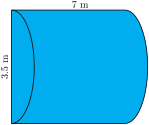
The figure alongside shows the roof of a motorbike shade. The roof is painted on the outer curved surface and the two semi-circle faces. Calculate the surface area of the part of roof that is painted.

Example 2.7.50.

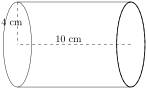
The cylinder below has a radius of 4 cm and a height of 10 cm. Use \(\pi = 3.142\)
Cylindrical prism
\begin{align*} V =\amp \text{Base Area }\times h \\ V = \amp \pi r^2 \times h\\ = \amp 3.142 \times (4)^2 \, \text{cm} \times 10\, \text{cm}\\ = \amp 502.65\, \text{cm}^3 \end{align*}

Example 2.7.51.

A pipe has a radius of 3 cm and a height of 15 cm. Find the volume of the pipe.
Solution.
\begin{align*} V =\amp \text{Base Area} \times h \\ V = \amp \pi r^2 \times h\\ = \amp 3.142 \times (3)^2 \, \text{cm} \times 15\, \text{cm}\\ = \amp 424.12\, \text{cm}^3 \end{align*}

Example 2.7.52.

Mueni’s water tank has a radius of 7 m and a height of 20 m. Find the capacity of the water tank in litres.
Solution.
\begin{align*} V =\amp \text{Base Area} \times h \\ V = \amp \pi r^2 \times h\\ = \amp \frac{22}{7} \times (7)^2\, \text{m} \times 20 \, \text{m}\\ = \amp 3080\, \text{m}^3 \end{align*}
To convert from \(m^3 \) to litres we multiply by \(1000 \, \text{m}^3\)
\begin{align*} 1 \text{litre} = \amp 1000\, \text{m}^3 \\ = \amp 3080\, \text{m}^3 \times 1000\, \text{m}^3\\ = \amp 3,080,000 \, \text{ litres} \end{align*}
\(\textbf{Exercise}\)
1. A cylinder has a volume of 1,570 cm³ and a diameter of 30 cm. Find its height.Use (\(\pi = 3.14\))
2. Alongside is a cross-sectional view of an open cylinder that has a radius of 7 cm and a height of 10 cm. Find its volume.
3. A hollow cylindrical pipe has an outer radius of 8 cm, an inner radius of 6 cm, and a length of 100 cm. Find the volume of material used to make the pipe.
4. A cylindrical water tank has a radius of 2 m and a height of 5 m. How many liters of water can it hold when full?
5. If the radius of a cylinder is doubled while keeping the height the same, by what factor does the volume increase?

Checkpoint 2.7.53.

Checkpoint 2.7.54.