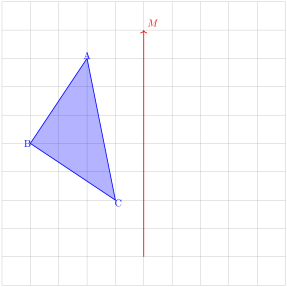
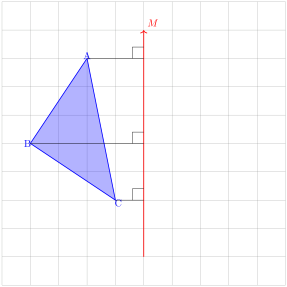
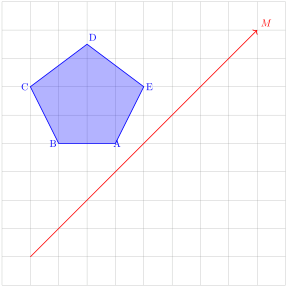
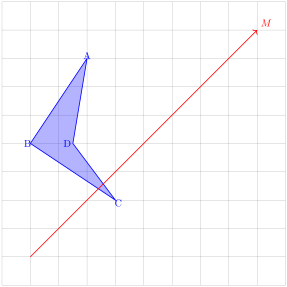
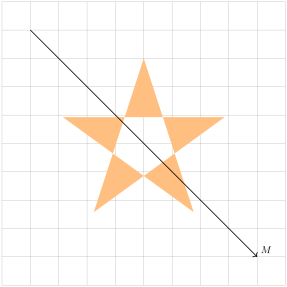
Draw a perpendicular line from vertex \(A\) to the mirror line \(M\) and measure the distance by counting the number of squares between vertex \(A\) and the mirror line \(M.\) Repeat this process for vertices \(B \text { and }C.\)
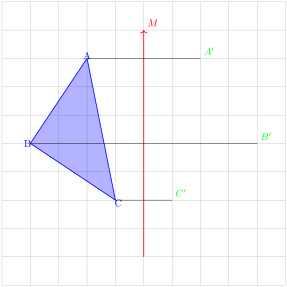
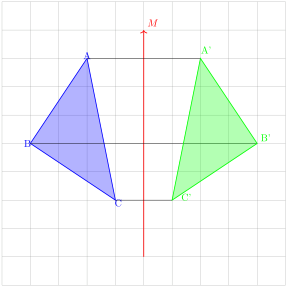
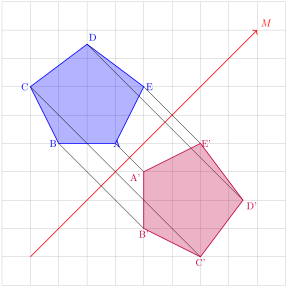
Determine the position of the reflected vertices. For vertex \(A\) the perpendicular distance between the vertex and the mirror line is \(2\) squares. Count \(2\) squares from the mirror line to the opposite side of the mirror line and mark that point as \(A',\) which is the reflected image of vertex \(A.\) Repeat the same procedure the remaining vertices \(B \text { and }C.\)
To obtain the image \(A'\) of \(A\) draw a perpendicular line from \(A\) to the mirro line \(M,\) extend the line the same distance on the opposite side of the mirror line and mark the point as \(A'.\) Similarly, obtain the images \(B', C', D', E'\) the images of vertices \(B, C, D, E\) respectively.
The line connecting a point to its image is perpendicular to the mirror line. Therefore, the mirror line is the perpendicular bisector of the lines connecting the object points and the image points.
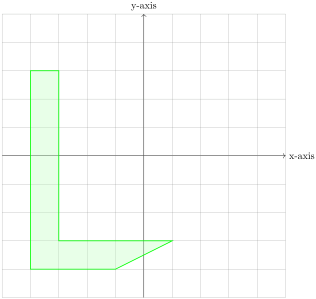
The vertices of a polygon are given as: A(-5,5), B(-6,3), C(-5,1), D(-3,0), E(-2,2) and F(-3,4). Find the image of the polygon under the following reflection lines:
The points \(A'(-4,1),\,B'(-2,4)\text{ and } C'(-1,3)\) are the images of points \(A,\,B \text{ and } C\) respectively under a reflection on the line \(x = -1.\) Find the coordinates for points \(A,\,B \text{ and } C.\)