Now that you understand how to represent vectors using magnitude and direction, we can explore how to compare them. Is it possible for two vectors to be considered “equal” even if they are located in different places on a graph? In this section, you will examine the specific conditions regarding length and direction that must be met for two vectors to be called equivalent.
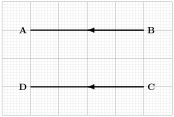
Calculate the length of both vectors and compare the direction they are pointing. What two properties do vector \(\mathbf{AB}\) and vector \(\mathbf{CD}\) have in common?
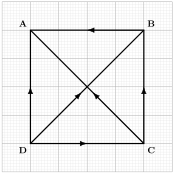
Vector \(\mathbf{AB} \text{ and } \mathbf{DC}\) are equivalent because they have the same magnitude, \(|\mathbf{AB}| = |\mathbf{DC}| \text{,}\) and they point in the same direction