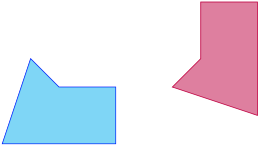
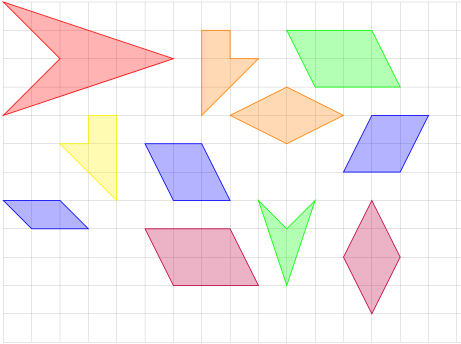
Activity 2.2.6.
Work in groups
Trace and cut out the following shapes on a piece of paper.
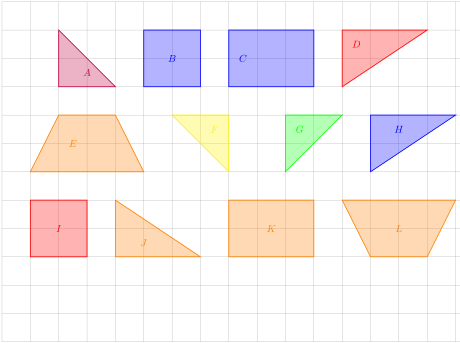
Match two shapes by aligning them directly on top of each other. Discuss how the sides and angles perfectly overlap.
Flip one shape (like turning it over) and try to align it with another shape. Discuss how the shapes still match in size and angles, even though one is flipped.
-
Identify the figures with the same shape.
-
Identify the figures with the same size.
-
Identify figure with same size and shape.
Key Takeaway
-
Figure with the same size and shape are said to be congruent.
-
Also, \(B\) fits directly on \(I\) without flipping, thus \(B \text{ and } I\) are said to be directly congruent. Identify other figures that are directly congruent.
-
\(E \text{ and } L\) do not fit directly but when you flip (lateral inversion) figure \(L\) and fit it on \(E,\) they align. This is called opposite congruence. Identify other figure that have opposite congruence from your activity.
-
Figures with the same shape but different size are said to be similar.
-
Congruence can also be applied to line segments and angles.