Subsection 1.3.6 Application Of Quadratic Equations To Real Life Situations.

Quadratic equations are a type of mathematical equation that can be used to describe many different real-life situations. Whether you’re throwing a ball in the air, trying to maximize the area of a garden, or calculating profits for a business, quadratic equations can help solve problems that involve relationships with squared terms.
In this section, we will learn how to recognize real-life situations that can be modeled by quadratic equations, how to set them up, and how to solve them step by step.
A quadratic equation is an equation that can be written in the form:
\begin{equation*} ax^2 + bx + c = 0 \end{equation*}
where,
  • \(a\text{,}\) \(b\) and \(c\) are real numbers or constants,
  • \(x\) is the unknown variable
  • and \(a \neq 0\) beacuse if \(a\) is \(0,\) it would npt be a quadratic
Quadratic equations show up in many situations, especially when something is changing in a way that involves squares (like height, area, or profit).
Lets take a look at some of the situations Quadratic Equations is involved in real life situations.
\(1. \, Projectile \, Motion (Throwing \, a \, Ball).\)
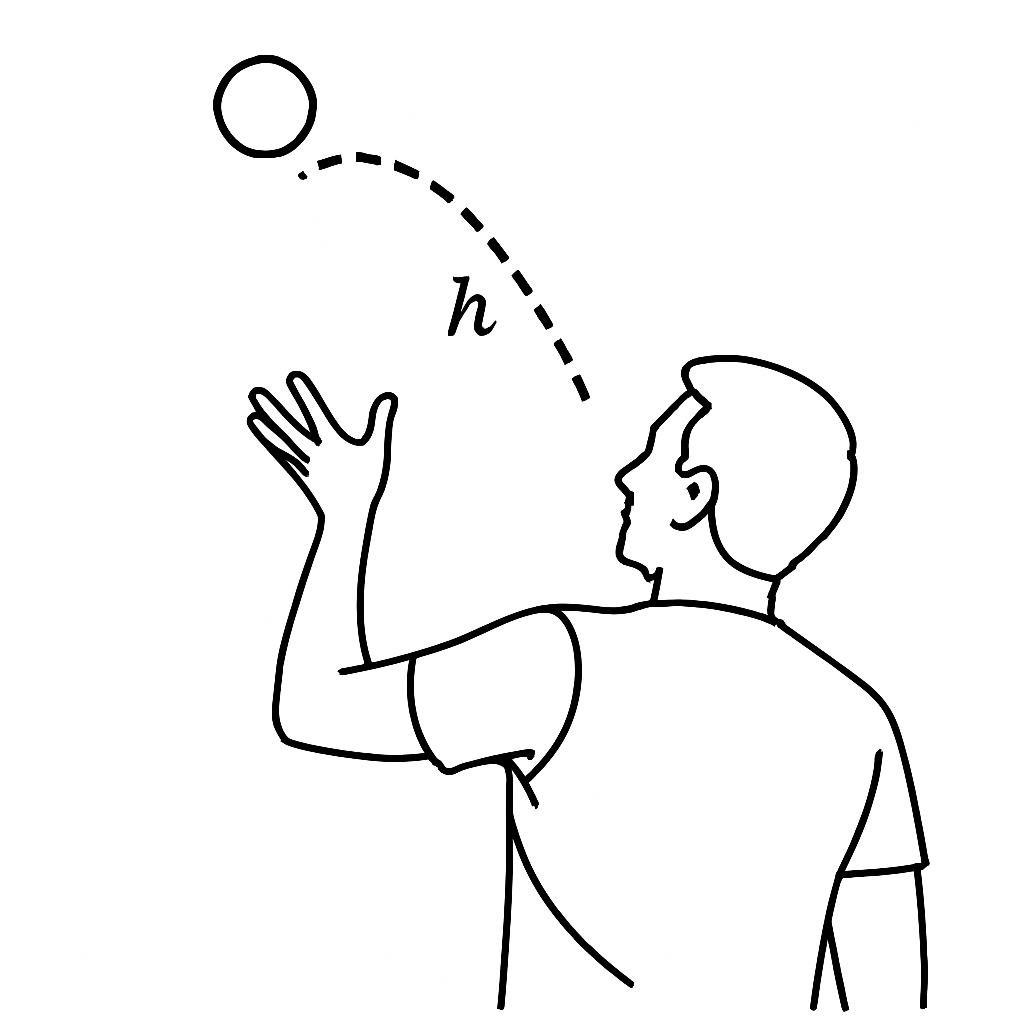
projectile
One of the most common real-life situations for quadratic equations is projectile motion, such as when you throw a ball in the air. The height of the ball over time can be described by a quadratic equation.

Example 1.3.19.

A rock is dropped from a height of \(50\) meters. Its height above the ground at time \(t\) is given by
\begin{equation*} h(t) = 5t^2 + 50. \end{equation*}
Use factorization to determine how long it will take for the rock to reach the ground.
Solution.
The height of the rock above the ground is given by:
\begin{equation*} h(t) = -5t^2 + 50 \end{equation*}
To find when the rock reaches the ground, set \(h(t) = 0\text{:}\)
\begin{equation*} -5t^2 + 50 = 0 \end{equation*}
Simplify the equation:
\begin{equation*} -5t^2 = -50 \end{equation*}
\begin{equation*} t^2 = 10 \end{equation*}
Solve for \(t\text{:}\)
\begin{equation*} t = \pm \sqrt{10} \end{equation*}
Since time cannot be negative, \(t = \sqrt{10}\text{.}\)
Therefore, the rock will take approximately \(\sqrt{10} \approx 3.16\) seconds to reach the ground.
\(2. \, Maximizing \, Area \, (Optimization \, Problem).\)
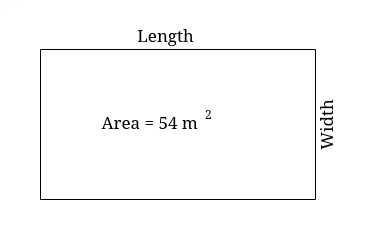
Quadratic equations are also used in optimization problems. These are problems where you want to maximize or minimize something, like the area of a garden.

Example 1.3.20.

The length of a rectangle is \(3\) meters more than its width. If the area of the rectangle is \(54\) square meters, find the dimensions of the rectangle by factoring the quadratic equation.
optimization problems
Solution.
Let the width of the rectangle be \(x\text{.}\) Then the length is \(x + 3\text{.}\)
The area of the rectangle is given by:
\begin{equation*} x(x + 3) = 54 \end{equation*}
Expand and rearrange into standard quadratic form:
\begin{equation*} x^2 + 3x - 54 = 0 \end{equation*}
Factorize the quadratic equation:
\begin{equation*} (x + 9)(x - 6) = 0 \end{equation*}
Solve for \(x\text{:}\)
\begin{equation*} x = -9 \, \text{or} \, x = 6 \end{equation*}
Since width cannot be negative, \(x = 6\text{.}\)
The dimensions of the rectangle are:
\begin{equation*} \text{Width} = 6 \, \text{meters}, \, \text{Length} = 6 + 3 = 9 \, \text{meters}. \end{equation*}
Since the width cannot be negative, the width is \(6\) meters, and lenght is \(6 + 3 = 9\) meters.
\(3. Business \, Applications (Profit \, Function)\)
Businesses often use quadratic equations to model their profit. For example, the profit a company makes from selling a product can be modeled by a quadratic equation.

Example 1.3.21.

A company’s profit \(P(x)\) from selling \(x\) units of a product is given by the equation:
\begin{equation*} P(x) = -x^2 + 15x - 50 \end{equation*}
Find how many units the company needs to sell to have no profit (i.e., when the profit is zero).
Solution.
To find when the company has no profit, set \(P(x) = 0\text{:}\)
\begin{equation*} -x^2 + 20x - 50 = 0 \end{equation*}
Multiply through by \(-1\) to simplify:
\begin{equation*} x^2 - 20x + 50 = 0 \end{equation*}
Factorize the quadratic equation:
\begin{equation*} (x - 10)(x - 5) = 0 \end{equation*}
Solve for \(x\text{:}\)
\begin{equation*} x = 10 or x = 5 \end{equation*}
Therefore, the company will have no profit when it sells either \(5\) units or \(10\) units.

Exercises Exercises

1.

A stone is thrown into the air from a height of \(4\) meters with an initial velocity of \(8\) meters per second. The height of the stone at time \(t\) is given by:
\begin{equation*} h(t) = -5t^2 + 8t + 4 \end{equation*}
Find when the stone reaches the ground.

2.

A farmer has \(200\) meters of fencing. He wants to build a rectangular garden. The length is \(50\) meters longer than the width. What should the dimensions be to maximize the area?

3.

A school’s profit function is given by:
\begin{equation*} P(x) = -x^2 + 30x - 100 \end{equation*}
Find the number of units the company must sell to achieve zero profit.

4.

A water fountain shoots water into the air, and its height at any time \(t\) (in seconds) is given by the equation:
\begin{equation*} h(t) = -4.9t^2 + 15t + 2 \end{equation*}
Find the time it will take for the water to return to the ground (i.e., when \(h(t)=0\)).

5.

Solve the following quadratic equation:
\begin{equation*} x^2 - 7x + 12 = 0 \end{equation*}
Find the value of \(x.\)

6.

A company finds that the revenue \(R(x)\) it generates from selling \(x\) units of a product is given by the quadratic equation:
\begin{equation*} R(x) = 2x^2 + 40x \end{equation*}
Find the number of units \(x\) that the company needs to sell to maximize its revenue.

7.

The path of a car is represented by the quadratic equation
\begin{equation*} y = 2x^2 - 8x, \end{equation*}
where \(x\) represents time in seconds and \(y\) represents the car’s position. Find the time when the car reaches its starting position by factorizing the equation.

