Subsection 2.8.9 Midpoint of a Vector

Activity 2.8.9.

Work in groups
What you require: Graph paper

(a)

Draw the \(x\) and \(y\) axis on the graph paper.

(b)

Choose any starting point on the graph and label it as Point \(A\text{.}\) write down its coordinates.

(c)

From Point \(A\text{,}\) move \(6\) units to the right parallel to the \(x\) axis and mark this new location as Point \(B\text{.}\) Write down its coordinates.

(d)

Draw a directed line from point \(A\) to Point \(B\) to represent \(\overrightarrow{AB}\text{.}\)

(e)

Find the midpoint of \(\overrightarrow{AB}\) and label it as Point \(M\text{.}\)

(f)

Identify the coordinates of Point \(M\text{.}\)

(g)

Think of a way to determine coordinates of Point \(M\) without manually counting the units.

(h)

Discuss and share your findings with the rest of the class.
\(\textbf{Key Takeaway}\)
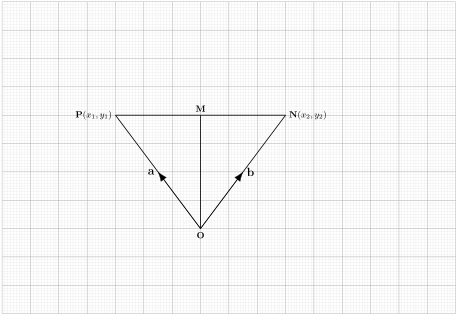
Consider the cordinates of point \(P\) given as \((x_1,y_1)\) and point \(N\) given as \((x_2,y_2)\) and \(M\) is the midpoint of \(\mathbf{PN}\) as shown in figure below.
Figure 2.8.48.
\begin{align*} \mathbf{OM} \amp = \mathbf{OP} + \mathbf{PM} \\ \amp = \mathbf{a} + \frac{1}{2} \mathbf{PN}\\ \amp = \mathbf{a} + \frac{1}{2} (\mathbf{b} - \mathbf{a})\\ \amp = \mathbf{a} + \frac{1}{2}\mathbf{b} - \frac{1}{2}\mathbf{a}\\ \amp = \mathbf{a} - \frac{1}{2}\mathbf{a} + \frac{1}{2}\mathbf{b}\\ \amp = \frac{\mathbf{a} + \mathbf{b}}{2} \end{align*}
But \(\mathbf{a} = \begin{pmatrix} x_1 \\ y_1 \end{pmatrix}\) and \(\mathbf{b} = \begin{pmatrix} x_2 \\ y_2 \end{pmatrix}\)
Thus, midpoint \(\mathbf{M} = \left( \frac{ x_1 + x_2 }{ 2}, \frac{ y_1 + y_2 }{ 2}\right)\)

Example 2.8.49.

Find the coordinates of the midpoint \(M\) of \(\textbf{AB}\) given the following points \(A(6,1), \,\, B(4,3)\text{.}\)
Solution.
To determine the midpoint \(M\) of \(\overrightarrow{AB}\) , we apply the midpoint formulae as follows.
\begin{align*} \text{Midpoint } \amp = \left( \frac{x_1 + x_2}{2}, \frac{y_1 + y_2}{2}\right) \\ \amp = \left(\frac{6 + 4}{2}, \frac{1+3}{2}\right)\\ \amp = \left(\frac{10}{2}, \frac{4}{2}\right)\\ \amp = \left(5, 2\right) \end{align*}
Thus, the coordinates of the midpoint \(M\) is \((5,2)\)

Exercises Exercises

1.

Find the coordinates of the midpoint of \(\mathbf{PQ}\) in each of the following cases:
  1. \(\displaystyle P\, (-5,6), Q\, (3,-4)\)
  2. \(\displaystyle P\,(1,−3), Q\,(5,7)\)
  3. \(\displaystyle P\, (-2,4), Q\, (6,0)\)
  4. \(\displaystyle P\, (a,b), Q\, (c,d)\)

2.

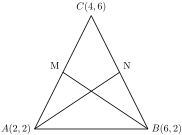
In the figure below, \(ABC\) is a triangle where \(M\) and \(N\) are midpoints of \(\overrightarrow{AC}\text{,}\) \(\overrightarrow{AB}\) respectively.
Triangle \(ABC\) has vertices at points \(A(2,2)\text{,}\) \(B(6,2)\) and \(C(4,6)\text{.}\) Determine the coordinates of \(M\) and \(N\text{.}\)

3.

Consider triangle \(PQR\) where \(\overrightarrow{PQ} = \mathbf{u}\) and \(\overrightarrow{PR} = \mathbf{v}.\) Point \(S\) is located on \(PR\) such that \(PS:SR = 2:3\text{.}\) Point \(T\) lies on \(QR\) with \(QT:TR = 3:2\text{,}\) and point \(U\) is on \(PQ\) such that \(PU:UQ = 4:1\text{.}\) Determine the following vectors in terms of \(\mathbf{u}\) and \(\mathbf{v}\text{:}\)
  1. \(\displaystyle \overrightarrow{PS} \)
  2. \(\displaystyle \overrightarrow{PT} \)
  3. \(\displaystyle \overrightarrow{PU} \)
  4. \(\displaystyle \overrightarrow{ST} \)
  5. \(\displaystyle \overrightarrow{TU} \)

Checkpoint 2.8.50.