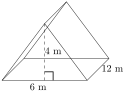
Activity 2.7.15.
Work together in small groups of 5 to:
Discuss ideas
Distribute tasks (e.g., measuring, cutting, assembling)
Share calculations
-
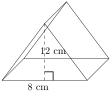
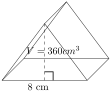
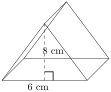
Building a Bridge\(\text{V } = \text{Base Area} \times \text{Height}\)where the base area is given by \(\frac{1}{2} \times \text{Base} \times \text{height of the triangle}\text{.}\)
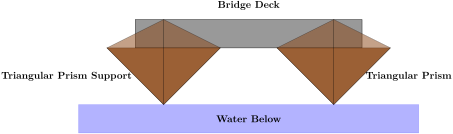
Skills to be Developed: Measurement, visualization, real-world connection
-
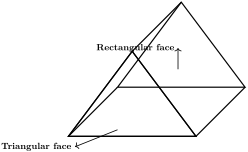
Materials needed:● Cardboard or wooden sticks● triangular prisms● Using the cardboards or wooden sticks construct a bridge model with the triangular prism acting as supports as shown alongside.● Have them measure the base, height of the triangle, and length of the prism.
-
Use the formula to calculate the volume of the prism-shaped supports.
-
Compare different bridge designs and discuss which structure is the strongest.Why Choose the "Build a Bridge" Activity?● Bridges are a perfect example of triangular prisms in engineering. Many bridges use triangular trusses because they:Distribute weight evenlyProvide structural stabilityAre used in real-life construction● By building a model bridge, students get to see, touch and manipulate triangular prisms, helping them connect abstract mathematical concepts to real-world engineering.\(\textbf{More Than Just Math!} \)The \(\textbf{"Build a Bridge"} \)activity isn’t just about calculating volume—it’s about seeing math in action!