Subsection 2.7.7 Surface Area of Composite solids

Activity 2.7.10.

\(\textbf{Tree Model Surface Area}\)
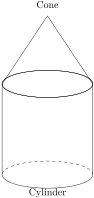
Theme: Modeling a tree using a cylinder \\(textbf{trunk}\) and hemisphere \(\textbf{tree top}\) or cone \(\textbf{pine tree top}\)
We will model a tree trunk as a composite solid, then calculate the total surface area, excluding the part where the top and trunk connect.
  • \(\displaystyle \textbf{Materials needed:}\)
  • Nets or templates for:
    Cylinder (tree trunk)
    Cone or hemisphere (tree top)
  • Scissors, glue or tape
  • Rulers and string
    Step-by-Step Instructions.
    1. Create the Model
  • Each student or group builds a tree model using
  • A cylinder for the trunk
  • Either a cone (pine tree) or a hemisphere (bushy tree) for the top
    For example, a pine tree would be a cone on top of a cylinder.
    2. Label Dimensions
  • Measure and label your dimensions (or give them pre-set values). For example:
    ♦ Radius of trunk = 3 cm
    ♦ Height of trunk = 10 cm
    ♦ Radius of cone = 3 cm
    ♦ Slant height of cone = 5 cm
    3. Surface Area Calculation
  • Surface area of cylinder: ♦ Lateral area: \(2 \pi r h\) ♦ Bottom circle: \(\pi r2\) ♦ Do NOT count the top circle — it is covered by the cone
  • Surface area of cone:
    ♦ Lateral area: \(2 \pi r \ell\)
    ♦ Do NOT count the base of the cone — it is attached to the trunk
    ♦ Add all visible surfaces:
    \(\text{S.A}_{\text{total}} = \textbf{Lateral area of cone} + \textbf{Lateral area of cylinder} + \textbf{Base of cylinder}\)
  • Sample Calculation:
    With the above values:
    Cylinder lateral: \(2\pi \times (3 \, \text{cm})\times(10 \, \text{cm}) = 60 \, \text{cm} \times 3.14 =188.40 \, \text{cm}^2\)
    Cylinder base: \(\pi \times (3 \, \text{cm})^2 =9 \, \text{cm} \times 3.14 = 28.26\, \text{cm}^2\)
    Cone lateral: \(\pi (3 \, \text{cm}) \times (5 \, \text{cm}) = 15 \, \text{cm} \times 3.14 = 47.10 \,\text{cm}^2\)
    \(S.A = 188.40 \, \text{cm}^2 + 28.26\, \text{cm}^2 + 47.10 \,\text{cm}^2 = 263.76 \, \text{cm}^2\)
  • \(\textbf{Study Questions}\)
    Why don’t we count the base of the cone or the top of the cylinder?
    What happens if the cone is bigger than the cylinder?
    How would the surface area change if the tree had branches modeled as small cylinders?
A \(\textbf{Solid}\) is a three dimensional shape. \(\textbf{Solids}\) are objects with three dimensions i.e Width, Length and Height and they have surface area and volumes..
\(\textbf{Area of composite solids} \)
When two or more different solids are placed together, the result is composite solids. The surface area of a composite solids can be found by adding areas of the parts of the solids.

Example 2.7.25.

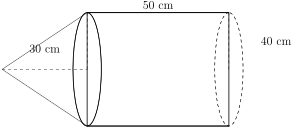
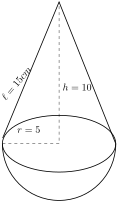
Find the surface area of the figure alongside. Leave your answer in \(\text{m}^2\)
Solution.
Surface Area of a cone.
\begin{align*} \text{CSA_{cone}} = \amp \pi r \times ( \ell = \sqrt{r^2 +h^2} )\\ = \amp 3.14 \times (40 \,\text{cm}) \times \sqrt{(40)^2 \, \text{cm} + (30)^2 \, \text{cm}} \\ = \amp 3.14 \times 40 \, \text{cm} \times 50 \, \text{cm}\\ = \amp 125.60 \times 50 \\ = \amp 6,280 \text{cm}^2 \end{align*}
Curved Surface Area of the Cylinder
\begin{align*} \text{CSA_{cylinder}} = \amp 2\pi r \times h\\ = \amp 2 \times 3.14 \times (40 \,\text{cm}) \times 50 \, \text{ cm} \\ = \amp 2 \times 3.14 \times 40 \, \text{cm} \times 50 \, \text{cm}\\ = \amp 251.20\, \text{cm}^2\times 50 \, \text{cm} \\ = \amp 12, 560 \,\text{cm}^2 \end{align*}
Base Area of the Cylinder (since only the bottom is exposed)
\begin{align*} \text{Base Area} = \amp \pi r^2 \\ = \amp \pi \times (40)^2 \, \text{cm} \\ = \amp 5024 \, \text{cm}^2 \end{align*}
Total Surface Area \(= \text{CSA_{cylinder}} + \text{CSA_{cone}} + \,\text{Base Area} \)
\begin{align*} = \amp 12, 560\, \text{cm}^2 + 6,280 \, \text{cm}^2 + 5024 \, \text{cm}^2 \\ = \amp 23,864 \, \text{cm}^2 \end{align*}
Converting to \(\text{m}^2 \)
\begin{align*} 1 \text{m} = \amp 100 \, \text{cm}\\ 1 \text{m}^2 = \amp 10,000\, \text{cm}^2\\ ? \amp 23,864\, \text{cm}^2 \\ = \amp 1\, \text{m} \times \frac{23,864\, \text{cm}^2} {10,000\, \text{cm}^2} \\ = \amp 2.3864 \, \text{m}^2 \\ = \amp 2.39\, \text{m}^2 \,\ \text{(to two d.p)} \end{align*}
\(\textbf{Exercise}\)
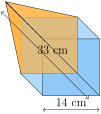
1. The solid below is made of a cube and a square pyramid whose height is 33cm and cube sides measures 14cm. Answer the following
  1. Find the surface area of the solid shown. Give your answers to two decimal places.
  2. Now determine the volume of the composite solids.
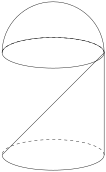
2. Calculate the volume and surface area of the solid alongside.
3. A right circular icecream cone with a radius of 3 cm and a height of 12 cm holds a half scoop of ice cream in the shape of a hemisphere on top. If the ice cream melts completely, will it fit inside the cone? Show all calculations to justify your answer.
4. A lampshade is in the shape of a frustum of a cone. The top and bottom circular openings have diameters of 12 cm and 20 cm, respectively. If the slant height is 15 cm, find the lateral surface area of the lampshade.
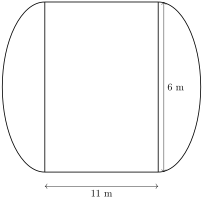
5. Mogaka a grade 10 student was trying to sketch an image of a ice cream cone container with icecream. Find the surface area of the sketched image alongside.
6.A birthday cake has a cylindrical base of radius 10 cm and height 15 cm. The top is shaped like a hemisphere with the same radius. Find the total volume of the cake.
7.A goblet consists of a hemisphere on top of a cylindrical base. The hemisphere has a radius of 5 cm, and the cylinder has the same radius with a height of 12 cm. Find the surface of the goblet and determine how much liquid it can hold.

Checkpoint 2.7.26.

Checkpoint 2.7.27.