Skip to main content
Contents Dark Mode Prev Up Next \(\newcommand{\N}{\mathbb N} \newcommand{\Z}{\mathbb Z} \newcommand{\Q}{\mathbb Q} \newcommand{\R}{\mathbb R}
\newcommand{\lt}{<}
\newcommand{\gt}{>}
\newcommand{\amp}{&}
\definecolor{fillinmathshade}{gray}{0.9}
\newcommand{\fillinmath}[1]{\mathchoice{\colorbox{fillinmathshade}{$\displaystyle \phantom{\,#1\,}$}}{\colorbox{fillinmathshade}{$\textstyle \phantom{\,#1\,}$}}{\colorbox{fillinmathshade}{$\scriptstyle \phantom{\,#1\,}$}}{\colorbox{fillinmathshade}{$\scriptscriptstyle\phantom{\,#1\,}$}}}
\)
Subsection 2.7.10 Volume of a Cuboid
Activity 2.7.13 .
🔹Small unit cubes e.g Match boxes,
Gather a set of small cubes.
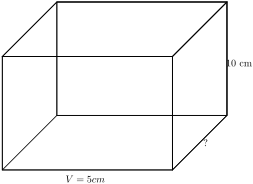
🔹Build a cuboid using a 2 cubes at the width, 3 cubes at the longer side and 4 cubes for your height.
🔹Fill the entire cuboid completely until it is uniformly fitted.
🔹Count the total number of cubes used.
🔹Compare your answer with the calculated volume using the formula.
\(\textbf{length }\times \textbf{width }\times \textbf{height}\)
What happens if we change one dimension?
🔹Continue experimenting with different lengths, widths and heights.
Activity 2.7.14 .
Demonstrating how volume can be measured in real life situations.
♦ Transparent boxes or cubical containers of different sizes.
♦ (You can take a cuboid-shaped Jerrycan cut the top to ensure it has a flat top and base)
♦ Note book and pen for recording findings and computing sums.
♦ Measure and record the units for height, length and width of the container.
♦ Slowly fill the box(or container) with water, sand or rice
♦ Measure how many cups are needed to fill the box completely.
♦ What’s the mass of the rice, sand or water that filled the cubical container? Convert to cubic Centimetres. Note down your answer.
Calculate the volume using the formula
\(l \times w \times h\)
Compare the actual measurement with their calculations.
NOTE:
\(\textbf{Slight differences may occur due to gaps in sand, Spills while transfering or measuring .}\)
Example 2.7.34 .
A cuboid has a length of 12 cm, a width of 8 cm, and a height of 5 cm. Find its volume.
1. A cuboid has a volume of 600 cm³, a length of 10 cm, and a width of 5 cm. Find its height.
2. A rectangular water tank has a base of 2 m by 3 m and a height of 4 m. How many liters of water can it hold when full?
3. A shipping company uses boxes shaped like cuboids. Each box has a length of 40 cm, width of 30 cm, and height of 20 cm. If a warehouse has a storage space of 12 m³, how many such boxes can fit in the warehouse?
4.If the length, width, and height of a cuboid are all doubled, by what factor does the volume increase?
5. A brick has dimensions 20 cm by 10 cm by 5 cm. A wall is built using 500 such bricks, with no gaps between them. Find the total volume of bricks used in constructing the wall.
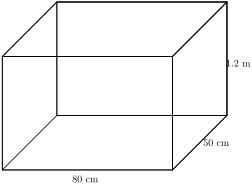
6. A wooden storage box has a length of 1.2 m, a width of 80 cm, and a height of 50 cm. Find the volume of the box in cubic meters.
(Hint: Convert all dimensions to meters before calculating.)
Checkpoint 2.7.35 .
Checkpoint 2.7.36 .