Activity 2.2.3.
Work in groups
Exploring reflections with mirrors.
Needed Materials
Steps.
-
Hold your hand about \(10 \, cm\) in front of the mirror, with your palm facing the mirror. What do you notice?
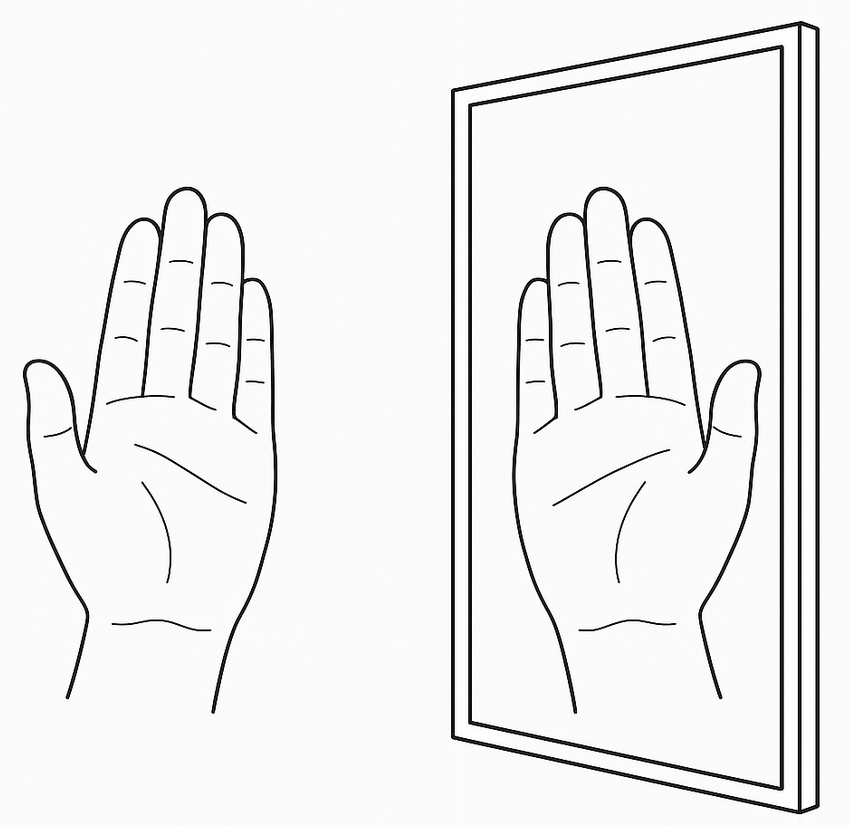
-
Turn your hand so that the back of your hand faces the mirror instead. Observe again. How does the reflection mimic the shape of your hand? Is there symmetry between your hand and its relection?
-
Hold your hand in front of the mirror with your palm facing the mirror, then fold your fingers to make a fist. Does the reflection mimic your hand movements in the same direction?
-
Slowly rotate your hand in different directions (up, down, sideways) while watching the mirror. Discuss how the mirror’s reflection always mirrors the real movement.
-
Move your hand closer to the mirror until it touches the mirror. What do you notice?
Key Takeaway
-
The mirror does not create a random image but produces a reversed copy of the object in front of it. From your activity, you will notice that when you hold your right hand in front of the mirror, the reflection is a reverse which appers as the left hand. This phenomena is called lateral inversion. Lateral inversion is when a reflected object appears to be flipped along a vertical axis.
-
You will also notice that the reflection mimics you hand movements when you flip, rotate it and when you fold it.
-
As you move your hand closer to the mirror, you notice that the distance between reflection and the mirror reduces. When you touch the mirror, the image appears to touch your hand. Your hand and its reflection are in symmetry.

