Skip to main content\(\newcommand{\N}{\mathbb N} \newcommand{\Z}{\mathbb Z} \newcommand{\Q}{\mathbb Q} \newcommand{\R}{\mathbb R}
\newcommand{\lt}{<}
\newcommand{\gt}{>}
\newcommand{\amp}{&}
\definecolor{fillinmathshade}{gray}{0.9}
\newcommand{\fillinmath}[1]{\mathchoice{\colorbox{fillinmathshade}{$\displaystyle \phantom{\,#1\,}$}}{\colorbox{fillinmathshade}{$\textstyle \phantom{\,#1\,}$}}{\colorbox{fillinmathshade}{$\scriptstyle \phantom{\,#1\,}$}}{\colorbox{fillinmathshade}{$\scriptscriptstyle\phantom{\,#1\,}$}}}
\)
Subsection 2.9.3 Displacement Time Graph of Different Situations
Activity 2.9.4.
\({\color{black} \textbf{Work in groups}}\)
A motorist travels from Limuru to Kisumu. The table below shows the distances covered at different times:
| \(\textbf{Time}\) |
\(\textbf{Distance (km)}\) |
| \(\textbf{9:00 AM}\) |
\(0\) |
| \(\textbf{10:00 AM}\) |
\(80\) |
| \(\textbf{11:00 AM}\) |
\(160\) |
| \(\textbf{11:30 AM}\) |
\(160\) |
| \(\textbf{12:00 PM}\) |
\(210\) |
Plot the graph using the data given in the table and use it to answer the questions below
-
How far was the motorist from Limuru at 10:30 AM?
-
What was the average speed during the first part of the journey?
-
What was the overall average speed?
\({\color{black} \textbf{Key Takeaway}}\)
\(\text{Distance}\) is the total length of the path traveled by an object.
\(\text{Displacement}\) is the shortest distance from the initial to the final position of an object, represented as a vector.
When distance is plotted against time, a distance-time graph is obtained.
Example 2.9.9.
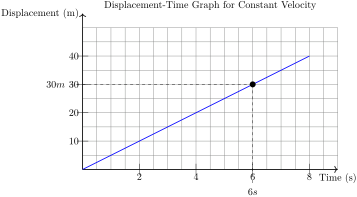
A car moves with a constant velocity of
\(\textbf{5 m/s}\) for
\(8\) seconds.
Draw the displacement-time graph and determine the displacement at
\(\textbf{t = 6s}\text{.}\)
Solution.
Since the velocity is constant, the displacement increases linearly with time
Hence ,
\begin{gather*}
\textbf{s = vt}
\end{gather*}
\begin{gather*}
\textbf{ S = 5} \, \times \, \textbf{6 = 30}
\end{gather*}
Example 2.9.10.
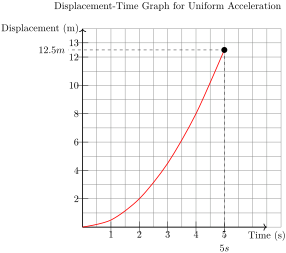
A car starts from rest and accelerates uniformly at
\(\textbf{2 m/s²}\) for
\(5\) seconds.
Draw the displacement-time graph.
Solution.
Since acceleration is constant, the displacement follows the equation
\begin{gather*}
\textbf{s} = \frac{1}{2}at^{2}
\end{gather*}
for different time values:
| Time (s) |
Displacement (m) |
| \(1\) |
\(0.5\) |
| \(2\) |
\(2\) |
| \(3\) |
\(4.5\) |
| \(4\) |
\(8\) |
| \(5\) |
\(12.5\) |
Example 2.9.11.
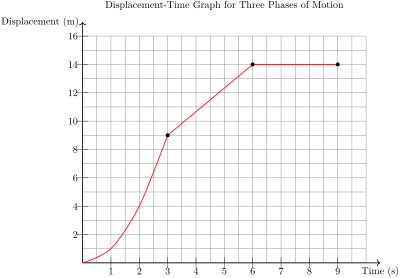
A car moves in three different phases as shown below;
The car starts from rest and accelerates uniformly. The car moves at a constant velocity. The car comes to a stop and remains at a fixed position.
-
Sketch a displacement-time graph for the motion.
-
Identify the type of motion in each phase.
-
Determine the displacement at
\(\textbf{t = 3s, t = 6s, and t = 9s }. \)
Solution.
\(\textbf{0s to 3s}\) - The displacement follows a curved path because the car is accelerating.
\(\textbf{3s to 6s}\) - The displacement increases linearly since the velocity is constant.
\(\textbf{6s to 9s}\) - The displacement remains constant because the car has stopped.
Exercises Exercises
1.
A car moves along a straight road, and its displacement from the starting point is recorded at different times.
| \(\textbf{Time (s)}\) |
\(\textbf{Displacement (m)}\) |
| \(0\) |
\(0\) |
| \(2\) |
\(4\) |
| \(4\) |
\(10\) |
| \(6\) |
\(16\) |
| \(8\) |
\(20\) |
| \(10\) |
\(20\) |
| \(12\) |
\(15\) |
| \(14\) |
\(8\) |
| \(16\) |
\(0\) |
-
Plot a displacement-time graph using the data above
-
Describe the motion of the car based on the graph.
-
Identify the time intervals when the car is at rest
-
Find the velocity of the car at the following intervals
-
Determine the total distance traveled by the car.
2.
Study the following description of a runner’s motion and sketch the corresponding displacement-time graph
-
The runner starts from rest and accelerates uniformly for
\(\textbf{ 5 seconds}\text{,}\) covering a displacement of
\(\textbf{25 meters}\text{.}\)
-
The runner maintains a constant speed for the next
\(\textbf{ 10 seconds}\text{,}\) covering an additional
\(\textbf{ 50 metres}\text{.}\)
-
The runner then decelerates uniformly for
\(\textbf{ 5 seconds}\) until stopping at
\(\textbf{ 100 meteres}\text{.}\)
-
Sketch the displacement-time graph based on this motion.
-
Determine the velocity during the constant speed phase.
-
Calculate the acceleration during the first
\(\textbf{ 5 seconds}\text{.}\)
-
Find the total time taken to complete the journey.
-
What is the average velocity for the entire motion?
3.
The displacement-time graph represents the motion of a cyclist
-
From
\(\textbf{0 to 4 seconds}\text{,}\) the cyclist moves forward at a uniform velocity.
-
From
\(\textbf{4 to 8 seconds}\text{,}\) the cyclist is stationary.
-
From
\(\textbf{8 to 12 seconds}\text{,}\) the cyclist moves back towards the starting point at a uniform velocity.
-
Sketch the graph for this motion.
-
What is the velocity during the first
\(\textbf{4 seconds}\text{?}\)
-
What does the flat section of the graph indicate?
-
Find the velocity during the last
\(\textbf{4 seconds}\text{.}\)
-
Calculate the total displacement at the end of
\(\textbf{12 seconds}\text{.}\)
Checkpoint 2.9.12.