Skip to main content
Contents Dark Mode Prev Up Next \(\newcommand{\N}{\mathbb N} \newcommand{\Z}{\mathbb Z} \newcommand{\Q}{\mathbb Q} \newcommand{\R}{\mathbb R}
\newcommand{\lt}{<}
\newcommand{\gt}{>}
\newcommand{\amp}{&}
\definecolor{fillinmathshade}{gray}{0.9}
\newcommand{\fillinmath}[1]{\mathchoice{\colorbox{fillinmathshade}{$\displaystyle \phantom{\,#1\,}$}}{\colorbox{fillinmathshade}{$\textstyle \phantom{\,#1\,}$}}{\colorbox{fillinmathshade}{$\scriptstyle \phantom{\,#1\,}$}}{\colorbox{fillinmathshade}{$\scriptscriptstyle\phantom{\,#1\,}$}}}
\)
Subsection 2.8.8 Magnitude of a Vector
Activity 2.8.8 .
What you require: Graph paper
(a) Draw the
\(x\) axis and
\(y\) axis on the graph paper.
(b) Mark the coordinate
\((0,0)\) as the initial point
\(O\text{.}\)
(c) From Point
\(O\text{,}\) move
\(3\) units to the
right along the
\(x\) axis and
\(4\) units upward in the
\(y\) axis. Mark this new position as Point
\(A\text{.}\)
(d) Draw a directed line from point
\(O\) to point
\(A\) to represent
\(\overrightarrow{OA}\text{.}\)
(e) Use a ruler to measure the length of
\(\overrightarrow{OA}\text{.}\)
(f) Analyze the relationship between the
\(x\) displacement,
\(y\) displacement, and the length of
\(\overrightarrow{OA}\text{.}\)
(g) Discuss and share your findings with your classmates in the class.
\(\textbf{Key Takeaway}\)
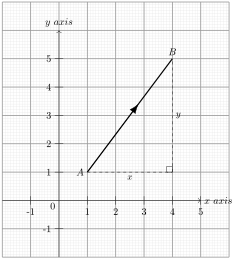
The
magnitude of
\(\overrightarrow{AB}\) in
Figure 2.8.42 can be denoted as
\(|\mathbf{AB}|\text{.}\) The magnitude of
\(\overrightarrow{AB}\) represents the distance between point
\(\text{A}\) and point
\(\text{B}\text{.}\)
We can represent the components of
\(\overrightarrow{AB}\) as
\(\begin{pmatrix} x \\ y \end{pmatrix}\text{,}\) where
\(x\) represents the horizontal displacement and
\(y\) represents the vertical displacement.
We determine the magnitude of
\(\overrightarrow{AB}\) by applying
Pythagorean theorem as shown below.
\begin{equation*}
|\mathbf{AB}| = \sqrt{x^2 + y^2}
\end{equation*}
Figure 2.8.42. The magnitude of a vector is always
positive since
\(x\) and
\(y\) components are squared, resulting in
\(x^2\) and
\(y^2\text{,}\) both of which are
non-negative .
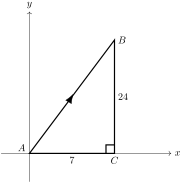
Example 2.8.43 .
Determine the magnitude of
\(\overrightarrow{AB}\) as shown in the
Figure 2.8.44 below.
Figure 2.8.44. Solution .
To find the magnitude of
\(\overrightarrow{AB}\text{,}\) we apply pythagora’s theorem to find the length
\(\textbf{AB}\text{.}\)
\begin{align*}
|\textbf{AB}| \amp = \sqrt{\text{(AC)}^2 + \text{(CB)}^2 } \\
\amp = \sqrt{7^2 + 24^2} \\
\amp = \sqrt{49 + 576}\\
\amp = \sqrt{625}\\
\amp = 25
\end{align*}
Hence, the magnitude of
\(\overrightarrow{AB}\) represented as
\(|\textbf{AB}|\) is
\(25.\)
Example 2.8.45 .
Given that
\(a=\binom{2}{4}\text{,}\) \(b=\binom{-2}{2.5}\text{,}\) \(c=\binom{6}{-4}\) and
\(r=a+2b-c\text{.}\) Find
\(|r|\)
Solution .
Substituting the values of
\(a\text{,}\) \(b\) and
\(c\) into the equation;
\(r=\binom{2}{4}+ 2\binom{-2}{2.5}-\binom{6}{-4}\)
\(r=\binom{2}{4}+ \binom{-4}{5}-\binom{6}{-4}\)
\(r=\binom{2+(-4)-6}{4+5-(-4)}\)
\(|r|=\sqrt{(-8)^2+13^2}=\sqrt{64+169}=\sqrt{233}\)
Exercises Exercises
1. Find the magnitude of each of the following vectors:
\(\displaystyle \left( \begin{matrix} -6 \\ 8 \end{matrix}\right)\)
\(\displaystyle \left( \begin{matrix} 8 \\ 15 \end{matrix}\right)\)
\(\displaystyle \left( \begin{matrix} -5 \\ 12 \end{matrix}\right)\)
\(\displaystyle \left( \begin{matrix} 3 \\ 7 \end{matrix}\right)\)
Checkpoint 2.8.46 .
Checkpoint 2.8.47 .