Skip to main content\(\newcommand{\N}{\mathbb N} \newcommand{\Z}{\mathbb Z} \newcommand{\Q}{\mathbb Q} \newcommand{\R}{\mathbb R}
\newcommand{\lt}{<}
\newcommand{\gt}{>}
\newcommand{\amp}{&}
\definecolor{fillinmathshade}{gray}{0.9}
\newcommand{\fillinmath}[1]{\mathchoice{\colorbox{fillinmathshade}{$\displaystyle \phantom{\,#1\,}$}}{\colorbox{fillinmathshade}{$\textstyle \phantom{\,#1\,}$}}{\colorbox{fillinmathshade}{$\scriptstyle \phantom{\,#1\,}$}}{\colorbox{fillinmathshade}{$\scriptscriptstyle\phantom{\,#1\,}$}}}
\)
Subsection 3.2.1 Introduction to Probability
Activity 3.2.1.
\({\color{black} \textbf{Work in groups}}\)
Write down 3 events that could happen today (e.g., “It will rain” or “I will be late to school”)
Predict the probability of each event:
\(\textbf{Is it likely, unlikely, or certain}\text{?}\)
\({\color{black} \textbf{Key Takeaway}}\)
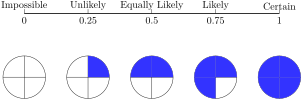
\(\text{Probability}\) is the measure of how likely an event is to occur. It is expressed as a number between 0 and 1, where:
-
\(0\) means the event is impossible.
-
\(1\) means the event is certain.
-
A probability closer to
\(1\) indicates a higher likelihood of the event occurring.
Probability is always between 0 and 1
\(\text{Probability Scale}\)
\({\color{black} \text{Key Terms in Probability}}\)
-
\(\text{Experiment}\) - A process that leads to a specific result.
-
\(\text{Outcome}\) - A possible result of an experiment.
-
\(\text{Event}\) - A collection of one or more outcomes.
-
\(\text{Sample Space (S)}\) - The set of all possible outcomes.
-
\(\text{Probability (P)}\) - A measure of how likely an event is to occur.
Probability is widely used in everyday life, including:
-
\(\text{Weather Forecasting}\) - Meteorologists predict the likelihood of rain based on past data.
-
\(\text{Sports}\) - Coaches analyze the probability of winning based on past performance.
-
\(\text{Medicine}\) - Doctors assess the probability of a patient responding to treatment.
-
\(\text{Finance and Insurance}\) - Insurance companies use probability to determine policy pricing.
-
\(\text{Games of Chance}\) - Dice rolling and card games use probability.
Checkpoint 3.2.1.
Checkpoint 3.2.2.