Subsection 2.8.10 Translation Vector

Activity 2.8.10.

Work in groups
What you require: Graph paper

(a)

Draw the \(x\) axis and \(y\) axis on the graph paper.

(b)

Plot the triangle with vertices \(A(-3,1)\text{,}\) \(B(-1,1)\text{,}\) and \(C(-2,3)\text{.}\)

(c)

Translate each point by moving \(2\) units to the right parallel to the \(x\) axis and \(3\) units up in the \(y\) axis. Label the new points as \(A', B',\) and \(C'\text{.}\)

(d)

Draw the new triangle \(A'B'C'\) on the graph.

(e)

Use dotted lines to connect each original point to its corresponding translated point \((A \text{ to } A', B \text{ to } B', C \text{ to } C')\text{,}\) add arrows to indicate the direction.

(f)

Observe and describe any similarities between triangle \(ABC\) and triangle \(A'B'C'.\)

(g)

Analyze the distance each point moved.

(h)

Discuss and share your findings with your classmates in the class.
\(\textbf{Key Takeaway}\)
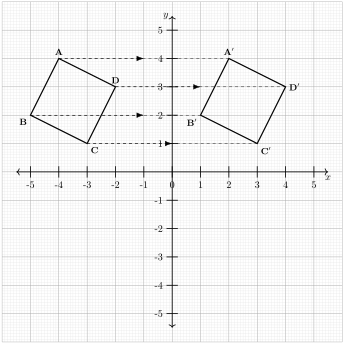
A square \(\mathbf{ABCD}\) undergoes a translation when each of its vertices (\(\mathbf{A}\text{,}\)\(\mathbf{B}\text{,}\)\(\mathbf{C}\) and \(\mathbf{D}\)) is moved the same distance and in the same direction. A translation vector, denoted by \(\mathbf{T}\text{,}\) describes this movement.
Using \(\mathbf{T}\) to represent a translation, the notation \(\mathbf{T}(\mathbf{P})\) indicates the application of the translation \(\mathbf{T}\) on \(\mathbf{P}\text{.}\) In Figure 2.8.51, shows \(\mathbf{A'B'C'D'}\) is the image of \(\mathbf{ABCD}\) under a translation.
Figure 2.8.51.

Example 2.8.52.

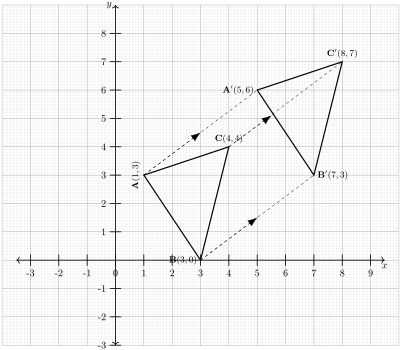
Triangle \(\mathbf{ABC}\) has vertices \(\mathbf{A}(1,3)\text{,}\) \(\mathbf{B}(3,0)\) and \(\mathbf{C}(4,4)\text{.}\)The triangle undergoes a translation \(\mathbf{T}\) defined by the vector \(\begin{pmatrix} 4 \\ 3 \end{pmatrix}\text{.}\)
  1. Determine the coordinates of the translated vertices \(\mathbf{A'}\text{,}\) \(\mathbf{B'}\) , and \(\mathbf{C'}\) ’.
  2. Draw the triangle \(\mathbf{ABC}\) and its image under \(\mathbf{T}\text{.}\)
Solution.
To find the coordinates of the translated vertices, we apply the translation \(\mathbf{T}\) to each original vertex.
\begin{align*} \mathbf{OA'} \amp = \mathbf{OA} + \mathbf{T}\\ \mathbf{OB'} \amp = \mathbf{OB} + \mathbf{T}\\ \mathbf{OC'} \amp = \mathbf{OC} + \mathbf{T} \end{align*}
\begin{align*} \mathbf{OA'} \amp = \binom{1}{3} + \binom{4}{3} = \binom{1+4}{3+3} = \binom{5}{6} \\ \mathbf{OB'} \amp = \binom{3}{0} + \binom{4}{3} = \binom{3+4}{0+3} = \binom{7}{3} \\ \mathbf{OC'} \amp = \binom{4}{4} + \binom{4}{3} = \binom{4+4}{4+3} = \binom{8}{7} \end{align*}
Figure 2.8.53.

Exercises Exercises

1.

Draw triangle \(\mathbf{XYZ}\) with vertices \(\mathbf{X(1, 4)}\text{,}\) \(\mathbf{Y(6, 2)}\text{,}\) and \(\mathbf{Z(5, 3)}\text{.}\) On the same axes, plot \(\mathbf{X'Y'Z'}\text{,}\) the image of triangle \(\mathbf{XYZ}\) under a translation given by \(\binom{4}{9}.\)

2.

The following points have been translated using the given vectors. Determine their original positions:
  1. \(\displaystyle (4,-1); \, \, \binom{2}{3}\)
  2. \(\displaystyle (0,-3); \, \, \binom{1}{3}\)
  3. \(\displaystyle (-3,8); \, \, \binom{-2}{7}\)
  4. \(\displaystyle (11,-5); \,\, \binom{5}{-1}\)
  5. \(\displaystyle (-12,5); \,\, \binom{3}{-10}\)
  6. \(\displaystyle (2,-7); \,\, \binom{-10}{15}\)

3.

A point \(\mathbf{P(5, -3)}\) is mapped to a new position after a translation. If the new coordinates are \(\mathbf{(9, 1)}\text{,}\) determine the translation vector used.

4.

A point \(\mathbf{M(1, -4)}\) undergoes a translation by \(\binom{3}{5}.\) Determine the coordinates of \(\mathbf{M'}\text{,}\) the transformed point. If \(\mathbf{M'}\) is then translated by \(\binom{-4}{2},\) find the final position \(\mathbf{M''}\text{.}\) What is the single translation vector that maps \(\mathbf{M'}\) to \(\mathbf{M''}\) directly?

5.

Translate each of the following points using the given vector:
  1. \(\displaystyle (10,1); \, \, \binom{-11}{2}\)
  2. \(\displaystyle (-2,-5); \, \, \binom{6}{14}\)
  3. \(\displaystyle (3,-15); \, \, \binom{-16}{11}\)
  4. \(\displaystyle (-11,4); \, \, \binom{-15}{10}\)
  5. \(\displaystyle (1,10); \, \, \binom{7}{2}\)
  6. \(\displaystyle (4,-9); \, \, \binom{5}{-8}\)
  7. \(\displaystyle (-2,13); \, \, \binom{-3}{1}\)
  8. \(\displaystyle (-6,5); \, \, \binom{-1}{2}\)

Reading Questions Further Exercises

1.

Given that \(a=\) \((-3,2)\) , \(b=\) \((6,-4)\) and \(c=\) \((5,-15) \)and that \(q=\) \(2a\)+ \(\frac{1}{2}b\) +\(\frac{1}{5}c\text{.}\) Express \(q\) as a column vector and hence calculate its magnitude \(|q|\) correct to two decimal places

2.

If \(P\text{,}\) \(Q\) and \(R\) are the points \((2, - 4)\text{,}\) \((4, 0)\) and \((1, 6)\) respectively, use the vector method to find the coordinates of point \(S\) given that \(PQRS\) is a parallelogram.

3.

The figure below shows a triangle of vectors in which \(OS: SP=\) \(1:3\text{,}\) \(PR:RQ=\) \(2:1\) and \(X\) is the midpoint of \(OR\text{.}\)
Given that \(OP=\) \(p\) and \(OQ=\) \(q\text{,}\) express the following vectors in terms of \(p\) and \(q\)
(i) \(PQ\)
(ii) \(QR\)
(iii) \(OR\)
(iv) \(QT\)

4.

Given that \(3p-2q=\binom{10}{5}\) and \(p+2q=\binom{-7}{15}\) find;
  1. \(p\) and \(q\)
  2. \(\displaystyle |2p+3q|\)

5.

In triangle \(OAB\text{,}\) \(M\) and \(N\) are points on \(OA\) and \(OB\) respectively, such that \(OM:OA=2:5\) and \(ON:OB=2:3\text{.}\) \(AN\) and \(BM\) intersect at \(T\text{.}\) Given that \(OA=a\) and \(OB=b\text{.}\)Express in terms of \(a\) and \(b\text{:}\)
(a). \(AB\)
(b) \(BM\)
(C) \(AN\)

6.

Find the scalars \(p\) and \(q\)
\(p\binom{8}{6}+q \binom{-6}{4}=\binom{10}{16}\)

7.

A point \(M\) divides \(PQ\) in the ratio \(3:5\text{.}\) Given that \(P\) is \((-6,8)\) and \(Q\) is \((4,-2)\text{.}\) Find the coordinates of \(M\)