Skip to main content
Contents
Search Book
Search Results:
No results.
Read aloud Readability settings Prev Up Next \(\newcommand{\N}{\mathbb N} \newcommand{\Z}{\mathbb Z} \newcommand{\Q}{\mathbb Q} \newcommand{\R}{\mathbb R}
\newcommand{\lt}{<}
\newcommand{\gt}{>}
\newcommand{\amp}{&}
\definecolor{fillinmathshade}{gray}{0.9}
\newcommand{\fillinmath}[1]{\mathchoice{\colorbox{fillinmathshade}{$\displaystyle \phantom{\,#1\,}$}}{\colorbox{fillinmathshade}{$\textstyle \phantom{\,#1\,}$}}{\colorbox{fillinmathshade}{$\scriptstyle \phantom{\,#1\,}$}}{\colorbox{fillinmathshade}{$\scriptscriptstyle\phantom{\,#1\,}$}}}
\)
Subsection 3.1.5 Interpretation of data
Curriculum Alignment
Strand
3.0 Statistics and Probability
Sub-Strand
Specific Learning Outcomes
Represent data using histograms and frequency polygons
Interpret data from histograms and frequency polygons
Teacher Resource 3.1.120 .
To assist your teaching, we have prepared lesson resources, aligned with this textbook and the CBC. The Lesson Plan links to syllabus learning outcomes and provides suggest time allocations. The Step-by-Step Guide provides more detailed guidance on how to teach the content, including suggested questions to ask learners, and possible answers.
Interpretation of data is the process of examining and explaining the meaning of organized or represented data in order to draw conclusions, make decisions or solve problems.
Once data is collected and represented in tables, graphs or charts, we look for patterns, relationships and trends to understand what the data is telling us.
Learner Experience 3.1.121 .
\(\textbf{Work in groups}\)
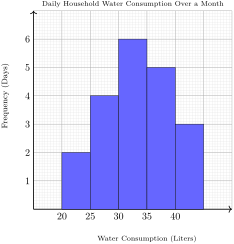
The histogram below represent a household’s daily water consumption (in liters) recorded over a month.
Determine the day when the water consumption was high.
Determine the day when the water consumption was low.
Discuss and share with other group.
Example 3.1.123 .
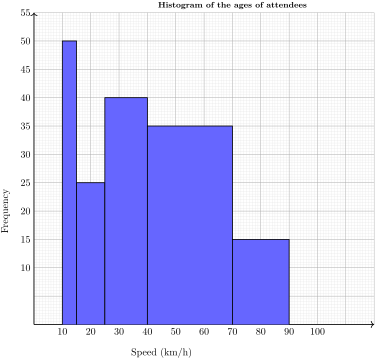
The histogram below represents the ages of attendees recorded by the organizers at a community event.
How many age groups are represented in the histogram?
What is the total number of attendees recorded in the histogram?
Which age group has the highest number of attendees?
Solution .
By counting the number of bars in the histogram, we can determine the number of age groups.
Therefore, there were five age groups that attended the event.
The total number of attendees is the sum of all frequencies (heights of the bars).
\(50+25+40+35+15\) =
\(165\)
Therefore, the number of attendees were
\(165\)
The age group corresponding to the tallest bar has the highest number of attendees.
Therefore, the age group
\(10 - 15\) had the highest number of attendees, with a total of
\(50\) participants.
Example 3.1.124 .
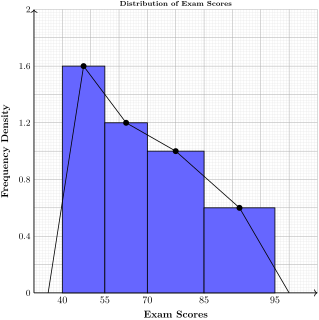
The graph below represents a histogram and frequency polygon of the distribution of exam scores of students in a Grade 10 class.
Describe the shape of the distribution of exam scores.
What is the midpoint of the class interval
\(70 - 85\text{?}\)
Compare the height of the first bar (
\(40 - 55\) score range) to the height of the last bar (
\(85 - 95\) score range). What does this tell you about the number of students in those score ranges?
Solution .
The distribution is skewed to the right (positively skewed).
The first bar is much taller than the last bar. This means that many more students got scores in the
\(40 - 55\) range than in the
\(85 - 95\) range.
Checkpoint 3.1.125 .
Checkpoint 3.1.126 .
Exercises Exercises
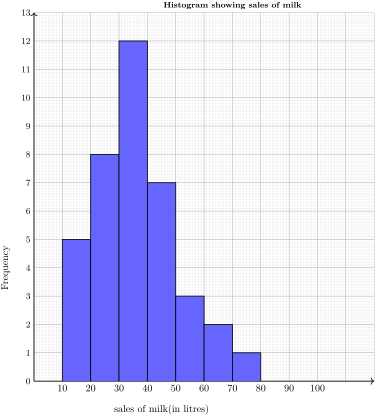
1. The following histogram shows sales of milk (in litres) sold by Akiru.
What does the y-axis represent?
What does the x-axis represent?
Describe the shape of the histogram. Is it symmetrical or skewed? If skewed, is it skewed left or right?
Answer .
Frequency (number of days).
Amount of milk sold (litres).
Skewed to the right (positively skewed).
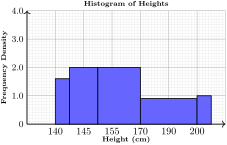
2. The following histogram shows the height of students in a grade 10 class.
Use the information from the graph to answer the following questions:
Calculate the frequency of individuals with heights between
\(145 \textbf{ cm}\) and
\(155 \textbf{ cm}\) Show your working
Identify the modal class.
Estimate the total number of individuals represented in the histogram.
Explain one difference between a histogram and a bar graph.
Describe the overall shape of the height distribution shown in the histogram.
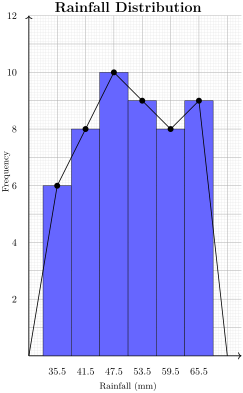
3. Interpret the histogram and frequency polygon graph below and answer the questions given.
Describe the overall shape of this rainfall distribution graph.
At which rainfall ranges do the frequencies seem to decline?
Calculate the total frequency across all rainfall ranges.
What range of rainfall appears most frequently?
Estimate the median rainfall range from this distribution.
Which rainfall range appears to be the mode of this distribution?
What might cause variations in rainfall distribution?