Skip to main content
Contents Dark Mode Prev Up Next \(\newcommand{\N}{\mathbb N} \newcommand{\Z}{\mathbb Z} \newcommand{\Q}{\mathbb Q} \newcommand{\R}{\mathbb R}
\newcommand{\lt}{<}
\newcommand{\gt}{>}
\newcommand{\amp}{&}
\definecolor{fillinmathshade}{gray}{0.9}
\newcommand{\fillinmath}[1]{\mathchoice{\colorbox{fillinmathshade}{$\displaystyle \phantom{\,#1\,}$}}{\colorbox{fillinmathshade}{$\textstyle \phantom{\,#1\,}$}}{\colorbox{fillinmathshade}{$\scriptstyle \phantom{\,#1\,}$}}{\colorbox{fillinmathshade}{$\scriptscriptstyle\phantom{\,#1\,}$}}}
\)
Subsection 2.9.4 Interpretation of Displacement Time Graph
Activity 2.9.5 .
\(\textbf{Work in groups}\)
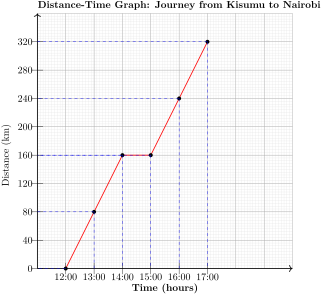
Consider the displacement time graph representing distance covered by a motorist traveling from Turkana to Nairobi.
How far was the motorist from the starting point at
\(2:30\textbf{ PM}\text{?}\)
What was the total distance covered by the motorist?
During which periods was the motorist stationary?
Calculate the average speed of the motorist between
\(12 \textbf{ noon}\) and
\(2 \textbf{ PM}\text{.}\)
What was the overall average speed for the entire journey?
\(\textbf{Key Takeaway}\)
The graph’s slope and shape reveal an object’s velocity. A steeper or curved lines indicate changing or higher velocity, while horizontal or flat lines show the object is stationary.
Example 2.9.13 .
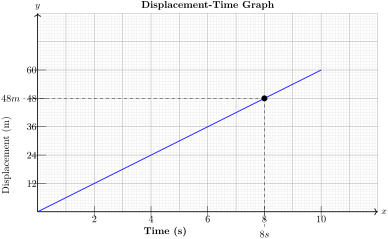
Use the displacement-time graph for constant velocity to answer the following questions.
What type of motion does the graph represent? Explain your answer.
What is the displacement of the car at
\(\textbf{t}\) =
\(8\) seconds?
What is the total displacement at
\(\textbf{t}\) =
\(10\) seconds
Determine the velocity of the car from the graph.
Solution .
The graph shows a straight line with a constant slope, indicating uniform motion. This means the car is moving at a constant velocity with no acceleration.
From the graph, the displacement at
\(\textbf{t}\) =
\(8\) seconds is
\(48\) meters.
Using the equation of motion:
\begin{align*}
\textbf{s} = \amp \textbf{t} \times \textbf{v}\\
\textbf{s} = \amp 6 \times 10\\
= \amp 60 \textbf{ meters}
\end{align*}
Therefore,
\(\textbf{t}\) =
\(10\) seconds, the car’s displacement is
\(60\) meters.
Velocity is given by the slope of the displacement-time graph:
\begin{align*}
\textbf{Velocity} = \amp \frac{\textbf{Change in displacement}}{\textbf{Change in time}}\\
\textbf{Velocity} = \amp \frac{48 - 0}{8 - 0}\\
= \amp \frac{48}{8} = 6
\end{align*}
This confirms the car’s velocity is
\(6\) \(\textbf{m/s}\text{.}\)
Example 2.9.14 .
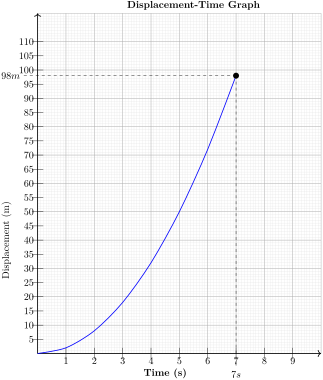
Use the graph below to answer the questions.
What type of motion is represented by the graph? Explain your reasoning.
If the train continued to accelerate at
\(4\) \(\textbf{ m/s²}\text{,}\) what would be its approximate displacement at
\(\textbf{t}\) =
\(8\) seconds?
What is the displacement of the body at
\(\textbf{t}\) =
\(7\) seconds?
Solution .
The graph represents uniformly accelerated motion.
The line on the graph is curved, not straight. This means the object is not moving the same distance each second. Its speed is changing.
\begin{align*}
\textbf{S} = \frac{1}{2}\textbf{at}^{2} + \textbf{ut}\\
\textbf{S} = \amp \frac{1}{2}4(8)^{2} + (0)(8)\\
\textbf{S} = \amp 0 + 2 (64)\\
\textbf{S} = \amp 128 \textbf{ m}
\end{align*}
The approximate displacement at
\(\textbf{t}\) =
\(8\) seconds would be
\(128\) meters.
\(\displaystyle 98 \textbf{ m}.\)
Exercises Exercises
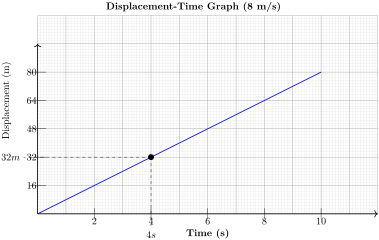
1. The displacement-time graph below shows a train moving at a constant velocity.
Use the graph to answer the following questions.
What is the displacement at
\(\textbf{t}\) =
\(4 \textbf{s}\text{?}\)
If the object continued moving for
\(15\) seconds, what would be its total displacement?
What would the graph look like if the object stopped moving after
\(6\) seconds?
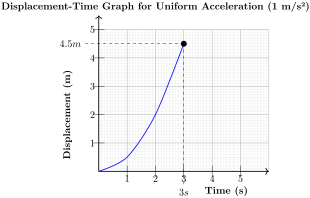
2. The displacement-time graph below shows a car accelerating smoothly from rest.
Use the graph to answer the following questions:
Describe the motion of the car as shown in the graph. Is the velocity constant, increasing, or decreasing? Justify your answer.
What does the y-intercept of the graph represent?
Calculate the average velocity of the object between
\(\textbf{t}\) =
\(0 \textbf{ s}\) and
\(\textbf{t}\) =
\(3 \textbf{ s}\)
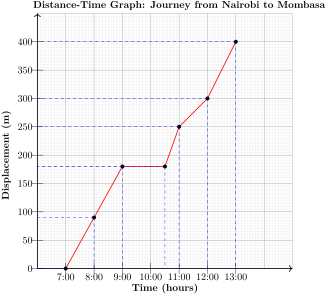
3. The distance-time graph below shows a motorist traveling from Nairobi to Mombasa with varying speeds and periods of rest.
Use the graph to answer the following questions:
What was the total distance traveled by the motorist?
At what time did the motorist stop for a break?
Calculate the speed of the motorist between
\(7:00\) \(\textbf{AM}\) and
\(8:00\) \(\textbf{AM}\text{.}\)
What was the speed of the motorist from
\(9:00\) \(\textbf{AM}\) and
\(10:30\) \(\textbf{AM}\text{?}\)
Find the overall average speed of the entire journey.
Identify a section of the graph where the motorist was stationary.
Describe what happens when the graph has a steeper slope.
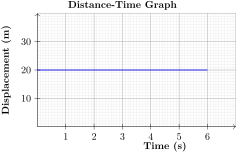
4. The displacement-time graph below shows a car parked on the roadside.
What is the displacement of the object throughout the time interval shown in the graph?
During which time interval(s) is the object stationary?
What is the total distance covered by the car in
\(6\) seconds?
What is the speed of the car during the time interval shown?