Subsection 2.7.3 Surface Area of a pyramid

Activity 2.7.5. Net of a triangle based Pyramid.

Paper Folding to form a Pyramid.
Materials Needed.
  • Steps.
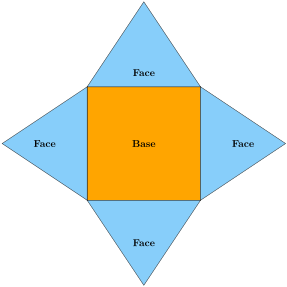
    ♦ Observe the net of the pyramid shown above.
    ♦ Draw on the Colored paper or cardstocks the net of a pyramid that is, four triangles. Note the sides of the triangles and height should be equal.
    ♦ Cut off the extra paper to remain with the pyramid net.
    ♦ Fold along the edges to form a pyramid. Hold the triangles in position using a tape.
    ♦ Using a ruler, measure the base height and slant height of the triangular faces.
  • Find the volume of the pyramid you have constructed.

Activity 2.7.6. Observing pyramidal objects in the surrounding environment.

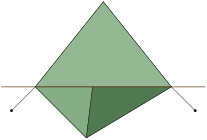
  • ♦ Identify pyramid-shaped objects around school/home e.g., tent(Shown alongside), roof, food container, toys etc.
    ♦ Measure dimensions or use estimated values.
    ♦ Find their surface area using the formula and compare with classmates.
A \(\text{pyramid}\) is a geometric solid object that has a polygon as its base and faces that converge at a point called the apex. In other words the faces are not perpendicular to the base
The polygons that can act as the face of the pyramids include:
🔹 Triangle: Thus called triangular pyramid.
🔹 Squares: Thus called square pyramid.
🔹The two pyramids take their names after the shape of their base.
A right pyramid’s line between the apex and the centre of the base is perpendicular to the base.

Example 2.7.6.

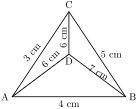
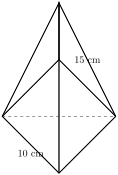
Find the surface area of the following triangular pyramid (correct to 1 d.p)
Solution.
The surface area of a triangular pyramid is the sum of the areas of all \(\textbf{four triangular faces}\)
In finding the surface area we need to recall the definations of a net and a prism.
The net of a pyramid consists of a base triangle \(ABC\text{,}\) which is a polygon that represents the base of the pyramid, and triangular faces\(\angle \, ABD,\, \angle \, BCD, \, \angle ACD\) that represent the sides of the pyramid.
Each triangle’s area will be found using Heron’s Formula:
\begin{align*} A =\amp \sqrt{S(S-a)(S-b)(S-c)} \end{align*}
Where \(S\) is the semi perimeter.
\begin{align*} S = \amp \frac{a+b+c}{2} \end{align*}
Find the Area of the Base Triangle \(ABC\text{.}\) Given sides \(AB = 4\, \text{cm}, \, BC = 5\, \text{cm} , \,AC = 3\, \text{cm}\)
Calculate the semi-perimeter:
\begin{align*} S = \amp \frac{4\, \text{cm}+5\, \text{cm}+3\, \text{cm}}{2} = 6 \, \text{cm} \end{align*}
Apply Heron’s Formula:
\begin{align*} A_{ABC} = \amp \sqrt{6(6-4)(6-5)(6-3)} \\ = \amp \sqrt{6 \times(2)\times(1)\times(3)} \\ = \amp \sqrt{36} \\ = \amp 6 \, \text{cm}^2 \end{align*}
Find the Area of Side Triangle\(ABD\) Given sides \(AB = 4\, \text{cm}, \, AD = 6\, \text{cm} , \, BD = 7\, \text{cm} \)
\begin{align*} S = \amp \frac{4 \,\text{cm}+6\, \text{cm}+7\, \text{cm}}{2} = 8.5 \, \text{cm} \\ A_{ABD} = \amp \sqrt{8.5(8.5-4)(8.5-6)(8.5-7)} \\ = \amp \sqrt{8.5 \times(4.5)\times(2.5)\times(1.5)} \\ = \amp \sqrt{143.44} \\ = \amp 11.97 \, \text{cm}^2 \end{align*}
Find the Area of Side Triangle\(BCD\) Given sides \(BC = 5, \, \text{cm} \,CD = 6 , \, \text{cm} \, BD = 7 \text{cm}\)
\begin{align*} S = \amp \frac{5 \, \text{cm}+6 \, \text{cm}+7 \, \text{cm}}{2} = 9 \, \text{cm} \\ A_{BCD} = \amp \sqrt{9(9-4)(9-6)(9-7)} \\ = \amp \sqrt{9 \times(4)\times(2)\times(3)} \\ = \amp \sqrt{216} \\ = \amp 14.7 \, \text{cm}^2 \end{align*}
Find the Area of Side Triangle\(ACD\) Given sides \(AC = 3, \, AD = 6 , \, CD = 6 \)
\begin{align*} S = \amp \frac{3 \, \text{cm}+6 \, \text{cm}+6 \, \text{cm}}{2} = 7.5 \, \text{cm} \\ A_{ACD} = \amp \sqrt{7.5(7.5-4)(7.5-6)(7.5-7)} \\ = \amp \sqrt{7.5 \times(4.5)\times(1.5)\times(1.5)} \\ = \amp \sqrt{75.94} \\ = \amp 8.71\, \text{cm}^2 \end{align*}
Find the Total Surface Area. Surface Area = \(A_{ABC} + A_{ABD} +A_{BCD} + A_{ACD}\)
\begin{align*} = \amp 6 \, \text{cm}^2 + 11.97 \, \text{cm}^2 + 14.7 \, \text{cm}^2 + 8.71 \, \text{cm}^2 \\ = \amp 41.38 \, \text{cm}^2 \end{align*}
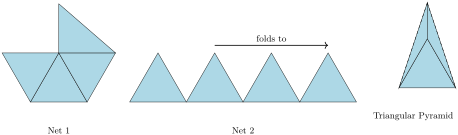
Example 2.7.7.

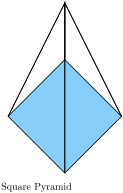
Draw the net of the pyramid.
Net of square pyramid
Square pyramid
Solution.
The net of the pyramid is shown below.
The surface area of a pyramid is the total area of the lateral faces and the base of the pyramid.

Example 2.7.8.

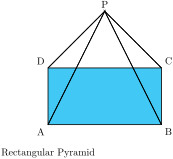
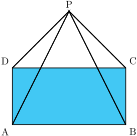
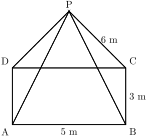
Calculate the surface area of a pyramid whose base is rectangular and slant height \(6\)\(\text{cm}\) as shown below.
Solution.
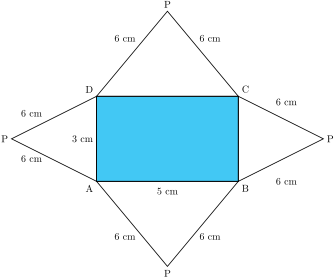
\(\text{First we form the net of the pyramid.}\)
The area of the rectangular base
\begin{align*} = \amp \text{length} \times \text{width} \\ = \amp5 \, \text{cm} \times 3 \, \text{cm} \\ = \amp 15 \, \text{cm}^2 \end{align*}
The height of triangles with base of \(5 \, \text{cm}\)
\begin{align*} = \amp\sqrt{36-6.25} \\ = \amp\sqrt{29.75} \\ = \amp 5.45 \, \text{cm} \, (2 \text{d.p}) \end{align*}
The area of a triangle with base of 5 cm
\begin{align*} = \amp\frac{1}{2}\times \text{base} \times \text{height} \\ = \amp\frac{1}{2} \times 5 \times 5.45 \\ = \amp13.625 \, \text{cm}^2 \end{align*}
Since this triangles are two,Therefore total area is:
\begin{align*} = \amp 2 \times 13.625\\ = \amp27.25 \, \text{cm}^2 \end{align*}
The height of triangles with base of 3 cm
\begin{align*} = \amp\sqrt{6^2-1.5^2} \\ = \amp\sqrt{36-2.25} \\ = \amp\sqrt{33.75} \\ = \amp5.81 \, \text{cm}^2 (2 \text{d.p}) \end{align*}
The area of a triangle with base of 3 cm
\begin{align*} = \amp\frac{1}{2}\times \text{base} \times \text{height} \\ = \amp\frac{1}{2} \times 3 \times 5.81 \, \text{cm}^2\\ = \amp 8.715 \, \text{cm}^2 \end{align*}
Since this triangles are two,Therefore total area
\begin{align*} = \amp 2 \times 8.715\\ = \amp17.43 \, \text{cm}^2 \end{align*}
Therefore, the surface area of the pyramid is,
\begin{align*} = \amp15 \, \text{cm}^2 + 27.25 \, \text{cm}^2 + 17.43 \, \text{cm}^2 \\ = \amp59.68 \, \text{cm}^2 \end{align*}
Example 2.7.9.

Find the surface area of a square pyramid with a height of 6 cm and a side length of 4cm.
Solution.
Select the correct formula and substitute with the given values.
We are given b = 2 by 2 and H = 4, therefore
\begin{align*} \text{Surface Area} = \amp \text{Base area} + 4\text{(area of triangles)} \\ \text{Base Area} = 2 \, \text{cm} \times 2 \, \text{cm}\amp \\ = \amp 4 \, \text{cm}^2 \\ \text{Area of one triangle} = \amp \frac{1}{2} b \times h \\ = \amp \frac{1}{2} \times 2 \, \text{cm} \times 4 \, \text{cm} \\ = \amp 4 \, \text{cm}^2 \\ \text{Area of all triangles}= \amp 4 \, \text{cm}^2 \times 4\, \text{triangles} \\ = \amp 16 \, \text{cm}^2\\ \text{Surface area}= \amp 16 \, \text{cm}^2 + 4 \, \text{cm}^2\\ = \amp 20 \, \text{cm}^2 \end{align*}
The surface area for the square pyramid is \(20 \, \text{cm}^2\text{.}\)
\(\textbf{Exercise}\)
Square pyramid
1. A square-based pyramid has a base with sides measuring 10 cm each, while its triangular faces have a slant height of 15 cm. Determine the total surface area of this pyramid, including the base and all four triangular faces.
2. A pyramid with a square base has a total surface area of 400 cm², and its base side measures 8 cm. Using the formula for surface area, calculate the slant height of the pyramid.
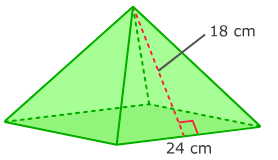
3. A square pyramid has a base with sides of 24 cm each, and the height of the triangular face is 18 cm. Find the total surface area of the pyramid.
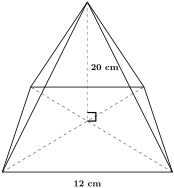
4. A miniature paper pyramid is being designed with a square base of 12 cm by 12 cm and a slant height of 20 cm. How much paper is required to construct the entire pyramid?
5. The roof of a small storage building is in the shape of a rectangular pyramid with a base side length of 5 m and a slant height of 6 m. If the entire roof needs to be covered with wooden shingles, calculate the total area that needs to be covered.
Net of square pyramid

Checkpoint 2.7.10.

Checkpoint 2.7.11.