Subsection 2.4.1 Trigonometric Ratios of Acute Angles

Subsubsection 2.4.1.1 Tangent of an Acute Angle

Activity 2.4.1.

\(\textbf{Work in pairs}\)
What you require:
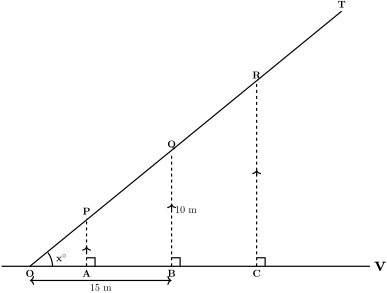
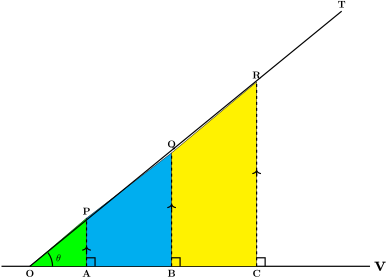
  1. Using a piece of paper, a ruler, and a pencil, carefully draw the diagram shown below.
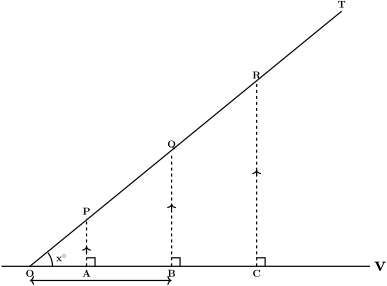
    Figure 2.4.1. fig 1.2
  2. Measure and record the lengths of \(OB,\,BQ,\,OC,\,CR,\,OA,\, \text{and}\,AP\)using a ruler..
  3. Identify whether triangles \(OPA,\,OQB,\,\text{and}\,ORC\) are similar.
    If they are similar, compare the ratios of their corresponding sides.
  4. Calculate the following ratios:
    \(\frac{PA}{OA}\)
    \(\frac{QB}{OB}\)
    \(\frac{RC}{OC}\)
  5. Observe the ratios from the previous step.
    What do you notice about the relationship between them?
  6. Considering the parallel lines \(BQ\text{,}\) \(AP\) and \(RC\) examine the relationship between the vertical and horizontal distances.
    What do you notice about their ratios?
  7. Use a protractor to measure the angle marked \(x^\circ\) in the diagram.
  8. Share your observations and conclusions with your classmates.
\(\textbf{Extended Activity}\)
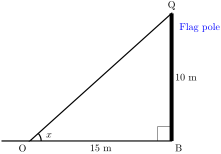
  1. The inclination of the observer’s line of sight to the top of a \(10\,m\) high flag pole, positioned \(15\,m\) away, can be determined using a scale drawing, as illustrated in the diagram below.
    Figure 2.4.2.
    What do we call the angle represented by \(x\text{?}\)
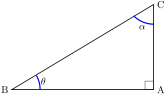
  2. Look at the triangle shown in \(\textbf{Figure 2.4.3.}\)
    Express \(tan\,\alpha\) in terms of the lengths of the sides of the triangle.
    Hint: Recall that in a right-angled triangle:
    \begin{equation*} tan\, \alpha=\frac{\text{opposite side​}}{\text{adjacent side}} \end{equation*}
\(\textbf{Key Takeaway}\)
When given the triangle below, you will notice the following:
Figure 2.4.3.
  1. The triangles \(OPA,\,OQB,\,\text{and }\, ORC\) are similar.
    This means that the ratios of their corresponding sides are equal:
    \begin{equation*} \frac{PA}{OA}=\frac{QB}{OB}=\frac{RC}{OC}=\frac{15}{10}=1.5 \end{equation*}
  2. For any line parallel to \(BQ\text{,}\) rthe ratio of vertical distance to horizontal distance remains the same in each triangle. In this case, the ratio is\(1.5\text{.}\)
    This constant ratio, \(\frac{\text{Vertical distance}}{\text{Horizontal distance}}\) is called the \(\textbf{tangent of angle} \, VOT\text{.}\)
    Therefore, the tangent of \(x^\circ\) is \(1.5\) which can be written as:
    \begin{equation*} \text{tan}\,x^\circ=1.5 \end{equation*}
    The tangent of an angle depends only on the size of the angle, not on the triangle’s size.
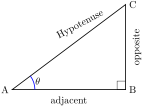
The diagram below shows a right-angled triangle \(ABC\text{,}\) where:
\begin{equation*} \angle ABC = \theta\text{.} \end{equation*}
Figure 2.4.4.
  • The side \(AC\) is the vertical side, which is \(\textbf{opposite}\) to angle \(\theta\text{.}\)
  • The side \(AB\) is the horizontal side, which is \(\textbf{adjacent}\) to angle \(\theta\)
  • The side \(BC\) is the \(\textbf{hypotenuse}\text{,}\) which is the longest side of the right-angled triangle.
In this case, the tangent of angle \(\theta\) is defined as the ratio of the opposite side to the adjacent side:
\begin{equation*} \text{tan}\,\theta = \frac{\textbf{Opposite side}}{\textbf{Adjacent side}}= \frac{AC}{AB}\text{.} \end{equation*}

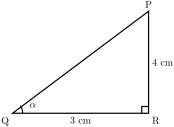
Example 2.4.5.

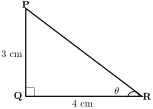
Find the tangent of the indicated angles using the given measurements below.
Solution.
The above diagram the sides given are,
Opposite side \(=3\,cm\)
Adjacent side \(= 4\,cm\)
Therefore,
\begin{align*} \text{tan} \, \theta = \amp \frac{\text{Opposite }}{\text{Adjacent }} \\ =\amp \frac{3\,cm}{4\,cm} \\ = \amp \frac{3}{4}\\ =\amp 0.75 \end{align*}
Therefore, \(\text{tan} \,\theta=0.75\)

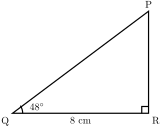
Example 2.4.6.

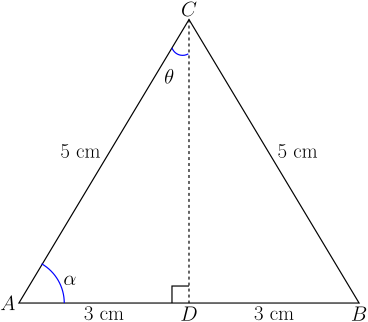
Find the tangent in the indicated angle below.
Solution.
The first thing you should do is to calculate the perpendicular height of the Triangle then identify the opposite and the adjacent sides of angle \(\theta\) and angle \(\alpha\text{.}\) Finaly find there tangents.
Finding the perpendicular height.
We use pythagorean relationship that is
\begin{equation*} H^2=b^2+h^2 \end{equation*}
\begin{align*} h^2=\amp H^2-b^2 \\ =\amp 5^2=3^2\\ =\amp 25-9 \\ =\amp 16 \\ \sqrt{h^2}= \amp \sqrt{16} \\ h= \amp 4\,cm \end{align*}
Finding \(\text{tan} \theta\)
\(\text{tan} \, \theta = \frac{\text{Opposite }}{\text{Adjacent }}\)
The opposite side \(=3\,cm\)
The adjacent side \(=4\,cm\)
\begin{align*} \text{tan} \, \theta= \amp \frac{3\,cm}{4\,cm} \\ =\amp \frac{3}{4}\\ =\amp 0.75 \end{align*}
Finding \(\text{tan} \alpha\)
\(\text{tan} \, \alpha = \frac{\text{Opposite }}{\text{Adjacent }}\)
The opposite side \(=4\,cm\)
The adjacent side \(=3\,cm\)
\begin{align*} \text{tan} \, \theta= \amp \frac{4\,cm}{3\,cm} \\ =\amp \frac{4}{3}\\ =\amp 1.3333333333\\ = \amp 1\frac{1}{3} \end{align*}
Therefore,
\begin{align*} \text{tan} \, \theta= \amp 0.75\\ \text{tan} \, \alpha=\amp 1.333 \end{align*}
\({\color{black} \textbf{Tables of Tangents}}\)

Activity 2.4.2.

\(\textbf{Work in groups}\)
What you require: Printed Table of Tangent, a \(30\,cm\) ruler, pencil, and calculator (for verification).
  1. What is the tangent of an angle?
  2. How do we use a Table of Tangents?
  3. Use your Table of Tangent to find the folowing tangents.
    1. \(\displaystyle 42^\circ\)
    2. \(\displaystyle 35^\circ\)
    3. \(\displaystyle 90^\circ\)
    4. \(\displaystyle 42^\circ \, 47^′\)
  4. Discuss your findings with other groups in your class.
\(\textbf{Key Takeaway}\)
Special tables have been prepared and can be used to obtain tangents of acute angle (see tables of natural tangents in your mathematical tables). The technique of reading tables of tangents is similar to that of reading tables of logarithms or square roots.
Here’s how you can use it:
  1. Identify the angle
    • Find the given angle in the leftmost column (if degrees) or the top row (if radians).
  2. Locate the Tangent Value
    • Read across the row (or down the column) to find the corresponding tangent value.
Note
  1. In the tables of tangents, the angles are expressed in decimals and degrees or in degrees and minutes.
  2. One degree is equal to \(60^′ \, (60\, \text{minutes})\) . Thus, \(30^′ = 0.50^\circ, \,54^′ = 0.9^\circ\, \text{and} \,6^′= 0.1^\circ.\text{.}\)
From the table, the values of tangents increase as the angles approach \(90^\circ\)

Example 2.4.7.

Find the tangent of each of the following angles from the table:
  1. \(\displaystyle 60^\circ\)
  2. \(\displaystyle 52^\circ\)
  3. \(\displaystyle 46.7^\circ\)
  4. \(\displaystyle 52^\circ \, 47^′\)
Solution.
  1. Find \(tan(60^\circ)\)
    Locate \(60^\circ \)in the table.
    Read the corresponding tangent value. that is
    \begin{equation*} tan(60^\circ)=1.732 \end{equation*}
  2. Find \(tan(52^\circ)\)
    Locate \(52^\circ\) in the table.
    Read the corresponding tangent value. that is
    \begin{equation*} tan(52^\circ)=1.279 \end{equation*}
  3. Find \(tan(46.7^\circ)\)
    Locate \(46.7^\circ\) in the table.
    Read the corresponding tangent value. that is
    \begin{equation*} tan(46.7^\circ)=1.0612 \end{equation*}
  4. Find \(tan(52^\circ \, 47^′)\)
    Convert \(47^′\) to degrees by deviding by \(60\)
    \begin{align*} (\frac{47}{60})^\circ =\amp 0.78^\circ \end{align*}
    Therefore,
    \begin{equation*} tan\,52^\circ \, 47^′= 52.78^\circ \end{equation*}
    Using decimal tables, \(tan\, 52.7^\circ = 1.3127 \text{.}\) From the difference column under \(8\) reads \(0.0038\)
    Therefore,
    \begin{align*} tan\,52^\circ \, 47^′=\amp 52.78^\circ \\ =\amp 1.3127+ 0.0038\\ =\amp 1.3165 \end{align*}

Example 2.4.8.

Using natural tangents in your mathematical tables, find \(\alpha\) as shown in the figure below.
Solution.
Opposite \(=4\,cm\)
Adjacent \(=3\,cm\)
\begin{align*} Tan \, \alpha =\amp \frac{\text{Opposite}}{\text{Adjacent}} \\ = \amp \frac{4\,cm}{3\,cm} \\ = \amp 1.3333 \end{align*}
Note that \(1.3333\) cannot be read directly from the tables of tangents. Therefore, look for a number nearest to \(1.3333\) from the tables. In this case, the nearest number is \(1.3319\) The angle whose tangent is \(1.3319\) is \(53.1^\circ\)
The difference between \(1.3333\) and \(1.3319\) is \(14.\text{.}\) From the difference column in the tangent tables, the nearest number to \(14.\) is \(9\) which gives a difference of \(0.44\text{.}\)
Adding \(0.44\) to \(53.1^\circ\) we get \(53.54^\circ\text{.}\)
Therefore, the angle whose tangent is \(1.3333\) \(=53.54^\circ\)
Thus, \(\alpha=53.54^\circ\text{.}\)

Checkpoint 2.4.9. Exact Values of Sine, Cosine, and Tangent Without a Calculator.

Load the question by clicking the button below.

Checkpoint 2.4.10. Finding the Tangent of a Right Angle Triangle.

Load the question by clicking the button below.

Checkpoint 2.4.11. Finding Trigonometric Ratios in a Right Angled Triangle (1).

Load the question by clicking the button below.
\(\textbf{Exercises}\)
  1. Read from tables the tangent of:
    1. \(\displaystyle 88^\circ\,46^′\)
    2. \(\displaystyle 60^\circ\,46^′\)
    3. \(\displaystyle 45^\circ\)
  2. Express each of the following in degrees and minutes:
    1. \(\displaystyle 26.75^\circ\)
    2. \(\displaystyle 40\frac{1}{2}^\circ\)
    3. \(\displaystyle 56\frac{1}{4}^\circ\)
  3. Use Natural logarithm of tangents to find the length \(PR\) in the figure below. (leave your answer to \(2\, \textbf{decimal places}\))
  4. A ladder leans against a wall so that its foot is \(4.5 \,m\) away from the foot of the wall and its top is \(10\,\) up the wall. Calculate the angle it makes with the ground .
  5. In a right-angled triangle, the shorter sides are \(6.5\, cm\) and \(12.2 \,cm\) long. Find the sizes of its acute angles.

Subsubsection 2.4.1.2 Sine and Cosine of an Acute Angle

Activity 2.4.3.

\(\textbf{Work in groups}\)
What you require; A piece of paper, a ruler and a pencil.
  1. The figure below shows \(AP,\,BQ, \textbf{and}\,CR\) perpendicular to \(OV \text{and } \, \angle \, TOV=\theta \)
    Figure 2.4.12. fig 1.5
  2. Copy the above figure in your writing materials.
    Measure lengths \(OA,\,OP,\,AP,\,OQ,\,OB,\,BQ,\,OR,\,OC \,\text{and}\,CR \)
  3. Fill in the following;
    1. \(\frac{AP}{OP}=\)____
    2. \(\frac{BQ}{OQ}=\)____
    3. \(\frac{CR}{OR}=\)____
  4. What do you notice about the ratios of roman (i...iii).
  5. Fill also the following;
    1. \(\frac{OA}{OP}=\)____
    2. \(\frac{OB}{OQ}=\)____
    3. \(\frac{OC}{OR}=\)____
  6. What do you notice about these ratios (5) above.
  7. Discuss your findings with other groups in your class.
\(\textbf{Key Takeaway}\)
You will notice that,
  1. The ratios of (3) are the same and is expressed as;
    \(\frac{AP}{OP}=\frac{BQ}{OQ}=\frac{CR}{OR}\)
    This constant value is obtained by taking the ratio of the side opposite to the angle \(\theta \) to the hypotenuse side in each case. This ratio is called the sine of angle \(\theta \text{,}\) which can be written as as \(sin \, \theta\text{.}\)
  2. The ratios of (5) are the same and is expressed as;
    \(\frac{OA}{OP}=\frac{OB}{OQ}=\frac{OC}{OR}\)
    This constant value is obtained by taking the ratio of the side adjacent to the angle \(\theta \) to the hypotenuse side in each case. This ratio is called the cosine of angle \(\theta \text{,}\) which can be written as \(cos \, \theta\text{.}\)
In general, given a right-angled triangle whith \(\textbf{opposite side, adjacent side}\) and \(\textbf{hypotenuse side}\) as shown,
\begin{align*} tan \, \theta=\amp \frac{\text{Opposite}}{\text{Adjacent}} \\ cos\, \theta =\amp \frac{\text{Adjacent}}{\text{Hypotenuse}}\\ sin\,\theta =\amp \frac{\text{Opposite}}{\text{Hypotenuse}} \end{align*}
\(\textbf{The above formula also applies to the trigonometric ratios for}\) \(\alpha\text{.}\)

Example 2.4.13.

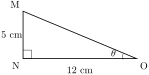
In the figure below, \(MN=5\, cm\,,NO=12\,cm \,\text{and} \, \angle MNO=90^\circ\text{.}\) Calculate:
  1. \(\displaystyle sin\,\theta\)
  2. \(\displaystyle cos\,\theta\)
Solution.
  1. \begin{align*} sin\,\theta=\amp \frac{\text{opposite}}{\text{hypotenuse}}\\ =\amp \frac{MN}{MO}\\ =\amp \frac{5}{MO} \end{align*}
    Recall:
    \begin{align*} MO^2=\amp 12^2+5^2 \\ =\amp 144+ 25\\ =\amp 169\\ MO= \amp 13\,cm \end{align*}
    Thus,
    \begin{align*} sin \,\theta= \amp \frac{5}{13}\\ =\amp 0.3846 \end{align*}
  2. \begin{align*} cos\,\theta=\amp \frac{\text{adjacent}}{\text{hypotenuse}}\\ =\amp \frac{NO}{MO} \\ =\amp \frac{12}{13} \\ = \amp 0.9231 \end{align*}

Example 2.4.14.

A ladder leans against a wall, forming a \(70^\circ\) angle with the ground. If the ladder is \(5\) meters long, how high does it reach on the wall?
Solution.
Using \(sin⁡\text{,}\) since we need the opposite side:
\begin{align*} sin\, 70^\circ=\amp \frac{\text{height}}{\text{hypotenuse}}\\ 0.9397=\amp \frac{\text{height}}{5}\\ \text{height}=\amp 5 \times 0.9397 \\ =\amp 4.6985 \,m \end{align*}
The ladder reaches \(4.6985 \,m\) up the wall.

Checkpoint 2.4.15. Exact Values of Sine and Cosine Without a Calculator.

Load the question by clicking the button below.

Checkpoint 2.4.16. Finding Ladder Height and Base Distance.

Load the question by clicking the button below.

Checkpoint 2.4.17. Finding Trigonometric Ratios in a Right Angled Triangle (2).

Load the question by clicking the button below.
\(\textbf{Exercises.}\)
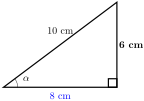
  1. In the figure given below,
    Find;
    1. \(\displaystyle sin\,\alpha\)
    2. \(\displaystyle cos\,\alpha\)
  2. A flagpole \(12\) meters tall casts a shadow of \(8\) meters on the ground.
    1. What is the angle of elevation of the sun?
    2. If the shadow increases to \(10\) meters, what will be the new angle of elevation?
  3. An airplane takes off at an angle of \(18^\circ\) to the ground. After flying \(500\) meters,
    1. How high is the airplane above the ground?
    2. How far has it traveled horizontally from the starting point?
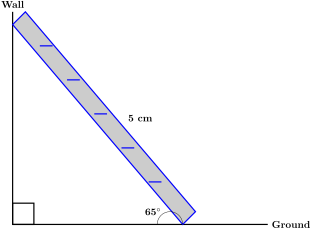
  4. A ladder \(5\) meters long leans against a vertical wall, making an angle of \(65^\circ\) with the ground as shown.
    1. How high does the ladder reach on the wall?
    2. How far is the base of the ladder from the wall?
\({\color{black} \textbf{Tables of Sines and Cosines}}\)

Activity 2.4.4.

\(\textbf{Work in groups}\)
What you require: A scientific calculator{for verification}, ruler and pencil, a printed table of sine and cosine values.
  1. Complete the Trigonometric Table.
    Fill in the missing values in the table below. Use a calculator to check your answers if needed.
    Angle(\({\color{black}^\circ}\)) \({\color{black} sin\,\theta}\) \({\color{black} cos\,\theta}\) \({\color{black} sin(90^\circ-\theta)}\) \({\color{black}cos(90^\circ-\theta)}\)
    \(0^\circ\) \(0.0000\) \(1.0000\)
    \(30^\circ\) \(0.5000\) \(1.0000\)
    \(45^\circ\)
    \(60^\circ\)
    \(45^\circ\) \(1.0000\) \(0.0000\)
  2. Analyze the following.
    • Compare \(sin\,\theta\) with \(cos(90^\circ-\theta)\text{.}\) What do you notice?
    • Compare \(sin\,\theta\) with \(cos(90^\circ-\theta)\text{.}\) What pattern do you see?
  3. Discuss your work with other groups in class.
\(\textbf{Extended Activity}\)

Activity 2.4.5.

\(\textbf{Work in groups}\)
What you require: Ruler, pencil, graph paper and a protractor.
  1. Draw a right triangle and label the opposite, adjacent and hypotenuse on all three sides and indicate the angle \(\theta\text{.}\)
  2. Measure both the length(\(cm\)) and angle \(\theta\text{.}\)
  3. Find \(sin(\theta),\,cos(\theta)\, \text{and}\, tan\,\theta \text{.}\)
  4. Divide \(sin(\theta) \,\text{by}\, cos(\theta)\) and record your answers on the table below.
    Side Measurement Length (\(cm\)) Ratio calculation Results
    Opposite \(sin(\theta)= \frac{\text{Opposite}}{\text{Hypotenuse}}\)
    Adjacent \(cos(\theta)= \frac{\text{Adjacent}}{\text{Hypotenuse}}\)
    Hypotenuse \(tan(\theta)= \frac{\text{Opposite}}{\text{Adjacent}}\)
  5. Repeat the procedure with a different right triangle.
  6. How are \(sin\,\theta,\, cos\,\theta,\, \text{and}\,tan\, \theta \) related?
  7. Discuss your work with other learners.
\(\textbf{Key Takeaway}\)
When you look at the tables of Cosine and sine, you will notice that,
  1. The values of their sines increase from \(0\) to \(1\text{.}\)
  2. The values of their cosines decrease from \(1\) to \(0\)
Therefore, the values in the difference column of cosine tables have to be subtracted and those in the difference columns of the sine tables have to be added.
Generally,
The values of sine and cosine ranges from \(0\) to \(1\)(\(0\leq \theta \leq 1\)).
As the angles increase from \(0^\circ\) to \(90^\circ\text{:}\)

Example 2.4.18.

Read the sine and cosine values of the following angles from the tables.
  1. \(\displaystyle 46^\circ\)
  2. \(\displaystyle 45.5^\circ\)
  3. \(\displaystyle 75.67^\circ\)
Solution.
  1. \(sin\,46^\circ\)
    Locate \(46^\circ\)in the sine and cosine table.
    Read the corresponding sine value. That is
    \begin{equation*} sin\,46^\circ= 0.7193\text{,} \end{equation*}
    \(cos\,46^\circ\)
    Read the corresponding cosine value. That is
    \begin{equation*} cos\,46^\circ= 0.6947\text{,} \end{equation*}
  2. \(sin\,45.5^\circ\)
    Locate \(45.5^\circ\)in the sine and cosine table.
    Read the corresponding sine value. That is
    \begin{equation*} sin\,45.5^\circ= 0.7133\text{,} \end{equation*}
    \(cos\,45.5^\circ\)
    Read the corresponding cosine value. That is
    \begin{equation*} cos\,45.5^\circ= 0.7009\text{,} \end{equation*}
  3. \(sin\,75.67^\circ\)
    Using decimal tables, \(sin\,75.6^\circ=0.9686\text{.}\) From the difference column under \(7\) reads \(0.0003\)
    Therefore,
    \begin{align*} sin\,75.67^\circ=\amp 0.9686+0.0003\\ = \amp 0.9689 \end{align*}
    \(cos\,75.67^\circ\)
    Using decimal tables, \(cos\,75.6^\circ=0.2487\text{.}\) From the difference column under \(7\) reads \(0.0012\)
    Therefore,
    \begin{align*} cos\,75.67^\circ=\amp 0.2487-0.0012\\ = \amp 0.2475 \end{align*}

Example 2.4.19.

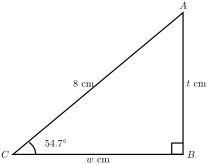
Find the value of \(t\) and \(w\) in the figure shown below (Using sine and cosine tables).
Solution.
Recall that;
\(sin\,\theta=\frac{\text{opposite}}{\text{Hypotenuse}}=\frac{\text{t}}{8}\)
\(cos\,\theta=\frac{\text{opposite}}{\text{Hypotenuse}}=\frac{\text{w}}{8}\)
Therefore,
\begin{align*} sin\,54.7^\circ=\amp \frac{\text{t}}{8}\\ 8\,sin\,54.7^\circ=\amp \text{t} \end{align*}
But, from tables of sine, \(sin\,54.7^\circ=0.8161\)
Therefore,
\begin{align*} \text{t} =\amp 8 \times 0.8161 \\ =\amp 6.5288 \end{align*}
\begin{align*} cos\,54.7^\circ=\amp \frac{\text{w}}{8}\\ 8\,cos\,54.7^\circ=\amp \text{w} \end{align*}
But, from tables of cosine, \(cos\,54.7^\circ=0.5779\)
Therefore,
\begin{align*} \text{w} =\amp 8 \times 0.5779 \\ =\amp 4.6232 \end{align*}
\(\textbf{Exercises}\)
  1. Find from tables the angle whose sine and cosine is:
    1. \(\displaystyle 0.4467\)
    2. \(\displaystyle 0.5875\)
    3. \(\displaystyle 0.0004\)
  2. Read from the tables the sine and the cosine of:
    1. \(\displaystyle 45.46^\circ\)
    2. \(\displaystyle 52^\circ\, 9^′\)
    3. \(\displaystyle 25^\circ\, 45^′\)
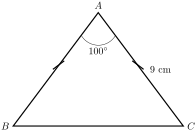
  3. The figure below shows an isosceles triangle in which \(AB = AC = 9\, cm\text{.}\) Angle \(BAC\) is \(100^\circ\text{.}\) Calculate the length of BC.