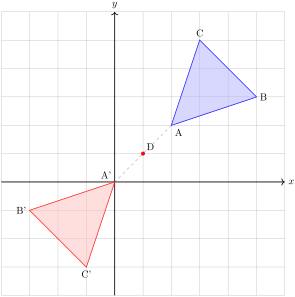
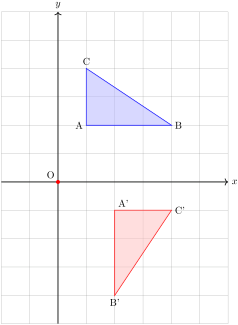
Under a
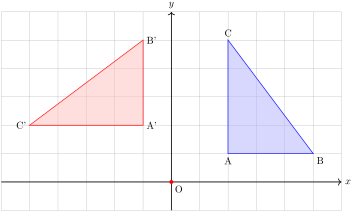
\(90^\circ\) anticlockwise rotation about the origin, the point
\((x,y)\) maps to
\((-y,x)\text{.}\) Applying this rule:
\begin{equation*}
A(2,1)\mapsto A'(-1,2)\text{,}
\end{equation*}
\begin{equation*}
\qquad B(5,1)\mapsto B'(-1,5)\text{,}
\end{equation*}
\begin{equation*}
\qquad C(2,5)\mapsto C'(-5,2).
\end{equation*}
Compare corresponding side lengths using the distance formula
\(d=\sqrt{(x_2-x_1)^2+(y_2-y_1)^2}\text{:}\)
\begin{align*}
AB \amp = \sqrt{(5-2)^2+(1-1)^2} = 3\\
A'B' \amp = \sqrt{(-1+1)^2+(5-2)^2} = 3
\end{align*}
\begin{align*}
BC \amp = \sqrt{(2-5)^2+(5-1)^2} = 5\\
B'C' \amp = \sqrt{(-5+1)^2+(2-5)^2} = 5
\end{align*}
\begin{align*}
CA \amp = \sqrt{(2-2)^2+(1-5)^2} = 4\\
C'A' \amp = \sqrt{(-1+5)^2+(2-2)^2} = 4
\end{align*}
Each pair of corresponding sides is equal:
\(AB=A'B'\text{,}\) \(BC=B'C'\) and
\(CA=C'A'\text{.}\)
Therefore, by
SSS,
\(\Delta ABC \equiv \Delta A'B'C'\text{.}\) The rotation has repositioned the triangle without changing its size or shape, so the object and image are
directly congruent.