Skip to main content\(\newcommand{\N}{\mathbb N} \newcommand{\Z}{\mathbb Z} \newcommand{\Q}{\mathbb Q} \newcommand{\R}{\mathbb R}
\newcommand{\lt}{<}
\newcommand{\gt}{>}
\newcommand{\amp}{&}
\definecolor{fillinmathshade}{gray}{0.9}
\newcommand{\fillinmath}[1]{\mathchoice{\colorbox{fillinmathshade}{$\displaystyle \phantom{\,#1\,}$}}{\colorbox{fillinmathshade}{$\textstyle \phantom{\,#1\,}$}}{\colorbox{fillinmathshade}{$\scriptstyle \phantom{\,#1\,}$}}{\colorbox{fillinmathshade}{$\scriptscriptstyle\phantom{\,#1\,}$}}}
\)
Subsection 2.7.12 Volume of a Pyramid
Activity 2.7.16.
-
🔹 Pictures of famous pyramids (e.g., Egyptian Pyramids, Mayan Pyramids)
🔹 Measuring tape or rulers (for estimating dimensions)
🔹 A small model or LEGO pyramid
A pyramid has a polygonal base and triangular faces that meet at the apex.
Example 2.7.38.
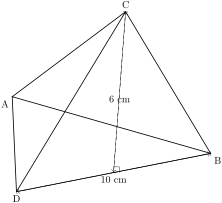
Find the volume of a square pyramid with a height of 6 cm and a side length of 10cm.
Solution.
Step 1: Select the correct formula and substitute the given values.
We are given b = 10 and H = 6, therefore
\begin{align*}
V = \amp \frac{1}{3} \times \text{base Area} \\
\text{Base Area} =\amp (10 \text{cm} \times 10 \text{cm}) \\
= \amp \frac {1}{3} \times (10 \times 10) \text{cm}^2 \times 6\text{cm} \\
= \amp 100 \text{cm}^2 \times 2 \text{cm} \\
= \amp 200 \text{cm}^3
\end{align*}
The volume of the square pyramid is
\(200 \text{cm}^3\text{.}\)
Example 2.7.39.
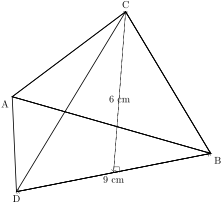
A square pyramid has a base of 6 cm × 6 cm and a height of 9 cm. Find it’s volume.
Solution.
\begin{align*}
V = \amp \frac{1}{3} \times \text{base Area} \times h\\
\text{Base Area} =\amp (6 \text{cm} \times 6 \, \text{cm}) \\
= \amp \frac {1}{3} \times (6 \times 6) \, \text{cm} \times 9 \, \text{cm}\\
= \amp \frac{1}{3} \times 36\, \text{cm}^2 \times 9 \, \text{cm} \\
= \amp 108 \, \text{cm}^3
\end{align*}
Example 2.7.40.
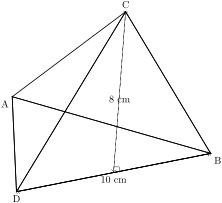
A triangular pyramid has a base of 5 cm × 8 cm and a height of 10 cm.
Solution.
\begin{align*}
V = \amp \frac{1}{3} \times \text{base Area} \times h\\
\text{Base Area} = \amp(\frac {1}{2} \times 5\, \text{cm}\times 8 \,\text{cm}) \\
= \amp \frac {1}{3} \times ( \frac {1}{2} \times 5 \,\text{cm} \times 8 \, \text{cm}) \times 10\, \text{cm} \\
= \amp \frac{1}{3} \times 20 \,\text{cm}^2 \times 10 \,\text{cm} \\
= \amp 66.67\, \text{cm}^3
\end{align*}
Example 2.7.41.
A pyramid has a rectangular base of 4 m by 6 m and a height of 12 m.
Solution.
\begin{align*}
V = \amp \frac{1}{3} \times \text{base Area} \times h\\
\text{Base Area} = \amp( \times 4\, \text{m}\times 6\,\text{m}) \\
= \amp \frac {1}{3} \times\times( 4 \,\text{m} \times 6 \,\text{m}) \times 12 \\
= \amp \frac{1}{3} \times 24\, \text{m}^2 \times 12 \,\text{m} \\
= \amp 96 \,\text{m}^3
\end{align*}
1. A pyramid has a square base with a side length of 6 cm. The height of the pyramid is 9 cm.
2. A pyramid-shaped tent has a rectangular base of 8 m by 6 m and a height of 5 m. Find the volume of air inside the tent.
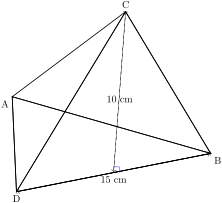
3. A pyramid has a square base with each side measuring 10 cm. The height of the pyramid is 15 cm.
4. A pyramid has a triangular base where the base of the triangle is 8 cm and the height of the triangle is 6 cm. The height of the pyramid is 10 cm.
5. A decorative garden pyramid has a square base with each side measuring 4 m. The height of the pyramid is 3 m.
Checkpoint 2.7.42.
Checkpoint 2.7.43.