Subsection 2.3.4 Rotational Symmetry
Rotational symmetry refers to the property of an object where it can be rotated (turned) around a central point and still look the same. In other words, if you spin the shape around its center, it matches its original position multiple times in a full \(360^\circ\) rotation.
Subsubsection 2.3.4.1 Rotational Symmetry of Plane Figures
Teacher Resource 2.3.18.
To assist your teaching, we have prepared lesson resources, aligned with this textbook and the CBC. The Lesson Plan links to syllabus learning outcomes and provides suggest time allocations. The Step-by-Step Guide provides more detailed guidance on how to teach the content, including suggested questions to ask learners, and possible answers.
Learner Experience 2.3.5.
Work in groups
Materials
-
A printed copy of the figure.
-
Pencils, push pin.
-
Constuction paper.
-
Pair of scissors.
Instructions
-
On a construction paper, trace and cut the figure above.
-
Place the tracing on top the printed copy and place a pin through their centre such that the tracing can rotate.
-
Manually rotate the tracing around the centre and note how many times the shape looks exactly the same in one full turn \((360^\circ).\)
Exploration 2.3.6. Rotating a Star.
You can explore the rotational symmetry of the star from Learner ExperienceΒ 2.3.5 by dragging the vertices below.
Key Takeaway 2.3.19.
Key Definitions:
-
Rotational symmetry: A shape has rotational symmetry if it looks the same after being rotated less than \(360Β°\) about its centre.
-
Order of rotational symmetry: The number of times a shape maps onto itself during a complete \(360Β°\) rotation.
-
Formula: \(\text{Order} = 360Β° \div \text{smallest angle of rotation}\)
-
All shapes have at least order 1.
The number of times the tracing of the star fits onto the printed copy in one complete turn is \(5 \) times. This is called the order of rotational symmetry, that is, the number of times the figure fits onto itself in one complete turn \((360^\circ).\)
When given a figure with the measure of the angle between the identical parts, the order of rotational symmetry can be computed as shown.
\begin{equation*}
\text{ Order of rotational symmetry} = \frac{360^\circ}{\text{angle between the identical parts}}
\end{equation*}
| Shape | Order of Rotational Symmetry | Angle of Rotation |
|---|---|---|
| Equilateral triangle | \(3\) | \(120Β°\) |
| Square | \(4\) | \(90Β°\) |
| Regular pentagon | \(5\) | \(72Β°\) |
| Regular hexagon | \(6\) | \(60Β°\) |
| Regular octagon | \(8\) | \(45Β°\) |
| Regular \(n\)-gon | \(n\) | \(360Β°/n\) |
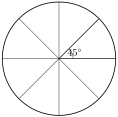
Example 2.3.21.
Find the order of rotational symmetry in the figure below.
Solution.
\begin{equation*}
\text{ Order of rotational symmetry} = \frac{360^\circ}{\text{angle between the identical parts}}
\end{equation*}
\begin{equation*}
\text{ Order of rotational symmetry} = \frac{360^\circ}{45^\circ}
\end{equation*}
\begin{equation*}
\text{ Order of rotational symmetry} = 8
\end{equation*}
In summary, a point \((p,q)\) which is rotated through the indicated angles about the origin is shown in the table below.
| \(\textbf{Angle of rotation}\) | \(0^\circ\) | \(+90^\circ\) | \(-90^\circ\) | \(180^\circ\) | \(-180^\circ\) | \(+270^\circ\) | \(+360^\circ\) | \(-360^\circ\) |
| \(\textbf{image of (p,q)}\) | \((p,q)\) | \((-q,p)\) | \((q,-p)\) | \((-p,-q)\) | \((-p,-q)\) | \((q,-p)\) | \((p,q)\) | \((p,q)\) |
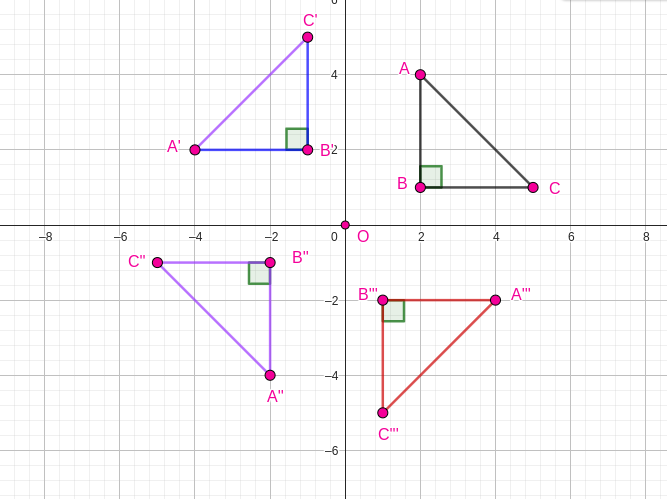
The figure below shows triangle \(ABC\) and its images after rotations about the origin with different angles of rotation (\(90^\circ\text{,}\) \(180^\circ\text{,}\) \(270^\circ\) and \(360^\circ\)).

| \(\textbf{Object}\) | \(A\, (2,4)\) | \(A\, (2,4)\) | \(A\, (2,4)\) | \(A\, (2,4)\) | \(A\, (2,4)\) | \(A\, (2,4)\) | \(A\, (2,4)\) | \(A\, (2,4)\) |
| \(B\, (2,1)\) | \(B\, (2,1)\) | \(B\, (2,1)\) | \(B\, (2,1)\) | \(B\, (2,1)\) | \(B\, (2,1)\) | \(B\, (2,1)\) | \(B\, (2,1)\) | |
| \(C\, (5,1)\) | \(C\, (5,1)\) | \(C\, (5,1)\) | \(C\, (5,1)\) | \(C\, (5,1)\) | \(C\, (5,1)\) | \(C\, (5,1)\) | \(C\, (5,1)\) | |
| \(\textbf{Angle of rotation}\) | \(0^\circ\) | \(+90^\circ\) | \(-90^\circ\) | \(+180^\circ\) | \(-180^\circ\) | \(270^\circ\) | \(+360^\circ\) | \(-360^\circ\) |
| \(\textbf{Image point}\) | \(A\, (2,4)\) | \(A'\, (-4,2)\) | \(A\, (4,-2)\) | \(A''\, (-2,-4)\) | \(A''\, (-2,-4)\) | \(A'''\, (4,-2)\) | \(A\, (2,4)\) | \(A\, (2,4)\) |
| \(B\, (2,1)\) | \(B'\, (-1,2)\) | \(B\, (1,-2)\) | \(B''\, (-2-1)\) | \(B''\, (-2,-1)\) | \(B'''\, (1,-2)\) | \(B\, (2,1)\) | \(B\, (2,1)\) | |
| \(C\, (5,1)\) | \(C'\, (-1,5)\) | \(C\, (1,-5)\) | \(C''\, (-5-1)\) | \(C''\, (-5,-1)\) | \(C'''\, (1,-5)\) | \(C\, (5,1)\) | \(C\, (5,1)\) |
\(\textbf{Rotation of Points by a Given Angle Around a Specified Center}\)
Consider a point \(A\, (4,3)\) .We are required to finding the coordinates of its image after a Rotation taking the centre to be \((1,2)\) and angle of rotation to be \(90^\circ\) ;
Given the point \((4,3)\) and the centre of rotation \((1,2)\text{,}\) To obtain this point \((0,5)\) without a graph, We follow this steps;
\begin{align*}
\text{x-coordinate}= \amp 1-(3-2)=0\\
\text{y-coodinate}= \amp 2+(4-1)=5\\
\text{Point of the image}= \amp (0,5)
\end{align*}
from the given points, for point \((4,3)\text{,}\)We let \(p=4\) and \(q=3\) and for the given centre \((1,2)\) we let \(x=1\) and \(y=2\text{.}\)
In general a point \((p,q)\) rotated through 90Β° about the centre \((x,y)\) is mapped on to the point \((x-(q-y)\, ,y+(p-x))\)
Considering the same point \(P\text{,}\) but now the angle of rotation to be \(180^\circ\text{;}\) To find the coordinates of its image we follow the following steps:
Given the point \((4,3)\) and the centre of rotation \((1,2)\text{,}\) To find the point of the image we follow the following steps;
\begin{align*}
\text{x-coordinate}= \amp (2 \times 1) -4\\
= \amp -2\\
\text{y-coordinate}= \amp (2 \times 2)-3\\
= \amp 1\\
\text{Point of the image}= \amp (-2,1)
\end{align*}
In general a point \((p,q)\) rotated through 180Β° about the centre \((x,y)\) is mapped on to the point \((2x-p\, ,2y-q)\)
Example 2.3.25.
A triangle \(ABC\) with coordinates \(A\,(2,1)\text{,}\) \(B\, (3,2)\) and \(C\, (3,4)\) is rotated through the centre and angle of \(90^\circ\) in a clockwise direction.Find the coordinates of its image
Solution.
Since triangle \(ABC\) is rotated in a clockwise direction with an angle of \(90^\circ\) through the origin, then the angle of rotation is \(-90^\circ\)
According to the rule, If we have our points \((p,q)\) which will be mapped to \((q,-p)\) if rotated through the centre and angle of rotation is \(-90^\circ\)
Therefore, we will individually apply the rotation formula to all three given points.
\begin{align*}
A (2,1) \rightarrow\amp A'(1,-2)\\
B (3,2) \rightarrow\amp B'(2,-3)\\
C (3,4) \rightarrow\amp C'(4,-3)
\end{align*}
The coordinates of triangle \(A'B'C'\) are \(A'\, (1,-2)\text{,}\) \(B'\, (2,-3)\) and \(C'\, (4,-3)\)
Checkpoint 2.3.26.
Checkpoint 2.3.27.
Exercises Exercises
1.
A point \(P\, (4,3)\) maps onto \(P'\, (-1,4)\) under a rotation R centre \((1,1)\text{.}\) Find the angle of rotation.
2.
Describe the rotation which maps the rectangle whose verticies are \(P\, (2,2)\text{,}\) \(Q\, (6,2)\text{,}\) \(R\,(6,4)\) and \(S\, (2,4)\) onto a rectangle whose verticies are \(P'\,(2,-2)\text{,}\) \(Q'\,(2,-6)\text{,}\) \(R'\,(4,-6)\) and \(S'\, (4,-2)\)
3.
Give the coordinates of the image of each of the following points when rotated through \(180^\circ\) in a clockwise direction about \((2,1)\)
-
\(\displaystyle (4,2)\)
-
\(\displaystyle (-2,2)\)
-
\(\displaystyle (4,4)\)
-
\(\displaystyle (-2,-1)\)
-
\(\displaystyle (-3,2)\)
4.
Find the coordinates of the verticies of the image of a triangle whose verticies are \(P\, (-4,6)\text{,}\) \(Q\, (-4,2)\) and \(R\, (-2,2)\) when rotated about the origin through:
-
\(\displaystyle -90^\circ\)
-
\(\displaystyle -180^\circ\)
-
\(\displaystyle 270^\circ\)
5.
The parallelogram whose verticies are \(A\, (4,4)\text{,}\) \(B\, (8,4)\text{,}\) \(C\, (2,2)\) and \(D\, (6,2)\) is rotated to give an image whose verticies are \(A'\, (4,-2)\text{,}\) \(B'\, (4,-6)\text{,}\) \(C'\, (2,0)\) and \(D'\, (2,-4)\text{.}\) Find the centre and angle of rotation.
6.
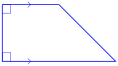
State the order of symmetry in the figures below.
7.
Find the order of rotational symmetry in the letters of the alphabet.
Subsubsection 2.3.4.2 Rotational Symmetry of Solids
Curriculum Alignment
Teacher Resource 2.3.28.
To assist your teaching, we have prepared lesson resources, aligned with this textbook and the CBC. The Lesson Plan links to syllabus learning outcomes and provides suggest time allocations. The Step-by-Step Guide provides more detailed guidance on how to teach the content, including suggested questions to ask learners, and possible answers.
Learner Experience 2.3.7.
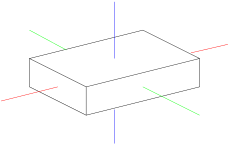
Here is an activity to explore on axis of rotation of a box (cuboid).
Materials
Instructions
-
Measure and note down the cuboidβs dimensions (length, width, height).
-
Mark the centre of box on each face using a pencil and make holes using pins through the centres.
-
Put the strings through the holes such that they appear as shown.
-
Suspend the cuboid and spin it around each of the strings and observe the alignment of the cuboid. Does the box appear to be the same as you rotate?
Exploration 2.3.8. Rotating a Square Prism.
You can explore the rotational symmetry of the square prism from Learner ExperienceΒ 2.3.5 by dragging the sliders below.
Key Takeaway 2.3.29.
-
A solid has rotational symmetry if it can be rotated about a fixed straight line and still appears to be the same.
-
The straight line around which the object is rotated is called axis of rotation. In the activity, the strings represents the axes of rotational symmetry for the cuboid.
Example 2.3.30.
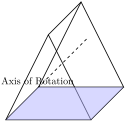
Find the axes of rotation for a triangular pyramid whose cross-section is an equilateral triangle.
Solution.
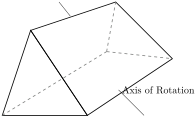
The figure below shows a triangular prism whose cross-section is an equialteral triangle.
The axis of rotation passes through the traingular face. Therefore, the order of rotation through this axis is \(3.\)
The prism also has other \(3\) axes of rotation with each axis having \(2\) orders of rotational symmetry as shown in the figure below:
Example 2.3.31.
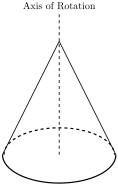
Find the axis of rotation of a cone. What is the order of rotational symmetry?
Checkpoint 2.3.32.
Exercises Exercises
1.
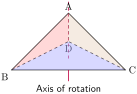
Find the other axes of rotation and order of rotational symmetry of the regular tetrehedron given one of the axes from \(A\) and passing at the center of the face \(BDC.\text{.}\)
2.
Find the axes of rotation and order of rotational symmetry of a triangular base pyramid whose base is: