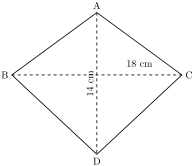
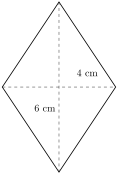
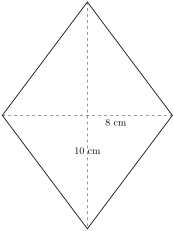
Subsection 2.5.2 Area of Quadrilaterals.

Activity 2.5.6.

  • \(\displaystyle \textbf{Materials needed:}\)
  • Grid paper or geoboards
  • Markers or colored pencils for highlighting shapes
  • Printable worksheets (with grid paper and templates for quadrilaterals)
  • RulersPencils and erasers
  • Protractors (for measuring angles)
  • Scissors (if cutting shapes from paper)
    1. Prepare the worksheets with grid paper or geoboard templates and space for calculations.
    2. Prepare cut-out shapes of different quadrilaterals (square, rectangle, parallelogram, rhombus, trapezoid, etc.), if using physical materials.
    3. Set up a projector or board to display instructions, the properties of quadrilaterals, and the step-by-step breakdown.
  • Take that cut-out shapes or access to digital templates of various quadrilaterals. Sort the shapes based on their properties:
    Number of parallel sides
    Number of equal sides
    Angles (right angles or acute/obtuse angles)
    Symmetry
  • For each quadrilateral, discuss with your patner and record:
    1. The type of quadrilateral.
    2. Whether it has parallel sides or right angles.
    3. The number of sides of equal length.
    Learners should be able to classify quadrilaterals by their properties.
\(\textbf{Key Takeaway}\)
\(\textbf{Properties of Quadrilaterals.}\)
🔹 Below are the key types of quadrilaterals and their properties:
Quadrilateral Properties
Parallelogram
  • Opposite sides are parallel and equal.
  • Opposite angles are equal.
  • Diagonals bisect each other.
Rectangle
  • Opposite sides are equal and parallel.
  • All angles are \(90^\circ\text{.}\)
  • Diagonals are equal and bisect each other.
Square
  • All sides are equal.
  • All angles are \(90^\circ\text{.}\)
  • Diagonals are equal, bisect each other at \(90^\circ\text{,}\) and are perpendicular.
Rhombus
  • All sides are equal.
  • Opposite angles are equal.
  • Diagonals bisect each other at \(90^\circ\).
Trapezium (Trapezoid)
  • One pair of opposite sides is parallel.
  • Non-parallel sides are called legs.
  • If legs are equal, it is called an isosceles trapezium.
Kite
  • Two pairs of adjacent sides are equal.
  • One pair of opposite angles is equal.
  • Diagonals intersect at \(90^\circ\), and one diagonal bisects the other.
♦ Can you remember the formula for finding the area of any Quadrilateral in the table above?
♦ If yes which one and what is the formula?
♦ Kindly write it down exchange your answers with your deskmate and see if their answers are correct.

Example 2.5.5.

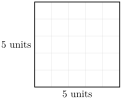
Find the area of a rectangular classroom measuring 6m by 4m .
Solution.
\begin{equation*} \text{Area of a rectangle} = Length \times Width \end{equation*}
\begin{equation*} = 6\text{m} \times 4\text{m} \end{equation*}
\begin{equation*} = 24\text{m}^2 \end{equation*}

Subsubsection 2.5.2.1 Area of a Parallelogram

Activity 2.5.7.

\(\textbf{Exploring the Area of a parallelogram}.\)
Materials needed.
Steps for the activity.
  1. Draw a parallelogram.
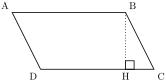
    1. On graph paper, draw a parallelogram with a given base and height. Label the vertices A, B, C and D.
    2. Use a pair of campus to drop a perpendicular. Lable the intersection point on line CD as H representing the height of the parallelogram.
    3. Use a ruler to measure and compare opposite sides (AB and CD, BC and AD. )
\(\textbf{Key Takeaway}\)
A parallelogram is a quadrilateral whose opposite sides are equal and parallel. Which other quadrilateral has similar characteristics like these?
🔹 The area of a parallelogram is given by: \(Base \times Height\text{:}\)
\begin{align*} \text{A } = \amp \, b \times h \end{align*}
where \(b\) is the base and \(h \) the perpendicular distance between the given pair of parallel sides.
🔹 The area of a parallelogram given the base is 28cm and the height 8cm is:
\begin{align*} \text{A} = \amp b \times h \\ = \amp 28\text{cm} \times 8\text{cm}\\ = \amp 224 \, \text{cm}^2 \end{align*}

Example 2.5.6.

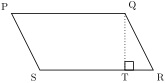
  • A parallelogram PQRS is of sides 28cm and 7cm. If \(\angle\) QRS is \(75^\circ\text{.}\)
    a. Find the height the parallelogram using sine rule.
    b. Find the area of the parallelogram.
Solution.
From Q drop a perpendicular to meet RS at T considering \(\angle QRS\text{.}\)
\(\text{Height (QT)} = \text{Hypotenuse(BC)} \times \text{sin} \theta\)
\begin{align*} QT = \amp 7 \, \text{sin} 75^\circ \\ = \amp 6.76 \, \text{cm} \end{align*}
b.
\begin{align*} \text{Area of PQRS} = \amp RS \times PT \\ = \amp 28 \times 7 \, \text{sin} \, 75^\circ \\ = \amp 189.32 \, \text{cm}^2\\ \amp \end{align*}
The area of the parallelogram is \(189.32 \, \text{cm}^2.\)
\(\textbf{Exercise}\)
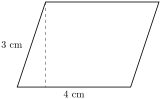
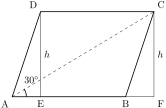
1. Find the area of the parallelogram given below.
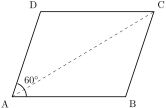
2. The parallelogram shown below has diagonals. Find the length of the diagonal.
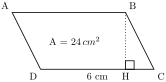
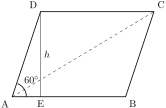
3. Find the missing height of the parallelogram ABCD given the area is 24 cm² and base is 6 cm.
4. A construction company is building a parallelogram-shaped floor with a base of 10 meters and height of 6 meters. Find the area of the floor.
5. A billboard has a parallelogram shape with a base of 12 feet and a height of 5 feet. Find the area of the billboard.
6. A solar panel is shaped like a parallelogram with a base of 8 meters and an inclined height of 4 meters. Find it’s surface area.

Subsubsection 2.5.2.2 Area of a Rhombus

Activity 2.5.8.

\(\textbf{Materials Needed:}\)
Ruler, Protractor, Pencil, Graph paper, Scissors (optional) and String or thread (optional)
  • Draw a Rhombus Using a ruler, draw a quadrilateral with all sides equal in length. Make sure the opposite angles are equal. Label the vertices as A, B, C, D in order.
  • Measure the Sides using a ruler to confirm that all four sides are of equal length.
  • Measure the angles using a protractor to measure each of the interior angles. Observe: Opposite angles should be equal.
  • Draw the Diagonals:
    Draw diagonal AC and diagonal BD.
    Measure their lengths and angles at the intersection point.
    Observe: Diagonals bisect each other at 90°, and they are not equal.
  • Cut and Fold (Optional):
    Cut out the rhombus and fold it along both diagonals.
    Observe the symmetry and how the diagonals act as lines of symmetry.
\(\textbf{Discussion Questions}\)
  1. What do you notice about the sides and angles of the rhombus?
  2. How do the diagonals interact with each other?
  3. What makes a rhombus different from a square or a general parallelogram?
\(\textbf{Key Takeaway}\)
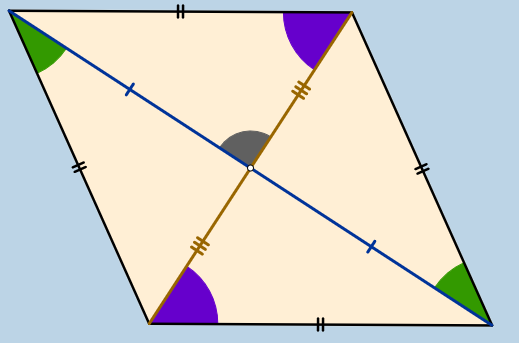
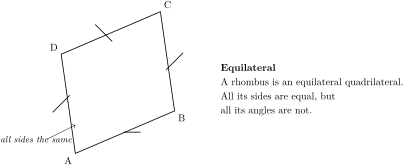
A \(\textbf{rhombus}\) is an equilateral quadrilateral. All it’s sides are of \(\textbf{equal length}\text{,}\) But all it’s angles are not. All its sides are equal and the diagnols bisect at \(90 ^\circ\text{.}\) Which other quadrilateral has all its sides equal?
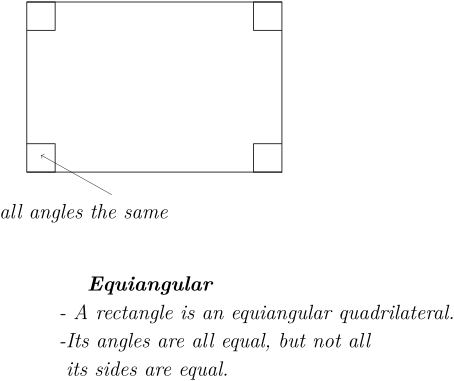
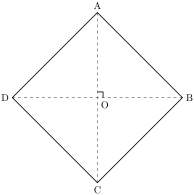
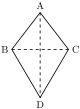
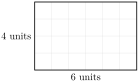
Compare the rhombus with the rectangle below.
\(\textbf{ Properties of a Rhombus}\)
  • All sides are equal in length.
  • Opposite angles are equal.
  • Diagonals bisect each other at right angles.
  • Diagonals bisect the interior angles.
  • Some examples of a rhombus are Tiles or patterns in flooring, or The shape of playing cards (diamonds suit).

Example 2.5.7.

A rhombus has a diagonal of 10 cm and another diagonal of 24 cm. Find:
i) The area of the rhombus.
ii).The length of one side of the rhombus.
Solution.
i.
One diagonal = 10 cm
Another diagonal = 24 cm
\begin{align*} \text{Area} = \amp \frac{1}{2 }\times d_1 \times d_2\\ = \amp \frac{1}{2} \times 10\, \text{cm} \times 24\, \text{cm} \\ = \amp 120 \, \text{cm}^2 \end{align*}
ii. Length of One Side of the Rhombus
In a rhombus, the diagonals bisect each other at 90°. That means each side of the rhombus forms a right-angled triangle with half of each diagonal.
Let’s find the length of one side using the Pythagorean Theorem.
Each side of the rhombus is the hypotenuse of a right triangle with legs:
\begin{align*} \text{Half of AC } = \amp \frac{10}{2} = 5\, \text{cm}\\ \text{Half of BD } = \amp \frac{24}{2} = 12\, \text{cm}\\ \text{Side} = \amp \sqrt{(5)^2 + (12)^2} \\ = \amp \sqrt{25\,\text{cm} + 144\,\text{cm}} \\ = \amp \sqrt{169 \,\text{cm}}\\ = \amp 13\,\text{cm} \end{align*}
\(\textbf{Exercise}\)
  1. A rhombus has diagonals measuring 16 cm and 30 cm.
    a) Find the area of the rhombus.
    b) Find the side length of the rhombus.
  2. A diamond-shaped road sign is a rhombus with a diagonal of 40 cm and another diagonal of 60 cm. Find:
    (a) The area of the sign.
    (b) The length of one side of the sign.
  3. The perimeter of a rhombus is 48 cm. Find the length of one side.
  4. A car logo is shaped like a rhombus. The diagonals measure 14 cm and 10 cm. Find its area.
  5. A rhombus has one of its angles measuring 60°. Find the other three angles.
  6. A tiling design on a floor is made of rhombus-shaped tiles. Each tile has diagonals of 18 cm and 24 cm.
    (a) Find the area of one tile.
    (b) If 20 such tiles cover a portion of the floor, what is the total area covered?

Subsubsection 2.5.2.3 Area of a Trapezium

Activity 2.5.9.

\(\textbf{materials needed: }\)
Materials: Ruler, Protractor, Pencil, Graph paper, Scissors (optional) and Calculator (optional)
  • Draw a Trapezium:
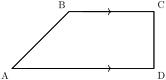
    On graph paper, draw a quadrilateral with one pair of opposite sides parallel (e.g., AB ∥ CD).
    Make sure the other pair (AD and BC) are not parallel.
    Label the trapezium as ABCD.
  • Identify the Parts:
    Label the bases (parallel sides).
    Label the legs (non-parallel sides).
    Draw the height (perpendicular distance between the two bases).
  • Now, let’s break it down algebraically:
    Imagine the Area of a Rectangle: If we could transform the trapezium into a rectangle, the area of that rectangle would be the \(\textbf{average of the two bases times the height}\) . This works because the average length of the two parallel sides is a \(\textbf{"representative" length for the trapezium,}\) and multiplying it by the \(\textbf{height}\) gives us the \(\textbf{correct area}\text{.}\)
  • Mathematical Expression:
    The average length of the two parallel sides is given by
    \begin{align*} \text{Average of bases}= \amp \frac{Base_1 + Base_2}{2} \end{align*}
    Therefore, the area of the trapezium is:
    \begin{align*} Area =\amp \text{Average of bases} \times \text {height} \\ = \amp \frac{Base_1 + Base_2}{2} \times \text{height} \end{align*}
    This is the formula for the area of a trapezium.
  • \(\displaystyle \textbf{Understanding the Formula}\)
  • The bases are the lengths of the parallel sides.
    The height is the perpendicular distance between the two bases.
    The average of the bases gives us a "typical length" for the trapezium, and when multiplied by the height, it gives the area, just like how you would calculate the area of a rectangle.
\(\textbf{Key Takeaway}\)
A trapezium is a four-sided polygon (quadrilateral) that has one pair of opposite sides that are parallel. These parallel sides are called the bases of the trapezium. The other two sides are not parallel and are called the legs.
\(\textbf{Proterties of a trapezium}.\)
  • A trapezium looks like a bridge. Suggest other three real life examples of trapeziums.
  • One pair of sides are parallel (they never meet).
  • The height is the straight-up distance between the parallel sides.
  • The angles inside add up to 360°.
\(\textbf{Study Questions.}\)
  1. Define a trapezium in your own words.
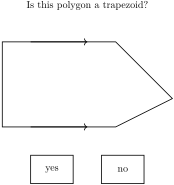
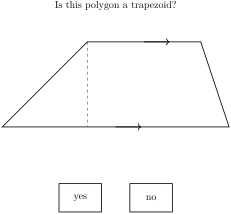
  2. Identify which of the following shapes are trapeziums giving reasons why:
    \(a.\) A square
    \(b.\) A shape with one pair of parallel sides
    \(c\) A rectangle
    • In the images provided below read the question and tick the appropriate answer.
  3. Draw a trapezium and label its bases, legs, and height.
  4. How many angles does a trapezium have? What is the sum of all interior angles?
  5. What is the difference between a trapezium and a parallelogram?
The area of a trapezium is given by the formula:
\begin{align*} A =\amp \frac{{a+b}}{2} \times {h} \end{align*}
where\(a \) and \(b\) are the two parallel sides and \(h \) height.

Example 2.5.8.

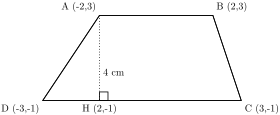
Calculate the area of the figure below.
Solution.
The given figure is a trapezium with the following vertices:
  • \(\displaystyle A(-2,3)\)
  • \(\displaystyle B(2,3)\)
  • \(\displaystyle C(3,-1)\)
  • \(D(-3,-1)\)
    From the diagram, we observe:
  • The two parallel bases are ABAB and DCDC.
  • The height is given as 4 cm, which is the perpendicular distance between the parallel bases.
Step 1: Determine the lengths of the bases
Length of \(AB:\)
\begin{align*} AB = |x_1-x_2| \amp = |2-(-2| = |2+2| = 4 \, \text{cm} \end{align*}
Length of \(DC:\)
\begin{align*} DC = |x_1-x_2| \amp = |3-(-3| = |3+3| = 6 \, \text{cm} \end{align*}
Step 2: Use the trapezium area formula.
The area of a trapezium is given by:
\begin{align*} \text{Area} = \amp \frac{1}{2} \times (\text{Base}_1 + \text{Base}_2) \times \text{Height} \end{align*}
Substituting the values:
\begin{align*} A = \amp \frac{1}{2} \times (4+6) \, \text{cm} \times 4 \, \text{cm}\\ = \amp \frac{1}{2} \times 10 \, \text{cm} \times 4 \, \text{cm} \\ = \amp 20 \, \text{cm}^2 \end{align*}
THe area of the trapezium is \(20 \, \text{cm}^2\)
\(\textbf{Exercise}\)
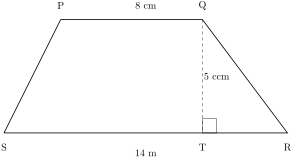
\(1. \)A trapezium has a height of 5 cm, the top base is 8 cm and the bottom base is 14 cm. Find its area.
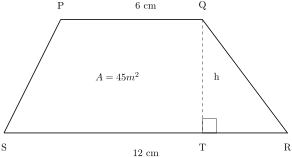
2. a) \(\) The bases of a trapezium are 12 cm and 6 cm and its area is 45 cm². Find the height.
b) Find the missing angle in a trapezium where three angles are 70°, 85° and 95°.
c) A trapezium has equal non-parallel sides (legs). What special type of trapezium is this?
d) The parallel sides of a trapezium are 20 m and 30 m and its height is 12 m. Find its area.
\(3.\) A trapezium-shaped farm has a shorter base of 150 m, a longer base of 300 m and a height of 200 m. Find the area of the farm.
\(4.\) A car window is shaped like a trapezium with a height of 50 cm, the top base is 60 cm and the bottom base is 80 cm. Find the area of the window.
\(5.\) A trapezoidal table has a top base of 1.2 m, a bottom base of 1.8 m and a height of 0.75 m. What is its surface area?

Subsubsection 2.5.2.4 Area of a Kite

Activity 2.5.10. Constructing a Kite Using Geometry Tools.

How to construct a kite accurately using a ruler, compass, and protractor.
  • Materials needed:
  • Graph paper or plain paper
  • Ruler , Compass, protractor, pencil and eraser
  • Follow this steps.
    \(\textbf{Step 1: Drawing the diagnol.}\)
  • Draw a vertical line of length 10 cm (this will be the longer diagonal, \(d_1\)).
  • Label the midpoint of this line as O.
    \(\textbf{Step 2: Draw the Perpendicular Diagonal}\)
  • At O, use a protractor to draw a perpendicular line.
  • Mark \(4 \, \text{cm} \) on each side of \(O\) (total shorter diagonal \(d_2 = \)\(8cm\text{.}\)
    \(\textbf{Step 3: Mark the Kite's Vertices}\)
  • Label the four points where the diagonals intersect as A, B, C, and D.
  • Connect \(\textbf{A}\) to \(\textbf{B}\text{,}\) \(\textbf{B}\) to \(\textbf{C}\text{,}\) \(\textbf{C}\) to \(\textbf{D}\) and \(\textbf{D}\) to \(\textbf{A}\text{.}\)
    \(\textbf{Step 3:Check Properties }\)
  • Measure adjacent sides to ensure two pairs are equal.
  • Verify opposite angles (one pair should be equal)
  • Confirm diagonals are perpendicular.
Design your own kite patterns on graph paper and justify why their design would be aerodynamic and stable in the air.
\(\textbf{Key Takeaway\)
A kite is a quadrilateral with two pairs of adjacent sides equal in length and one pair of opposite angles equal.
A kite can be analyzed using coordinate geometry when its vertices are given on a Cartesian plane.
Since the diagonals are perpendicular, right-angled triangles are formed.
We can use trigonometric ratios (sine, cosine, tangent) to find missing angles and side lengths.
\(\textbf {Finding Angles Using Trigonometry} \)
If a kite has diagonals \(d_2\) and \(d_2\) we can find interior angles using:
\begin{align*} \text{sin}\, \theta = \amp \frac{\text{ opposite side}} {\text{hypotenuse}}\\ \text{cos}\, \theta = \amp \frac{\text{ adjacent side}} {\text{hypotenuse}}\\ \text{tan}\, \theta = \amp \frac{\text{ opposite side}} {\text{adjacent side}} \end{align*}
If a kite has diagonals 14 cm and 10 cm, then each right-angled triangle within the kite has:
\begin{align*} \text{Base}= \frac{d_1} {2}=\amp \frac{14}{2} \\ \amp \\ = \amp 7 \, \text{cm} \\ \text{Height} = \frac{d_2}{2} =\amp \frac{10}{2} \\ \amp \\ = \amp 5 \, \text{cm} \end{align*}
The angle θθ between the diagonal and a side can be found using:
\begin{align*} \text{tan} \, \theta = \amp \frac{5}{7} \\ \theta = \amp \text{tan}^{-1} \, 0.7143\\ = \amp 35.5^ \circ \end{align*}

Example 2.5.9.

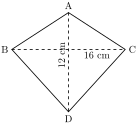
A kite whose has the diagonals are 16 cm and 12 cm.
a) Find the area of the a kite
b) If one pair of adjacent sides is 10 cm, find the perimeter of the kite.
c) Find the angles of the kite using trigonometry.
Solution.
\(\textbf{ Find the Area of the Kite}\) Let \(d_1 = 16 \, \text{cm}\) and \(d_2 = 12 \, \text{cm}\)
\begin{align*} \textbf{Area} = \amp \frac{1}{2} \times d_1 \times d_2 \end{align*}
\(\text{substitute} \, d_1 = 16 \, \text{cm and } d_2 = 12 \, \text{cm}\)
\begin{align*} \text{Area} = \amp \frac{1}{2} \times 16 \, \text{cm } \times 12 \, \text{cm} \\ = \amp \frac{192}{2} \, \text{cm}^2 \\ = \amp 96 \, \text{cm}^2 \end{align*}
(b) Find the Perimeter of the Kite. The diagonals bisect each other at right angles, so each half-diagonal forms a right-angled triangle. \(\frac{d_1}{2} = 6\text { cm }\) and \(\frac{d_2}{2} = 8 \text{cm}\) Using the Pythagoras Theorem:
\begin{align*} \amp a^2 + b^2 = c^2\\ = \amp 6^2 + 8^2\\ c^2 = \amp 36 + 64\\ \sqrt{c^2} = \amp \sqrt{100} \\ c = \amp 10 \, \text{cm} \end{align*}
Since a kite has two pairs of equal sides, the perimeter is:
\begin{align*} P = \amp 2(a+b) \\ = \amp 2(10 + 10) \, \text{cm}\\ = \amp 40 \, \text{cm} \end{align*}
(c) Finding the Angles Using Trigonometry. Using trigonometry in the right-angled triangle:
\begin{align*} \text{tan} \, \theta = \amp \frac{\text{Opposite}}{\text{adjacent}} \\ = \amp \frac{6}{8} \\ \theta = \amp \text{tan}^{-1} \, 0.75 \\ \amp \\ \theta = \amp 36.87^\circ \end{align*}
A kite is a quadrilateral, meaning it has four angles.
The sum of the interior angles of any quadrilateral is given by the formula:
Sum of Interior Angles=\((n-2) \times 180^\circ\)
where \(n = 4\)(since a kite has 4 sides) \((4-2) \times 180^\circ \) \(= 2 \times 180^\circ\) \(= 360^\circ\)
Since the kite is symmetric, the larger angle ( \(\alpha \) )is
\begin{align*} = \amp 360^\circ - 2 \theta \\ = \amp 360^\circ - 2 (36.87)^\circ \\ = \amp 360^\circ - 73.74 ^\circ \\ 2(\alpha)= \amp 286.26 ^\circ\\ \alpha = \amp 143.13^\circ \end{align*}
The angles of the kite are:\(143^\circ, \, 143.13^\circ, \, 36.87^\circ \, \text{and} \, 36.87^\circ\)
\(\textbf{Exercise}\)
1. Find the area of the kite given below.
1. A kite has diagonals of length 10 cm and 8 cm. Find its area.
3. A playground has a kite-shaped design with diagonals measuring 15 meters and 12 meters. Find its area.
4. A rescue helicopter designates an emergency landing zone in the shape of a kite. The diagonals measure 60 m and 45 m. Calculate the available landing space.
5. A playground has a kite-shaped design with diagonals measuring 15 meters and 12 meters. Find its area.A playground has a kite-shaped design with diagonals measuring 15 meters and 12 meters. Find its area.
6. Engineers are designing a kite-shaped solar panel with diagonals of 30 m and 18 m. What is the total solar-collecting area?
7. A relief team sets up a kite-shaped safe zone for disaster survivors. The diagonals measure 50 m and 40 m. What is the area available for the survivors?