To assist your teaching, we have prepared lesson resources, aligned with this textbook and the CBC. The Lesson Plan links to syllabus learning outcomes and provides suggest time allocations. The Step-by-Step Guide provides more detailed guidance on how to teach the content, including suggested questions to ask learners, and possible answers.
Look around your surroundings and find two circular objects that can fit inside each other (e.g., two different-sized bowls, two bottle caps, or two CDs).
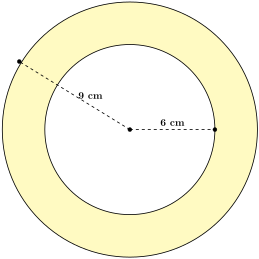
Situation: Imagine a running track built around a circular field. The track has an inner boundary (smaller circle) and an outer boundary (larger circle). The track itself forms an annulus.
Exploration2.6.5.Exploring the Area of an Annulus.
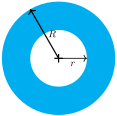
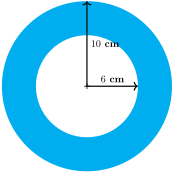
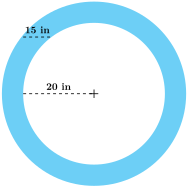
An annulus is the region between two concentric circles—one larger circle and one smaller circle that share the same center. In this exploration, you will use sliders to change the outer radius and inner radius of the circles. As the radii change, observe how the shaded ring (the annulus) changes and how its area is calculated.
Use the interactive to investigate the following questions:
Start with an outer radius of about \(8\) and an inner radius of about \(4\text{.}\) How does the shaded annulus compare visually to the areas of the two circles?
Try making the inner radius very small. What does the annulus begin to look like? What does this suggest about the relationship between the annulus area and the area of a circle?
Can you write a formula for the area of an annulus using the radii \(R\) and \(r\text{?}\) Compare your formula with the calculations shown in the panel.
If two annuli have the same difference between their radii (for example, \(R - r = 2\)), do they always have the same area? Use the sliders to test your conjecture.
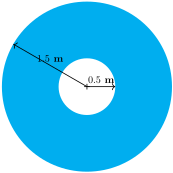
A circular tabletop has a hole in the middle for an umbrella. The outer radius of the table is \(1.5 \,m\text{,}\) and the hole has a radius of \(0.5 m\) as shown below.
A circular swimming pool has an outer radius of \(8\) meters, and a smaller circular island is in the center with a radius of \(2\) meters. Find the area of the water surface.