Subsection 2.6.4 Area of a Segment of a Circle

Activity 2.6.6.

\(\textbf{Work in groups}\)
What you require;
  1. Use a compass to draw a circle of radius \(r\text{.}\)
  2. Draw a chord across the circle using a ruler.
  3. Use a protractor to measure the angle subtended at the center by the chord.
    Shade the segment formed
  4. Find the area of the segment part and record your results.
  5. Perform the same process for different chords and angles eg \(70^\circ, \,90^\circ,\,120^\circ,\,150^\circ...\)
  6. Discuss your work with other learners in your class.
\(\textbf{Key Takeaway}\)
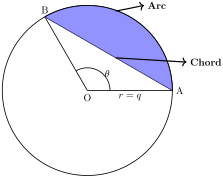
A \(\textbf{segment} \) is the region of a circle bounded by a chord and an arc as shown in the figure below.
The shaded region is a segment of the circle with centre \(O\) and the radius \(q\)
\(\textbf{Area of a segment of a circle.}\)
The area of a segment is given by;
\(\text{Area of a segment}=\text{Area of sector}-\text{Area of triangle}\)

Example 2.6.14.

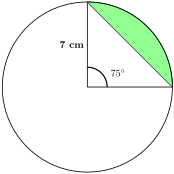
A chord in a circle of radius \(7\, cm\) subtends an angle of \(75^\circ\) at the center as shown below. Find the area of the segment.
Solution.
To find the area of the segment, you the area of the triangle and subtract from the area of the sector.
\(\textbf{Area of sector }\)
\(A= \frac{\theta}{ 360} \times \pi r^2\)
\begin{align*} A=\amp \frac{75^\circ}{ 360} \times \frac{22}{7} \times 7^2 \\ =\amp \frac{5}{24} \times \frac{22}{7} \times 49\\ =\amp \frac{385}{12} \\ =\amp 32.0833 \,cm^2 \end{align*}
\(\textbf{Area of a triangle }\)
\(A= \frac{1}{2} ab sin \,\theta\)
Where \(a=7\,cm \,\text{and} \,b= 7 \,cm\)
\begin{align*} A=\amp \\ =\amp \frac{1}{2} \times 7 \times 7\times \times sin \,75^\circ\\ =\amp \frac{1}{2} \times 49 \times sin \,75^\circ\\ =\amp 23.6652 \,cm^2 \end{align*}
Therefor,
\begin{align*} A= \amp 32.0833 \,cm^2- 23.6652 \,cm^2 \\ = \amp 8.4181\,cm^2 \end{align*}

Example 2.6.15.

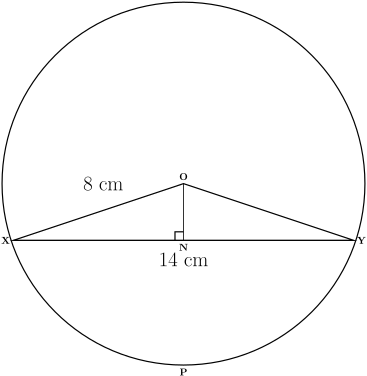
A chord XY of length \(14 \,cm\) is drawn in a circle with centre O and radius \(8 cm\text{,}\) as in the figure below
Calculate:
  1. the distance ON.
  2. the area of the sector OXPY.
  3. the area of triangle OXY
  4. the area of the minor segment.
  5. the area of the major segment.
Solution.
Given a circle with center \(O\text{,}\) radius \(8\) cm, and a chord \(XY\) of length \(14\,cm\) , we find the required values step by step.
  1. Finding the Distance \(\text{ON}\)
    Since ON is the perpendicular bisector of XY, we use the right triangle ONX where:
    \begin{align*} \text{OX}=\amp 8\,cm (\text{radius}) \\ \text{NX}=\amp \frac{\text{XY}}{2} \\ = \amp \frac{12}{2} \\ = \amp 7\,cm \end{align*}
    Using Pythagoras’ Theorem in \(\triangle\) ONX:
    \begin{align*} \text{ON}^2+ \text{NX}^2 =\amp \text{OX}^2\\ \text{ON}^2+ 7^2= \amp 8^2 \\ \text{ON}^2+ 49= \amp 64 \\ \text{ON}^2=\amp 64-49\\ \text{ON}^2= \amp 15 \\ \text{ON} =\amp \sqrt{15} \\ ​≈\amp 3.87 \,cm \end{align*}
  2. Finding the area of sector OXPY.
    Finding the \(\angle\) XOY which is given by:
    \begin{align*} cos\,\theta= \amp (\frac{\text{XN}}{\text{XO}} )\\ =\amp \frac{7}{8} \\ =\amp 0.875 \\ \theta=\amp cos^{-1}(0.875) \\ =\amp 28.9550^\circ \end{align*}
    therefor, \(\angle \text{XOY}= 28.9550^\circ\times 2\)
    \begin{equation*} =57.9100^\circ \end{equation*}
    The area of a sector is:
    \begin{align*} A=\amp \frac{\theta}{360} \times \pi r^2\\ =\amp \frac{57.9100}{360} \times \pi 8^2 \\ =\amp \frac{57.9100}{360} \times \frac{22}{7} \times 64\\ =\amp 32.3561 \,cm^2 \end{align*}
    Therefore, area of sector OXPY \(= 32.3561 \,cm^2\)
  3. Finding the area of triangle OXY
    \begin{align*} \text{Area}= \amp \frac{1}{2} \times \text{base} \times \text{height} \\ =\amp \frac{1}{2} \times 14 \times 3.87 \,cm \\ = \amp 7 \times 3.87 \,cm \\ =\amp 27.09 \,cm^2 \end{align*}
  4. Finding the area of the minor segment.
    \(\text{Area of minor segment}=\text{Area of sector}- \text{Area of} \triangle \text{OXY}\)
    \begin{align*} \text{Area of minor segment}=\amp \\ =\amp 32.3561 \,cm^2-27.09 \,cm^2 \\ =\amp 5.2661\,cm^2 \end{align*}
  5. Finding the area of the major segment
    Area of major segment \(=\) Total circle area\(-\)Area of minor segment
    Area of a circle.
    \begin{align*} A= \amp \pi r^2 \\ =\amp \frac{22}{7} \times 8^2 \\ =\amp \frac{22}{7} \times 64 \\ =\amp 201.1429 \,cm^2 \end{align*}
    Therefore, Area of major segment is
    \begin{align*} = \amp 201.1429 \,cm^2- 5.2661\,cm^2\\ =\amp 195.8768\,cm^2 \end{align*}
\(\textbf{Exercises}\)
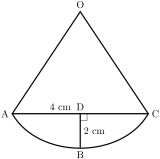
  1. In the figure below, ADC is a chord of a circle with centre O passing through A, B and C. BD is a perpendicular bisector of AC. AD \(= 4 \,cm\) and BD \(= 2 \,cm\text{.}\)
    Calculate:
    1. the radius OA of the circle.
    2. the area of the sector OABC.
    3. the area of the segment ABCD
  2. A circular table has a radius of \(15 \,cm\text{.}\) A slice of cake is cut out, forming a \(75^\circ \) segment. Find the area of the cake slice not covered by the straight cut
  3. A wheel of a car has a radius of \(30 \,cm\text{.}\) A mudguard covers a \(60^\circ\) segment of the wheel. Find the area of the covered segment.
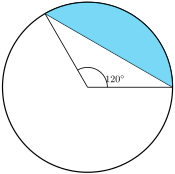
  4. A circular park has a radius of \(20\) meters. A walking path cuts across the park, forming a chord that subtends an angle of \(120^\circ\) at the center as shown below.
  5. A chord XY subtends an angle of \(120^\circ\) at the centre of a circle of radius \(13\, cm\text{.}\) Calculate the area of the minor segment.

Checkpoint 2.6.16.

Checkpoint 2.6.17.