Skip to main content\(\newcommand{\N}{\mathbb N} \newcommand{\Z}{\mathbb Z} \newcommand{\Q}{\mathbb Q} \newcommand{\R}{\mathbb R}
\newcommand{\lt}{<}
\newcommand{\gt}{>}
\newcommand{\amp}{&}
\definecolor{fillinmathshade}{gray}{0.9}
\newcommand{\fillinmath}[1]{\mathchoice{\colorbox{fillinmathshade}{$\displaystyle \phantom{\,#1\,}$}}{\colorbox{fillinmathshade}{$\textstyle \phantom{\,#1\,}$}}{\colorbox{fillinmathshade}{$\scriptstyle \phantom{\,#1\,}$}}{\colorbox{fillinmathshade}{$\scriptscriptstyle\phantom{\,#1\,}$}}}
\)
Subsection 2.4.4 Determining Trigonometric Ratios Using a Calculator
Activity 2.4.9.
\(\textbf{Work in pairs}\)
-
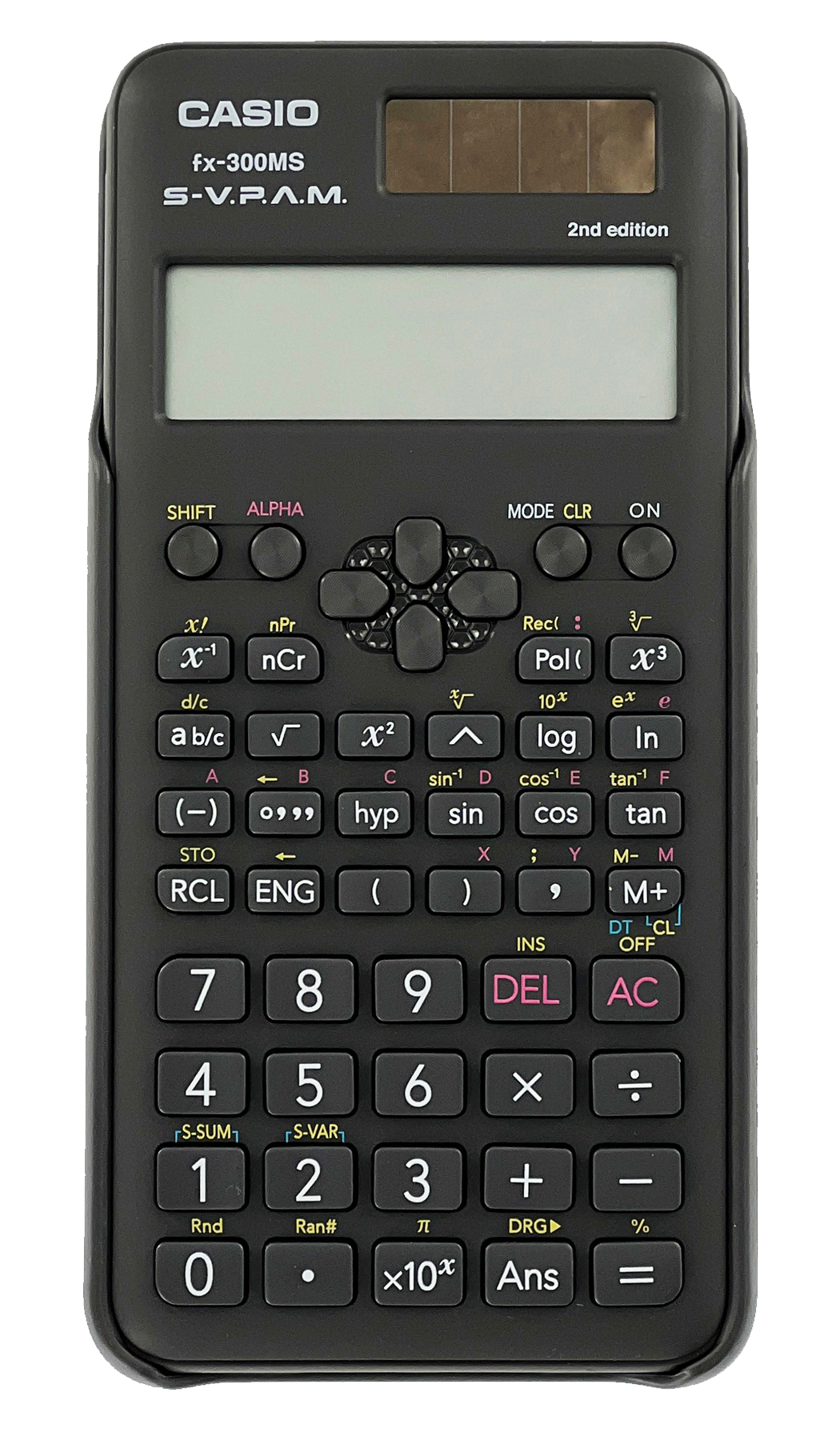
Scientific calculators or any other calculator having
\(sin\text{,}\)\(cos\) and
\(tan\) battons.
-
Protractor and ruler (for optional verification with a drawn triangle).
-
-
Turn on your scientific calculator.
-
Ensure your calculator is set to degree mode (not radians).
-
For each given angle (0°, 25°, 30°, etc.), do the following;
-
Press the sin button followed by the angle, then note the value.
-
Press the cos button followed by the angle, then note the value.
-
Press the tan button followed by the angle, then note the value.
-
Record all values in the table below.
-
Use a calculator to find the sine, cosine, and tangent of the given angles, and fill in the table.
| \(0^\circ\) |
|
|
|
| \(25^\circ\) |
|
|
|
| \(30^\circ\) |
|
|
|
| \(45^\circ\) |
|
|
|
| \(60^\circ\) |
|
|
|
| \(75^\circ\) |
|
|
|
| \(90^\circ\) |
|
|
|
-
-
Observe the values of sin in your table. Do they increase or decrease?
-
Compare the cosine values for different angles.
-
Why does
\(tan\,90^\circ\) display a syntax error?
-
Discuss your work with other learners.
\(\textbf{Key Takeaway}\)
When given an acute angle, a calculator can be used to determine these ratios accurately.
\(\textbf{How to determine trigonometric ratios using a calculator}\text{.}\)
-
Ensure the calculator is in degree mode.
-
Press the "
MODE" button and select "
DEG" (if using a scientific calculator).
-
-
For example, to find
\(sin\,30^\circ\text{,}\) type:
-
Press
sin \(\to\) Press
30 \(\to\) Press
=
-
The calculator should display
\(0.5\) or some calculator will display
\(\frac{1}{2}\text{.}\)
Example 2.4.29.
Use calculator to find the following;(write your answer to
\(\textbf{4 decimal places}\)).
\(sin\,40^\circ \quad cos\, 40^\circ \quad tan\,40^\circ\)
Solution.
Ensure the calculator is in degree mode
-
Press
sin \(\to\) Press
40 \(\to\) Press
=
-
Press
cos \(\to\) Press
40 \(\to\) Press
=
-
Press
tan \(\to\) Press
40 \(\to\) Press
=
Example 2.4.30.
Find
\(sin\,25^\circ \quad cos\, 25^\circ \quad tan\,25^\circ\) using calculator .
Solution.
-
Press
sin \(\to\) Press
25 \(\to\) Press
=
-
Press
cos \(\to\) Press
25 \(\to\) Press
=
-
Press
tan \(\to\) Press
25 \(\to\) Press
=
Use a calculator to determine the following trigonometric ratios:
-
Find
\(sin\,35^\circ \quad cos\, 35^\circ \quad tan\,35^\circ\text{.}\)
-
Find
\(sin\,50^\circ \quad cos\, 50^\circ \quad tan\,50^\circ\text{.}\)
-
Find
\(sin\,15^\circ \quad cos\, 15^\circ \quad tan\,15^\circ\text{.}\)
-
Find
\(sin\,75^\circ \quad cos\, 75^\circ \quad tan\,75^\circ\text{.}\)