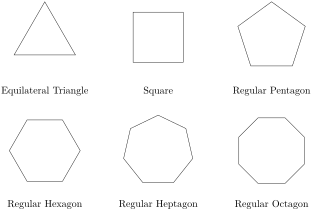
Subsection 2.5.3 Area of Regular Polygons

Activity 2.5.11.

\(\textbf{Materials Needed:}\)
i.Compass,
ii. Ruler
ii. Protractor
iv. Calculator
v. Pencil and paper
vi. Colored pencils (optional)
  • Draw a line from the center O perpendicular to a side (e.g., side BC). This line is the apothem (denoted a). Label the apothem clearly.
\(\textbf{Key Takeaway\)
♦ The \(\textbf{area}\) of a \(\textbf{regular polygon}\) can be found using this formula, where \(\textbf{P}\) is the \(\textbf{perimeter}\) and \(\textbf{a}\) is the apothem
The \(\textbf{apothem}\) is the distance from the center of a regular polygon to \(\, \textbf{a} \)side. Where \(\textbf{a}\) is the half \(\frac{1}{2} \text{side.}\)
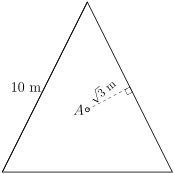
You want to find the area of the triangle. You can see it has an apothem of \(\sqrt{3}\) meters and a side length of 10 meters.
If you also find the perimeter, P , then you can use the formula A= \(\frac{1}{2} \textbf{P}a\) to find the area.
\begin{equation*} \textbf{P} = \text{length of each side } \times a \text{, where } a = h \end{equation*}
\begin{equation*} P = 10 \, \text{m} \times 3 \end{equation*}
\begin{equation*} = 30, \text{m} \end{equation*}
Now, use the formula for the area of a regular polygon is :
\begin{align*} A = \amp \frac{1}{2} \times 30 \times \sqrt{3} \\ = \amp 125.98 \, \text{m}^2 \end{align*}

Example 2.5.10.

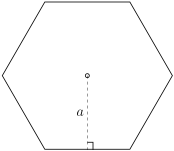
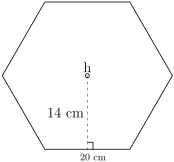
A regular hexagon with center h is shown below
Similarly you can use \(A = \frac{1}{2} \times n \times S \times a\)
Solution.
Find the perimeter P, Then use the formula A= \(\frac{1}{2} \textbf{P}a\) to find the area.
\begin{equation*} \textbf{P} = \text{length of each side } \times a \end{equation*}
\begin{equation*} P = 20 \, \text{cm} \times 6 \end{equation*}
\begin{equation*} = 120 \, \text{cm}^2 \end{equation*}
Now, use the formula for the area of a regular polygon is :
\begin{align*} A = \amp \frac{1}{2} \times 120 \times 14 \, \text{cm} \\ = \amp 840 \text{cm}^2 \end{align*}
Where \(n = \text{number of sides,} S = \text{length of each side and } a = \frac{S}{2} \)
\begin{align*} A = \amp \frac{1}{2} n \times S \times a\\ = \amp \frac{1}{2} \times 6 \times 20 \, \text{cm} \times 14 \, \text{cm}\\ = \amp \frac{1,680}{2} \, \text{cm}^2\\ = \amp 840 \,\text{cm}^2 \end{align*}
Subsubsection 2.5.3.1 Area of Heptagon

A heptagon is a seven-sided polygon. It has seven edges and seven vertices.

Activity 2.5.12.

\(\textbf{Objective:}\)
learners are expected to know how to construct a regular heptagon (7-sided polygon) using a compass, ruler, and protractor.
Materials Needed:
  1. Materials Needed:
    ♦ Compass
    ♦ Ruler
    ♦ Protractor
    ♦ Pencil
    ♦ Eraser
    ♦ Graph paper (optional)
  2. Step:1 Draw a Circle.
    • Place the compass pointer on the paper and draw a circle of any radius.
    • Mark the center (O) of the circle.
  3. Step 2: Draw a Horizontal Diameter
    • Use the ruler to draw a straight line measuring 10cm through the center (O), creating a diameter (A 0 to P1).
    • Label the first point P1 on the circumference.
  4. Step 3: Divide the Circle into Seven Equal Parts
    • Use a protractor to measure angles of 360° ÷ 7 = 51.43° from point P1.
    • Mark each 51.43° interval around the circle to get seven points.
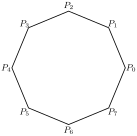
  5. Step 4: Connect the Points as shown below.
    • Use the ruler to draw straight lines connecting the seven points in sequence.
    • The heptagon is now complete!
\(\textbf{Extended Activity.}\)
🔹 Try drawing a heptagon using only a compass (without a protractor)
🔹 Shade the inside of the heptagon with different colors to make a pattern.
🔹 Find the sum of the interior angles of the heptagon. (\(Hint: (n-2) \times 180^\circ\))
\(\textbf{Discussion Questions}\)
1. What is the sum of all interior angles of a heptagon?
2. How do we calculate the measure of one interior angle of a regular heptagon?
3. Can you find a heptagon in real life (architecture, logos, etc.)?
\(\textbf{Key Takeaway\)
\(\textbf{Properties of a Regular Heptagon.}\text{.}\)
♦ Sum of interior angles = \((n-2) \times 180^\circ\text{.}\) Where n is the number of sides.
♦ Example for a Heptagon (7-sided polygon).
\begin{equation*} (n-2) \times 180^\circ \end{equation*}
\begin{equation*} (7-2) \times 180^\circ = 900^\circ \end{equation*}
♦ Sum of exterior angles of any \(\textbf{polygon(regular or irregular)}\) is always equl to \(360^\circ\) for both regular and irregular polygons.
♦ Each Interior and Exterior Angle (Regular Polygon Only)
\begin{equation*} \textbf{Each Interior Angle (for a regular polygon):} \end{equation*}
\begin{equation*} Interior Angle = \frac{(n-2) \times 180^\circ}{n} \end{equation*}
\begin{equation*} \textbf{Each Exterior Angle (for a regular polygon):} \end{equation*}
\begin{equation*} Exterior Angle = \frac{360^ \circ}{n} \end{equation*}
♦ Example for a Regular Heptagon:
\begin{equation*} \textbf{Each Interior Angle} = \frac{900}{7} \end{equation*}
\begin{equation*} = 128.57^ \circ \end{equation*}
\begin{equation*} \textbf{Each Exterior Angle} = \frac{360}{7} \end{equation*}
\begin{equation*} =51.43^ \circ \end{equation*}
\(\textbf{Study Questions}\)
1. What is the sum of all interior angles of a heptagon ?
2. How do we calculate the measure of one interior angle of a regular heptagon ?
3. Can you find heptagons in real life?

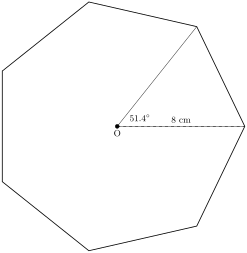
Example 2.5.11.

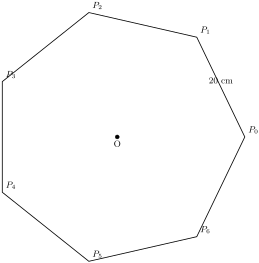
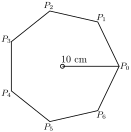
A regular heptagon measures 10 cm as indicated in the figure below, find its area given the sum of it’s interior angles is\(\, 900^\circ?\)
Solution.
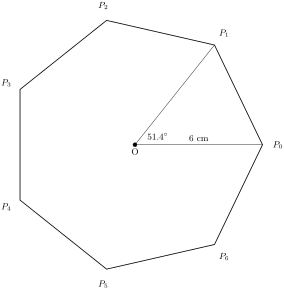
There are 7 triangles since a heptagon has 7 sides. Area of Triangle \(P_0OP_1 = \frac{1}{2} ab \, \text{sin } \, 51.43^\circ \)
\begin{align*} \triangle P_0OP_1 = \amp \frac{1}{2}\times 10\times 10\, \text{ sin} \,51.43^\circ \\ = \amp \frac{1}{2}\times 100\, \text{cm}^2 \times \text{ sin } \, 51,43^\circ\\ = \amp \frac{1}{2}\times 100\, \text{cm}^2 \times 0.7818 \\ = \amp 39.0923 \, \text{cm}^2 \end{align*}
Therefore the total area
\begin{align*} = \amp 7 \times 39.0923 \, \text{cm}^2 \\ = \amp 273.65 \,\text{cm}^2 \end{align*}

Subsubsection 2.5.3.2 Area of a an Octagon

A regular octagon is an(8-sided) polygon with eight vertices (corners) and ten edges (sides).

Activity 2.5.13.

\(\textbf{Materials Needed:}\)
♦ Compass, Ruler, Protractor
♦ Pencil, Eraser, Graph paper (optional)
\(\textbf{ Drawing a Regular Octagon (8-sided Polygon)}\)
1. Draw a Circle:
🔹Use a compass to draw a circle of your deired radius.
🔹Mark the center (O).
2. Draw the First Diameter:
🔹Use a ruler to draw a horizontal diameter (P0 to 95) passing through the center.
3. Divide the Circle into 8 Equal Parts.
🔹Use a protractor to measure angles of 360° ÷ 8 = 45° from point P0.
🔹Mark each 45° interval on the circle to get 8 points.
4. Connect the Points:
🔹Use a ruler to connect the eight points in order to form the octagon.
\(\textbf{Discussion Questions}\)
\(\textbf{Study Questions}\)
1. What is the sum of all interior angles of an octagon ?
2, How do we calculate the measure of one interior angle of a regular octagon?
3, Have you ever seen octagon-shaped objects in real life?

Example 2.5.12.

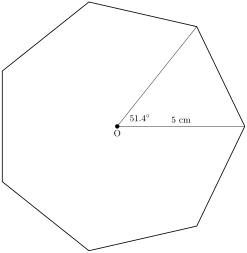
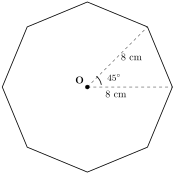
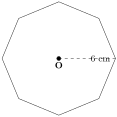
A regular octagon with O as its centre. If OA is 8 cm, find its area.
Solution.
There are 8 triangles since an octagon has 8 sides. Area of Triangle \(AOB = \frac{1}{2} ab \text{sin} 45^\circ \)
\begin{align*} \triangle AOB = \amp \frac{1}{2}\times 8\times 8\, \text{sin} \, 45^\circ \\ = \amp \frac{1}{2}\times 64\, \text{cm}^2 \times \text{sin} \, 45^\circ\\ = \amp \frac{1}{2}\times 64\, \text{cm}^2 \times 0.7071 \\ = \amp 22.6274 \, \text{cm}^2 \end{align*}
Therefore the total area
\begin{align*} = \amp 8 \times 22.6274 \, \text{cm}^2 \\ = \amp 181.02 \, \text{cm}^2 \end{align*}

Example 2.5.13.

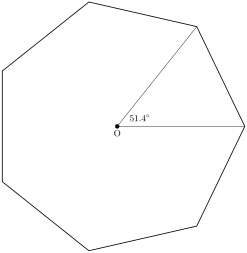
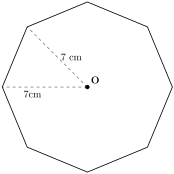
The figure below represents a regular octagon with O as its centre. If OA is 7cm, find its area
Solution.
There are 8 triangles since an octagon has 8 sides and the sum of interior angles of one triangle is \(360 ^\circ\text{.}\) Area of Triangle \(AOB = \frac{1}{2} ab \, \text{sin} \, 45^\circ \) .
The angle of \(\triangle AOB = \frac{360}{8} = 45^\circ \)
\begin{align*} \triangle AOB = \amp \frac{1}{2}\times 7\times 7 \, \, \text{ sin} \, 45^\circ \\ = \amp \frac{1}{2}\times 49\, \text{cm}^2 \times \text{sin}\, 45^\circ\\ = \amp \frac{1}{2}\times 49\, \text{cm}^2 \times 0.7071 \\ = \amp 17.3241 \, \text{cm}^2 \end{align*}
Therefore the total area
\begin{align*} = \amp 8 \times 17.3241 \, \text{cm}^2 \\ = \amp 138.59\, \text{cm}^2 \end{align*}

Subsubsection 2.5.3.3 Area of a Nonagon

A nonagon is a nine-sided polygon with nine vertices (corners) and nine edges (sides).

Activity 2.5.14.

\(\textbf{Materials Needed:}\)
♦ Compass, Ruler, Protractor
♦ Pencil, Eraser, Graph paper (optional)
\(\textbf{ Drawing a Regular nonagon (9-sided Polygon)}\)
1. Draw a Circle:
🔹Use a compass to draw a circle of your desired radius.
🔹Mark the center (O).
2. Draw the First Diameter:
🔹Use a ruler to draw a horizontal diameter (P0 to P6) passing through the center.
3. Divide the Circle into 9 Equal Parts.
🔹Use a protractor to measure angles of 360° ÷ 9 = 40° from point P0.
🔹Mark each 40° interval on the circle to get 9 points.
4. Connect the Points:
\(\textbf{Study Questions}\)
  • What is the sum of all interior angles of an nonagon ?
  • How do we calculate the measure of one interior angle of a regular nonagon?
  • Have you ever seen nonagon-shaped objects in real life?

Example 2.5.14.

Nonagon example.
One of the angles of a regular polygon is \(40^\circ\) and its sides are \(15 \text{cm}\) long. Sketch the polygon and then find the area of the polygon.
Solution.
🔹 From the definition of a polygon all interior angle add up to \(360^ \circ\text{.}\)
🔹 To find the number of sides of a triangle we use the formula \(\frac{360}{\text{Interior angle}} = \text{Number of sides}\text{.}\)
Where \(n\) is the number of sides.
\begin{align*} \frac{360^ \circ}{\text{interior angle}} = \amp \text{ Number of sides} \\ \frac{360^\circ}{40} = \amp 9 \text{ sides } \end{align*}
🔹Finding the area of the nonagon we use the formula:
Area of a tringle using sine rule \(\times \text{the number of sides} \) Where our \(ab \) is the radii.
\begin{align*} \frac{1}{2}ab \, \text{sin} 40^\circ = \amp \frac {1}{2} \times 15\text{cm} \times 15\text{cm} \times \text{sin} \, 40^\circ \\ = \amp \frac{1}{2} \times 225 \times 0.6428 \text{ cm}^2 \end{align*}
🔹 There are 9 triangles since a nonagon has 9 sides.
🔹Therefore, total area is:
\begin{align*} = \amp 9 \times (\frac{1}{2} \times 225 \times 0.6428 ) \\ = \amp 9 \times 225 \times 0.3214 \\ = \amp 73.6006 \text{ cm}^2 \end{align*}

Subsubsection 2.5.3.4 Area of a Decagon

A decagon is a ten-sided polygon with ten vertices (corners) and ten edges (sides).

Activity 2.5.15.

\(\textbf{Materials neede:}\)
♦ Compass, Ruler, Protractor,
♦ Pencil, Eraser, Graph paper (optional)
\(\textbf{ Drawing a Regular Decagon (10-sided Polygon)}\)
1. Draw a Circle:
🔹Use a compass to draw a circle of your desired radius.
🔹Mark the center (O).
2. Draw the First Diameter:
🔹Use a ruler to draw a horizontal diameter (P0 to P6) passing through the center.
3. Divide the Circle into 10 Equal Parts.
🔹Use a protractor to measure angles of 360° ÷ 10 = 36° from point A.
🔹Mark each 36° interval on the circle to get 10 points.
4. Connect the Points:
🔹Use a ruler to connect the ten points in order to form the decagon.
\(\textbf{Study Questions}\)
  • What is the sum of all interior angles of an decagon ?
  • How do we calculate the measure of one interior angle of a regular decagon?
  • Can you find decagons in real life?
  • What is the sum of all interior angles of a decagon?

Example 2.5.15.

A regular decagon has an apothem \(a\) of \(7.5 \text{cm}\) and a side length \(S\) of\(5 \text{cm}\text{.}\) Find its area.
Solution.
Find the perimeter P, Then use the formula A= \(\frac{1}{2} \textbf{P}a\) to find the area.
\begin{equation*} \textbf{P} = \text{length of each side } \times a \end{equation*}
\begin{equation*} P = 5 \, \text{cm} \times 10 \end{equation*}
\begin{equation*} = 50 \, \text{cm} \end{equation*}
Now, use the formula for the area of a regular polygon is :
\begin{align*} A = \amp \frac{1}{2} \times 50 \times 7.5 \, \text{cm}\\ = \amp \frac{375}{2} \, \text{cm}^2\\ = \amp 187.5 \, \text{cm}^2 \end{align*}
Where \(n = \text{number of sides,} S = \text{length of each side and } a = \frac{S}{2} \)
\begin{align*} A = \amp \frac{1}{2} n \times S \times a\\ = \amp \frac{1}{2} \times 10 \times 5 \, cm \times 7.5 \, \text{cm}\\ = \amp \frac{375}{2} \, \text{cm}^2\\ = \amp 187.5 \, \text{cm}^2 \end{align*}
\(\textbf{ Exercise}\)
1. A regular octagon has a side length of \(10 \text{cm}\text{.}\) Calculate its area using the formula for the area of a regular polygon.
2. A regular nonagon is inscribed in a circle of radius\(5 \text{cm}\text{.}\) Find its area and perimeter, considering that all sides are equal and the internal angles can be derived using geometric properties.
3. The perimeter of a regular decagon is \(50 \text{cm}\text{.}\) Determine the length of each side and use it to calculate the area of the decagon.
4. A stop sign is shaped like a regular octagon with a side length of \(30 \text{cm}\text{.}\) If the material costs are based on area, determine the total surface area needed for manufacturing \(100\) signs.
5. A company designs floor tiles shaped like regular decagons with a side length of \(12 \text{cm}\text{.}\) If a room requires \(50\) tiles, calculate the total area covered by the tiles.