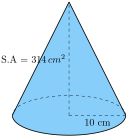
Subsection 2.7.6 Surface area of a Cone

Activity 2.7.9.

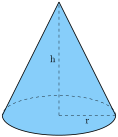
If a cone has a height of h and a base of radius r, show that the surface area is: \(\pi r^2 + \pi r \sqrt{r^2 + h^2}\)
Sketch and label the cone
Identify the faces that make up the cone
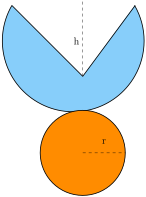
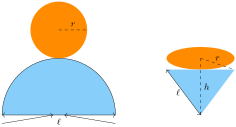
The cone has two faces: the base and the faces makig up a wall. The base is a circle of radius r and the walls can be opened out to a semi-circle
This curved surface can be cut into many thin triangles with height close to a (where \(\ell\) is the slant height). The area of these triangles or sectors can be summed as follow;
\begin{align*} \text{Area} \amp = \frac{1}{2} \times \text{base} \times \text{height of a small triangle}\\ = \amp \frac {1}{2} \times 2 \pi r \times \ell \\ = \amp \pi r \ell \end{align*}
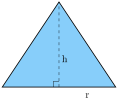
\(\ell \) can be calculated using the pythagorean theorem.
\(\ell = \sqrt{r^2 + h^2}\)
Calculate the area of the circular base \(C_1 = \pi r^2\)
Calculate the area of the curved walls \(C_2 = \pi r \ell\) \(= \pi r \sqrt{r^2 + h^2}\)
To find the surface area we sum up all the areas that is:
\begin{align*} A = \amp C_1 + C_2\\ = \amp \pi r^2 + \pi r \sqrt{r^2 + h^2}\\ = \amp \pi (r + \sqrt{r^2 + h^2}) \end{align*}
The \(\textbf{net of a cone} \) is a two-dimensional representation of the three-dimensional shape of the cone. It is made up of the curved surface of the cone laid out flat, so that you can see the shape of the cone. The net of a cone is useful for visualizing the shape of the cone and for calculating its surface area and volume.

Example 2.7.22.

Given a cone with the radius \(r = \, 14\, \text{cm} \) and an angle of \(\angle 60^\circ\text{.}\) Find the surface area of the cone.
Solution.
\begin{align*} \text{Area of sector A}= \amp \frac{ \theta }{360^\circ} \pi r^2\\ = \amp \frac{60}{360^\circ} \times\frac{22}{7}\times14\times14 \\ = \amp102.67 \, \text{cm}^2 \\ \text{Area of circle B}= \amp\pi r^2 \\ = \amp\frac{22}{7} \times14 \, \text{cm} \times14\, \text{cm}\\ = \amp616 \, \text{cm}^2 \\ \text {Surface area}= \amp102.67 \, \text{cm}^2+616 \, \text{cm}^2 \\ = \amp 718.67 \, \text{cm}^2 \end{align*}
\(\textbf{Exercise}\)
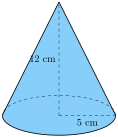
1. A circular cone has a base radius of 5 cm and a slant height of 12 cm. Calculate the total surface area of the cone, including both the curved surface and the circular base
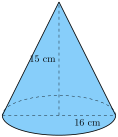
2. A cone is constructed with a base diameter of 16 cm and a height of 15 cm. Before finding the total surface area, determine the slant height of the cone using the Pythagorean theorem. Then, calculate the complete surface area.
3. A conical container, open at the top, is made of metal and has a base radius of 10 cm and a slant height of 18 cm. Determine the total metal sheet required to construct this container, excluding the base.
4. The total surface area of a cone is given as 314 cm², and its base radius is 10 cm. Using the surface area formula, determine the slant height of the cone.
5. A conical tent made of waterproof fabric has a radius of 4.2 m and a slant height of 7.5 m. If the tent does not have a base, calculate the area of fabric required to cover the tent completely.
Checkpoint 2.7.23.

Checkpoint 2.7.24.