Subsection 2.8.8 Volume of Composite Solids

Learner Experience 2.8.8.

Constructing a real-world object using basic solids (cylinder, cube, cone, hemisphere, etc.) and calculate the total volume.
  • \(\textbf{Materials needed:}\)
    πŸ”Ή Building blocks or 3D shape cut-outs (foam, paper nets, or toy blocks)
    πŸ”Ή Rulers or measuring tapes
    πŸ”Ή Worksheets for drawings and calculations
    πŸ”Ή Volume formula sheet
  • Review volume formulas for Cube/cuboid, cylinder, cone, sphere, Hemisphere, triangular prisms and pyramids.
  • Work in groups of atleast four members.
  • πŸ”Ή Build UP a structure using 2 to 3 shapes. For example
    πŸ”Ή A lighthouse (cylinder + cone)
    An ice cream cone (cone + hemisphere)
    πŸ”Ή A mailbox (cuboid + half-cylinder)
    πŸ”Ή A robot body (cuboid + cylinder arms + sphere head)
    πŸ”Ή After building up draw the structure, label the parts and measure dimensions. Then alculate the volume of each solid part using the correct formulas.
    πŸ”Ή Then they add all volumes to get the total.
\(\textbf{Key Takeaway}\)
A composite solid is a three-dimensional shape made up of two or more simple solids (such as cubes, cylinders, cones, spheres, prisms, and pyramids). To find the volume of a composite solid, the volumes of the individual solids are calculated and then either added or subtracted, depending on the situation.
  • Identify the simple solids that make up the composite solid
  • Calculate the volume of each individual solid using the appropriate formula
  • Add or subtract the volumes i.e:
    πŸ”Ή If the solids are joined together, add their volumes.
    πŸ”Ή If a part of one solid is removed (e.g., a hole), subtract its volume from the total.
  • Examples of Composite Solids include Cylinder with a Hemisphere on Top, Rectangular Prism with a Cylindrical Hole etc.

Example 2.8.48.

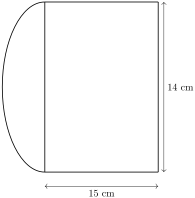
A solid is formed by mounting a hemisphere on top of a cylinder. The cylinder has a height of \(14\) cm and a diameter of \(12\) cm. Find the total volume of the solid. Give your answer in terms of \(\pi\) and correct to two decimal places.
Solution.
Radius of the cylinder:
\(r = \frac{12}{2} = 6 \;\text{cm}\)
Volume of the cylinder:
\begin{align*} V = \amp \pi r^2 h\\ = \amp \pi (6)^2 (14)\\ = \amp 504\pi \end{align*}
Volume of the hemisphere:
\begin{align*} V = \amp \frac{1}{2} \times \frac{4}{3}\pi r^3\\ = \amp \frac{2}{3}\pi (6)^3\\ = \amp \frac{2}{3}\pi (216)\\ = \amp 144\pi \end{align*}
Total volume:
\(V = 504\pi + 144\pi\)
\(V = 648\pi \;\text{cm}^3\)
In decimal form:
\(V \approx 2036.73\; \text{cm}^3\)

Example 2.8.49.

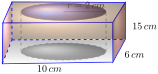
A rectangular prism has dimensions length = 10 cm, width = 6 cm, and height = 15 cm. A cylindrical hole of radius 2 cm passes vertically through the entire height of the prism. Find the volume of the remaining solid after the hole is removed.
Solution.
Step 1: Find the Volume of the Rectangular Prism
\begin{align*} V_{\text{prism}} =\amp \text{length} \times \text{width }\times \text{height} \\ = \amp \, 10 \, \text{cm} \times 6 \, \text{cm} \times 15 \, \text{cm}\\ = \amp 900 \, \text{cm}^3 \end{align*}
Step 2: Find the Volume of the Cylindrical Hole
\begin{align*} V_{\text{cylinder}} = \amp \pi r^2h \\ = \amp 3.14 \times \, (2 \,\text{cm})^2 \times 15 \, \text{cm} \\ = \amp 188.4 \, \text{cm}^2 \end{align*}
Step 3: Find the Volume of the Remaining Solid
\begin{align*} V_{\text{Total volume remaining}} = \amp V_{\text{prism}} - V_{\text{cylinder}} \\ = \amp (900 -188.4)\, \text{cm}^3\\ = \amp 711.6 \, \text{cm}^3 \end{align*}
The volume of the remaining solid after the hole is removed is \(711.6 \text{cm}^3\text{.}\)
Exercises Exercises

1.

A cylinder has a diameter of \(14\) cm and a height of \(15\) cm. A hemisphere with the same radius is attached to the top. Find the total volume of the composite solid. (Take \(\pi = \frac{22}{7}\))
Answer.
\(3028.7 \;\text{cm}^3\)

2.

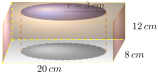
A rectangular prism has dimensions \(12\) cm by \(8\) cm by \(20\) cm. A cylindrical hole with a radius of \(3\) cm is drilled vertically through the entire height of the prism. Find the volume of the remaining prism .
Answer.
\(1354.3 \;\text{cm}^3\)

3.

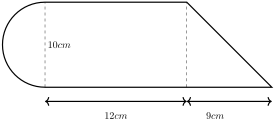
A cylinder has a radius of \(5\) cm and a height of \(12\) cm. A cone with the same radius and a height of \(9\) cm is placed on top. Find the total volume of the solid.
Answer.
\(1178.1 \;\text{cm}^3\)

4.

A solid sphere with a radius of \(6\) cm is completely enclosed in a cube. Find the volume of the space inside the cube but outside the sphere
Answer.
\(823.2 \;\text{cm}^3\)

5.

A rectangular prism has a base of \(10\) cm by \(6\) cm and a height of \(15\) cm. A square pyramid with a base of \(10\) cm and a height of \(8\) cm is placed on top of the prism. Find the total volume of the solid.
Answer.
\(1166.7 \;\text{cm}^3\)