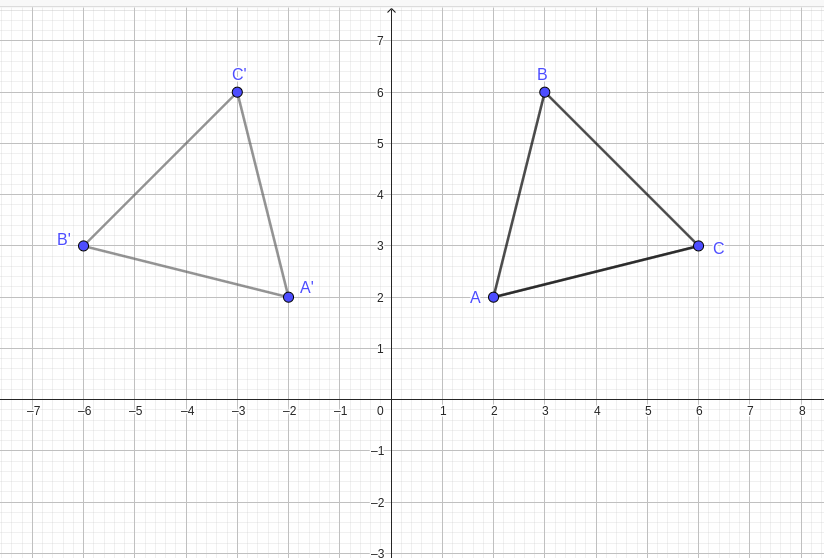
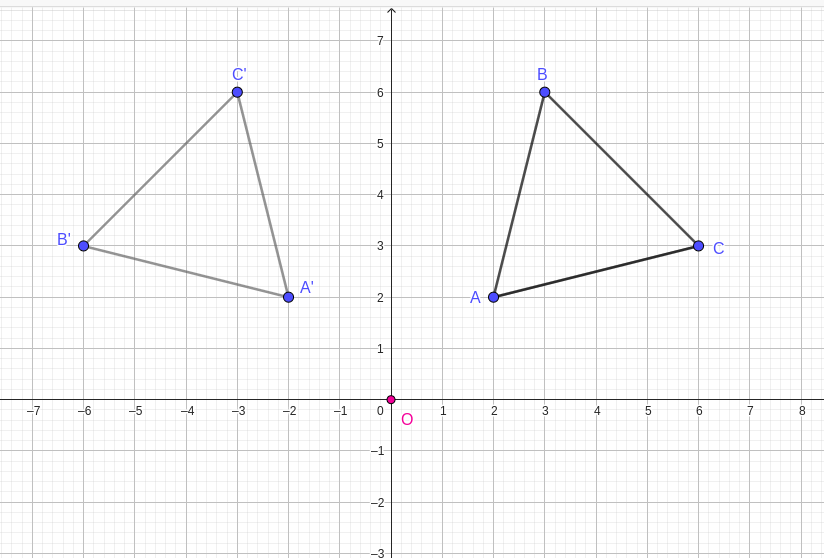
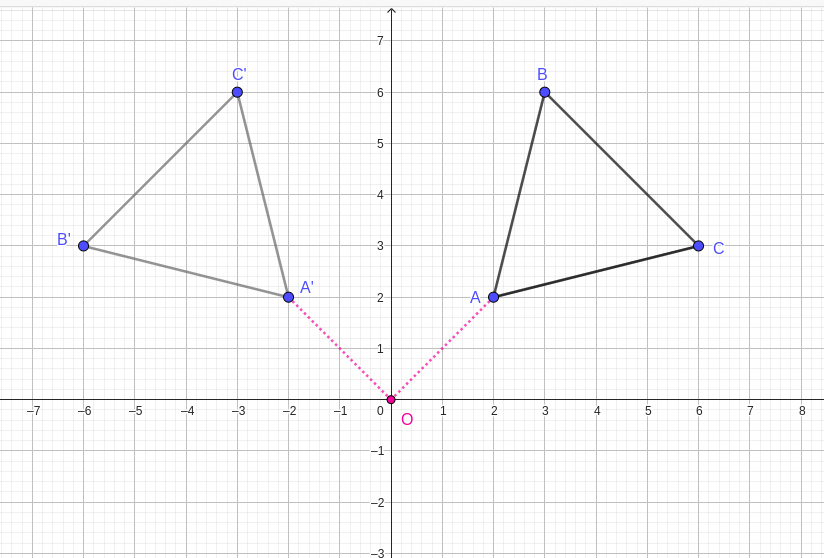
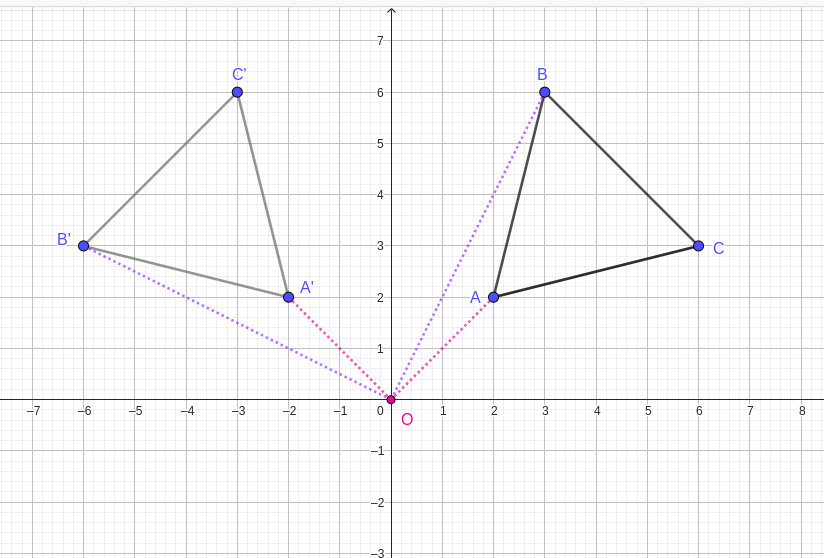
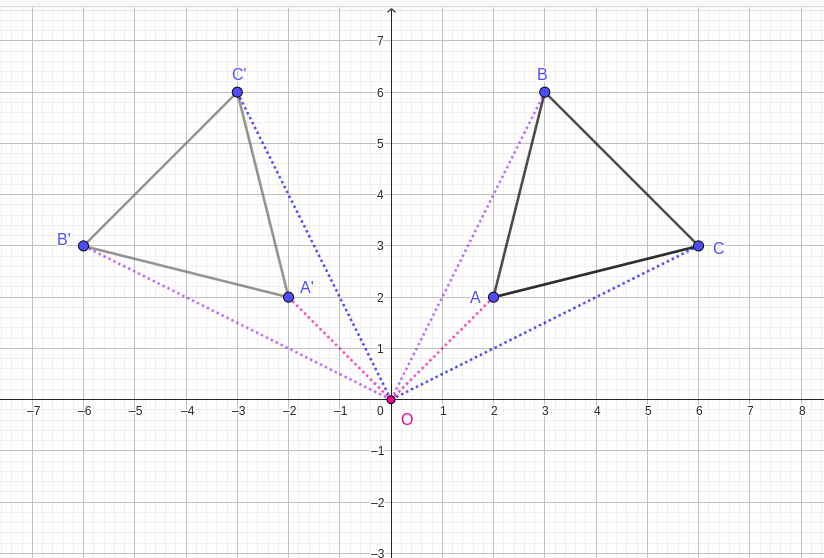
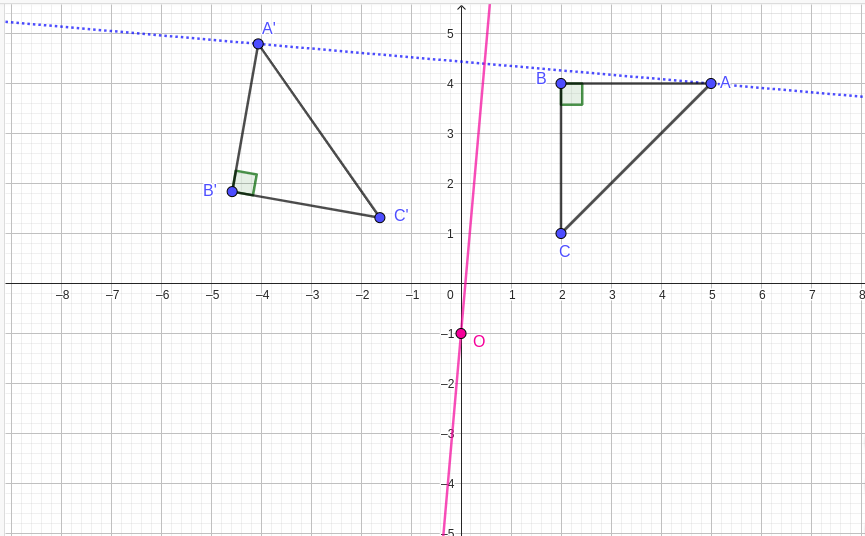
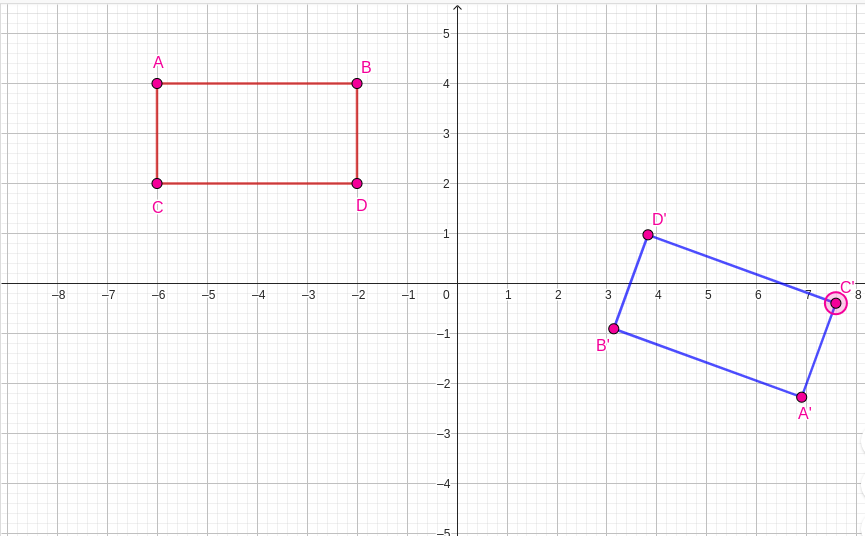
Using a ruler, draw a straight line from point \(A\) to \(O\) and also from point \(A'\) to \(O\) as shown below. Measure the distance \(OA\) and \(OA'\) and record your results. What do you notice?
Similarly, draw a straight line from point \(B\) to \(O\) and also from point \(B'\) to \(O\text{.}\) Measure the distance \(OB\) and \(OB'\) and record your results. What do you notice?
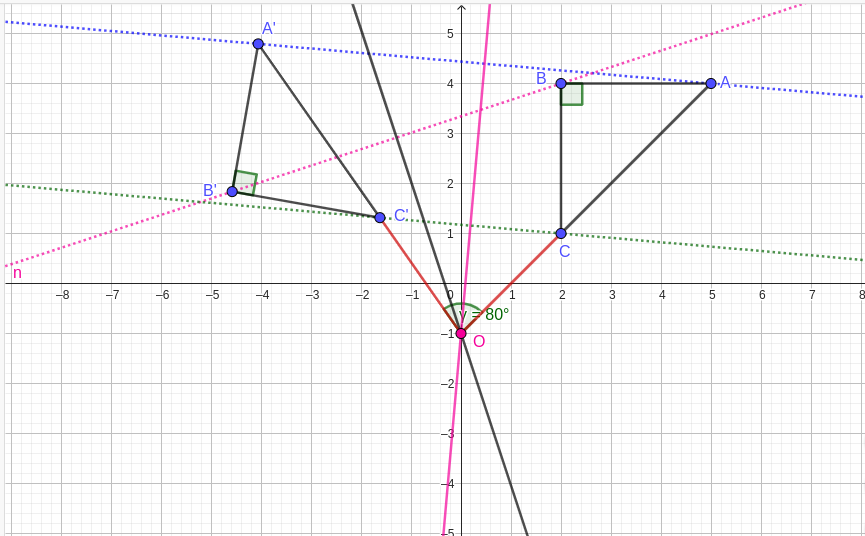
Finally, draw a straight line from point \(C\) to \(O\) and also from point \(C'\) to \(O\text{.}\) Measure the distance \(OC\) and \(OC'\) and record your results. What do you notice?
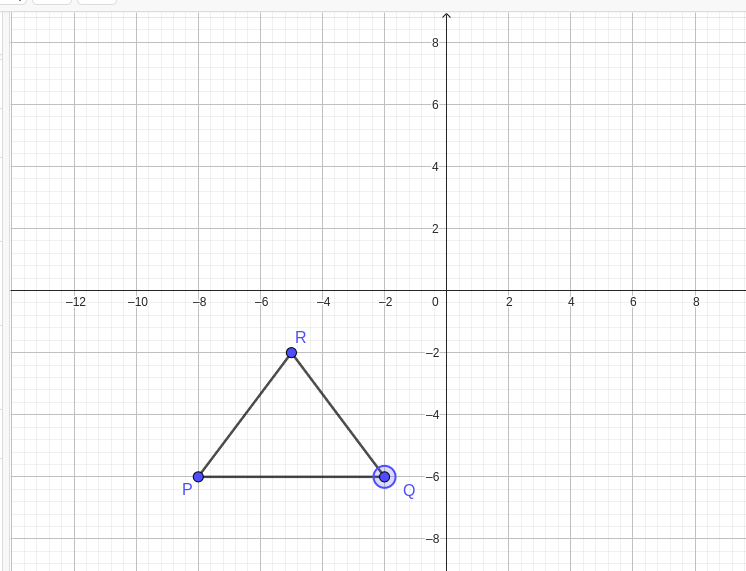
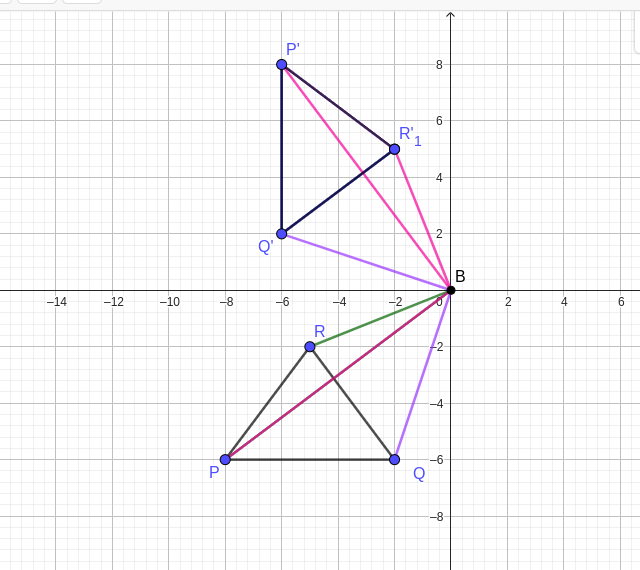
The coordinates of the vertices for triangle \(PQR\) that can be graphed in the coordinate plane are \((-8,-6)\text{,}\)\((-2,-6)\) and \((-5,-3)\) as shown below. The triangle is rotated through \(90^\circ\) in a clockwise direction about the origin to produce triangle \(P'Q'R'\text{.}\)Copy the figure and draw triangle \(P'Q'R'\)
Similary join point \(O\) to \(B'\) and \(B\) and \(O\) to \(A'\) and \(A\)and measusure \(\angle\, BOB'\) and \(\angle\,AOA'\text{.}\) What do you notice?
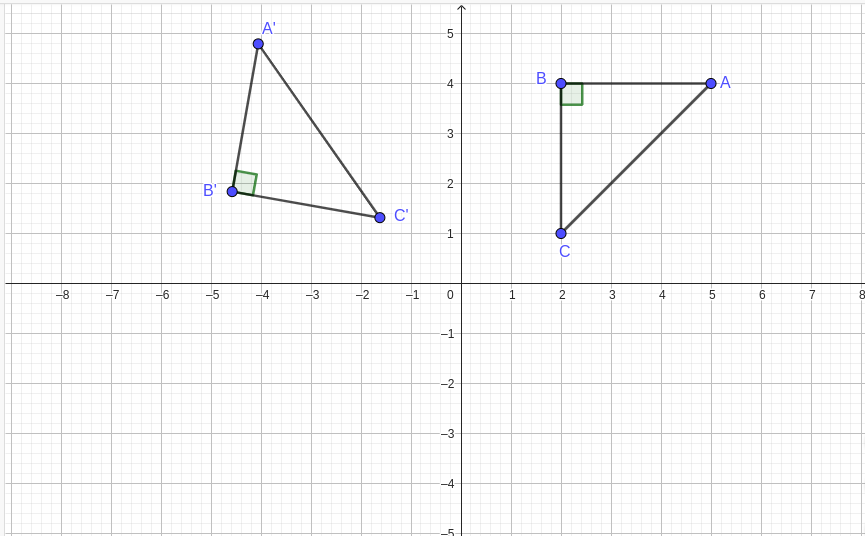
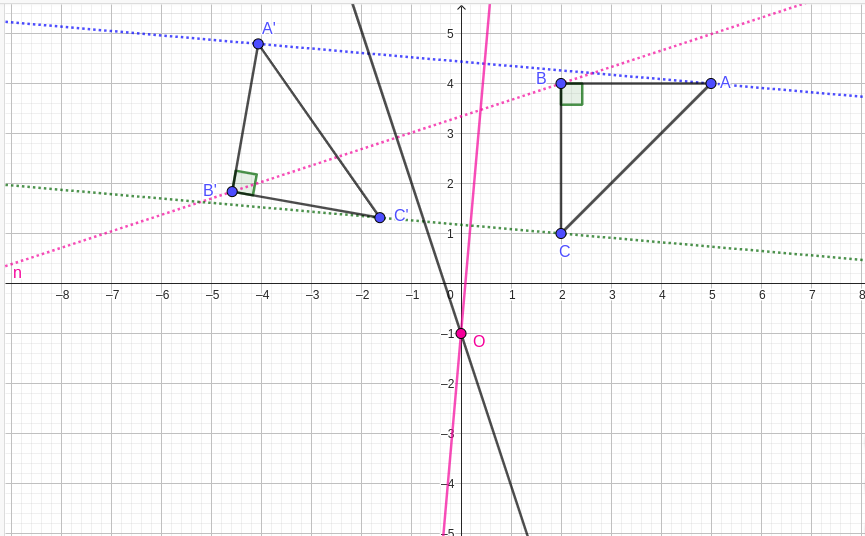
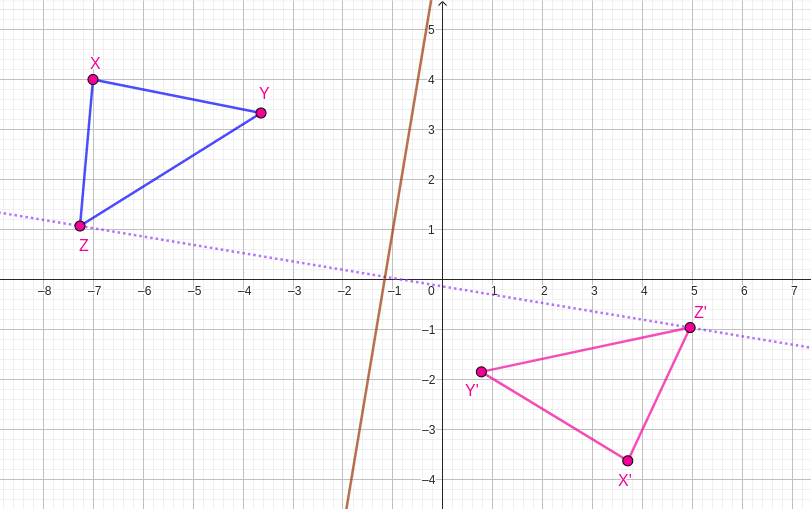
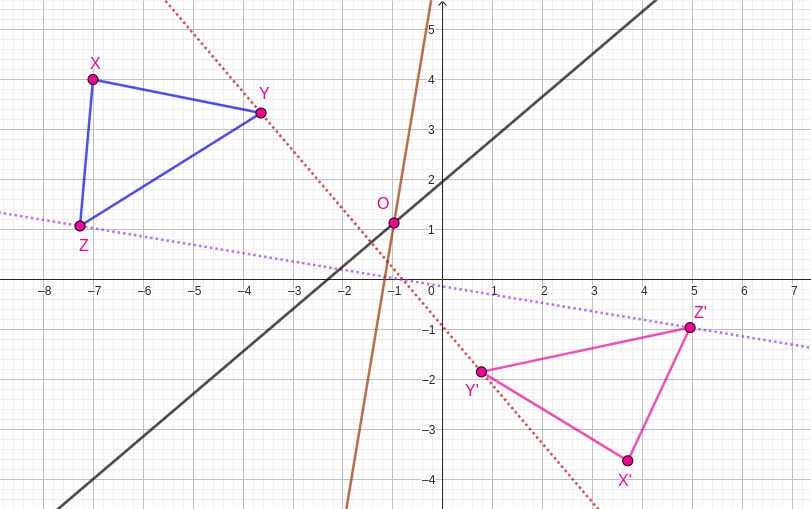
Triangle \(A'B'C'\) is the image of triangle \(ABC\) after a rotation.The centre and angle of rotation can be found by drawing the perpendicular bisectors of the lines between two sets of points, \(C\) and \(C'\) and \(B\) and \(B'\) or \(A\) and \(A'\)
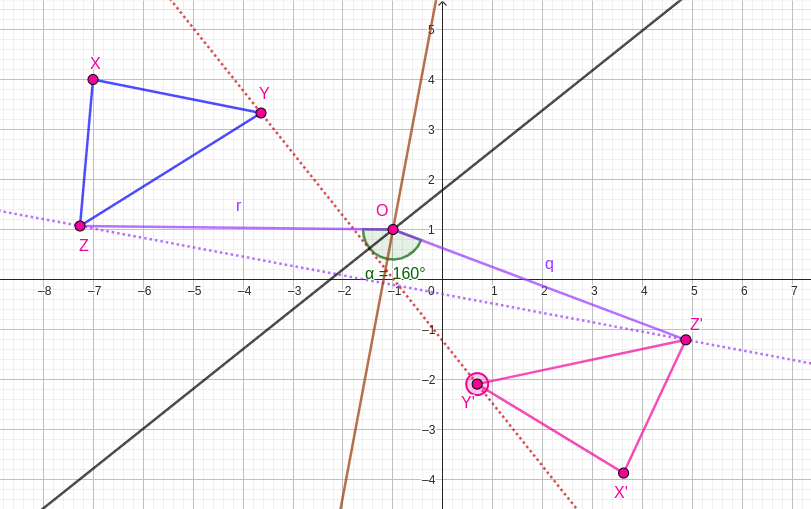
The point where two perpendicular bisectors intersect is called \(\textbf{the centre of rotation.}\) To find \(\textbf{ the angle of rotation}\text{,}\) join \(C'\) and \(C\) to the centre of rotation and measure the angle between these lines.
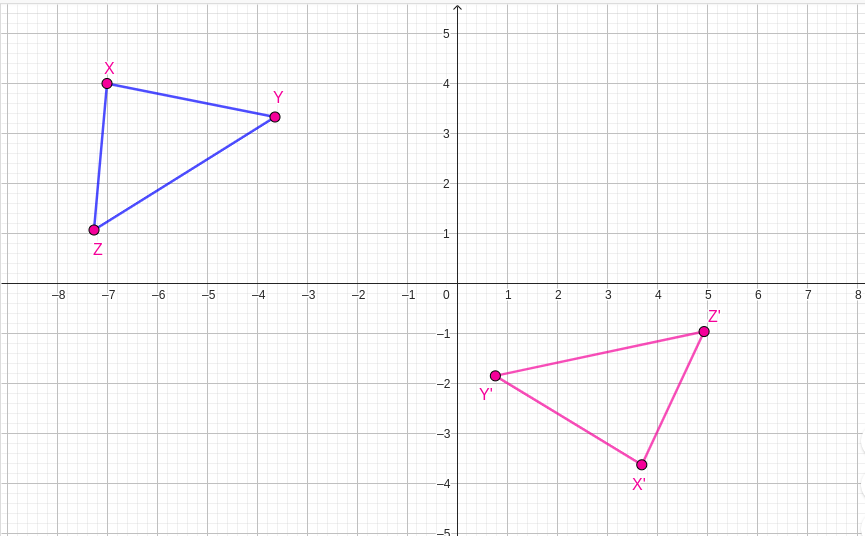
Also join point \(Y\) to \(Y'\) and construct a perpendicular bisector to \(YY'\) as shown below. Mark the point of intersection of perpendicular bisectors \(O\)