Subsection 3.1.4 Representation of Data

Representation of data is the process of presenting collected information (data) in an organized and visual form so that it is easy to understand, interpret and analyze.
Instead of leaving data as raw numbers, we use tables, charts and graphs to show patterns, trends, and comparisons more clearly.

Subsubsection 3.1.4.1 Drawing Histograms and Frequency Polygons of Data

Activity 3.1.6.

Work in groups
In a school with \(500\) students, their heights were measured and recorded in the following table.
Table 3.1.37.
Height (cm) Number of Students (Frequency)
\(140 - 149\) \(30\)
\(150 - 159\) \(70\)
\(160 - 169\) \(110\)
\(170 - 179\) \(150\)
\(180 - 189\) \(90\)
\(190 - 199\) \(50\)
  1. Choose a suitable scale and represent the data on a histogram and a frequency polygon.
  2. Compare and discuss your graphs with other groups.
Key Takeaway 3.1.38.

A histogram uses adjacent bars to show frequency distribution, while a frequency polygon connects the midpoints of the bars with a line to show patterns.
\(\textbf{Class Width}\) is the difference between the upper and lower boundaries of a class.
\(\textbf{Equal class width}\) means all bars have the same width.
\(\textbf{Unequal class width}\) means bars have different widths to better represent uneven data.
\(\textbf{Frequency density}\) is a measure used in histograms to ensure that the area of each bar represents the actual frequency of observations, especially when class widths are unequal.
Frequency density is calculated using the formula:
\begin{align*} \textbf{Frequency density} = \amp \frac{\textbf{Frequency}}{\textbf{Class width}} \end{align*}
Where;
\(\textbf{Frequency}\) is the number of observations in a class interval.
\(\textbf{Why Use Frequency Density Instead of Frequency?}\)
  • In a histogram, the area of each bar (not just the height) represents the frequency.
  • If class widths are unequal, simply plotting frequency would distort the representation.
  • Using frequency density ensures that the area of each bar remains proportional to the actual frequency.
\(\textbf{Midpoint}\) of a class interval represents the central value of that range. It is the average of the lower and upper boundaries of the class.
Formula for midpoint:
\begin{align*} \textbf{Midpoint} = \amp \frac{\textbf{Lower bound + Upper bound}}{2} \end{align*}

Example 3.1.39.

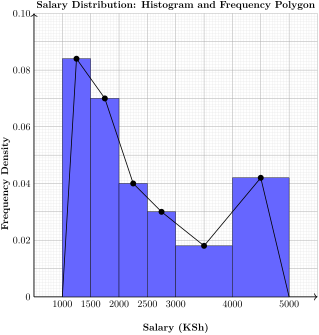
The table below presents the salary distribution of employees in a company.
Table 3.1.40.
Salary Range (KSh) Frequency
\(1000 - 1500\) \(42\)
\(1500 - 2000\) \(35\)
\(2000 - 2500\) \(20\)
\(2500 - 3000\) \(15\)
\(3000 - 4000\) \(18\)
\(4000 - 5000\) \(42\)
Draw a histogram and a frequency polygon to represent the data.
Solution.
To draw a histogram and a frequency polygon, we need to find the frequency density and the midpoint of each class interval.
We use frequency density instead of frequency to draw the histogram because the class widths are unequal.
The formula for frequency density:
\begin{align*} \textbf{Frequency density} = \amp \frac{\textbf{Frequency}}{\textbf{Class width}} \end{align*}
The formula for Midpoint:
\begin{align*} \textbf{Midpoint} = \amp \frac{\textbf{Lower bound + Upper bound}}{2} \end{align*}
Table 3.1.41.
Salary range(Ksh.) Frequency Class width Frequency density Midpoint
\(1000 - 1500\) \(42\) \(500\) \(0.084\) \(1250\)
\(1500 - 2000\) \(35\) \(500\) \(0.070\) \(1750\)
\(2000 - 2500\) \(20\) \(500\) \(0.040\) \(2250\)
\(2500 - 3000\) \(15\) \(500\) \(0.030\) \(2750\)
\(3000 - 4000\) \(18\) \(1000\) \(0.018\) \(3500\)
\(4000 - 5000\) \(42\) \(1000\) \(0.042\) \(4500\)

Example 3.1.42.

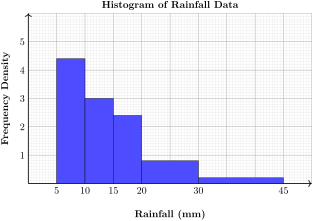
The following frequency distribution shows the daily rainfall amounts (in mm) recorded at a weather station over a \(60\) day period.
Table 3.1.43.
Rainfall(mm) Frequency
\(0 - 5\) \(22\)
\(6 - 10\) \(15\)
\(11 - 15\) \(12\)
\(16 - 25\) \(8\)
\(26 - 40\) \(3\)
Create a histogram to represent this data.
Solution.
To draw a histogram we need to find the frequency density because class width are unequal.
The formula for frequency density:
\begin{align*} \textbf{Frequency density} = \amp \frac{\textbf{Frequency}}{\textbf{Class width}} \end{align*}
Table 3.1.44.
Rainfall(mm) Frequency Class width Frequency density
\(5 - 10\) \(22\) \(5\) \(4.4\)
\(10 - 15\) \(15\) \(5\) \(3.0\)
\(15 - 20\) \(12\) \(5\) \(2.4\)
\(20 - 30\) \(8\) \(10\) \(0.8\)
\(30 - 45\) \(3\) \(15\) \(0.2\)

Exercises Exercises

1.
The following data represents the heights (in cm) of \(30\) students in a class:
\(150, 155, 160, 162, 165, 158, 170, 172, 168, 153, 163, 167, 175, 178, 161,\)
\(156, 169, 171, 159, 164, 173, 176, 157, 166, 174, 177, 154, 165, 179, 160\)
  1. Create a frequency table with class intervals of \(5 \textbf{ cm}\) and midpoints of the data.
  2. Using the frequency table you created Draw a histogram to represent the data.
  3. Draw a frequency polygon on the same axes as your histogram.
  4. Label your axes and give your graphs appropriate titles.
2.
The following data represents the ages of \(25\) people in a community meeting:
\(20, 25, 30, 35, 40, 22, 28, 33, 38, 42, 27, 32, 37, 41,\)
\(24, 29, 34, 39, 43, 26, 31, 36, 44, 23, 45\)
  1. Create a frequency table with class intervals of \(5\) years
  2. Draw a histogram to represent the data.
  3. Draw a frequency polygon on the same axes.
  4. Label the axes and provide titles for your graphs.
3.
A school collected data on the number of books read by students in a term. The following frequency table shows the results:
Table 3.1.45.
Number of Books Read Frequency
\(0 - 2\) \(15\)
\(3 - 5\) \(25\)
\(6 - 8\) \(35\)
\(9 - 11\) \(15\)
\(12 - 14\) \(10\)
  1. Draw a histogram to represent the data from your frequency table.
  2. On the same axes, draw a frequency polygon.
  3. Estimate the median number of books read. Explain your reasoning.
4.
A survey was conducted to find out how much time people spend on social media daily. The following data was collected:
Table 3.1.46.
Time (Minutes) Frequency Class Width Frequency Density
\(0 - 10\) \(15\) \(10\) \(1.5\)
\(10 - 20\) \(25\) \(10\) \(2.5\)
\(20 - 30\) \(30\) \(10\) \(3.0\)
\(30 - 60\) \(40\) \(30\) \(1.33\)
\(60 - 120\) \(20\) \(60\) \(0.33\)
  1. Draw a histogram to represent the sales data.
  2. Draw a frequency polygon to represent the sales data.
  3. Label your axes and provide appropriate titles for your graphs.

Checkpoint 3.1.47.

Checkpoint 3.1.48.