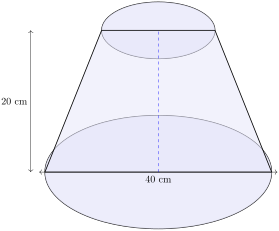
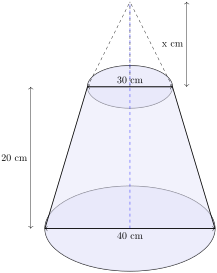
Activity 2.7.11.
Modelling a frustum using a paper cup or cone-shaped fruit juice glass and calculate its surface area.
\(\textbf{ Materials needed:}\)
-
Printable nets of a cone (to cut and create a frustum)🔹 Rulers or measuring tape🔹 Scissors🔹 Tape or glue🔹 Formula sheet🔹 Worksheets for sketching and calculations
-
A frustum is formed when the top part of a cone is cut off parallel to the base.
-
Surface area includes:🔹 \(\textbf{Curved surface area}\) (side)🔹 \(\textbf{Area of both circular bases}\)
-
Build the Frustum Model.🔹 Take the cone net and cut off the top part (smaller cone) parallel to the base.🔹 Assemble the remaining portion to form a frustum🔹 Alternatively, use actual paper/plastic cups and measure directly
-
Label Dimensions🔹 Radius of the larger base (R)🔹 Radius of the smaller top base (r)🔹 Slant height (l) of the frustum🔹 (If not provided, measure the height and use the Pythagorean theorem)
-
Calculate Surface Area
-
🔹 Use the surface area formula:🔹 Total Surface Area = \(\pi (R+r)\ell + \pi R^2 + \pi r^2\)
-
🔹 \(\pi(R+r)\)l: Curved surface🔹 \(\pi R^2\text{:}\) Area of bottom base🔹 \(\pi r^2\text{:}\) Area of top base
-
Example: Given Top radius (r): 3 cm , Bottom radius (R): 5 cm and Slant height (l): 6 cm\begin{align*} \text{Surface Area } =\amp \pi(5\, \text {cm}+3\, \text {cm})(6\, \text {cm}) + \pi(5\, \text {cm})^2 + \pi(3\, \text {cm})^2 \\ = \amp 3.14 \times (8\, \text {cm})\times(6\, \text {cm}) + 3.14 \times 25\, \text {cm} + 3.14 \times 9\, \text {cm}\\ =\amp (3.14 \times \, 48 \text {cm} ) \times(3.14 \times \, 25 \text {cm} ) \times(3.14 \times \, 9 \text {cm} ) \\ = \amp 150.72 \, \text{cm}^2 + 78.50 \, \text{cm}^2 + 28.26\, \text{cm}^2 \\ = \amp257.48\, \text{cm}^2 \end{align*}
-
\(\textbf{Study Questions}.\)🔹 What would happen to the surface area if the top radius increased?🔹 Why is it necessary to measure the slant height, not the vertical height?🔹 Can you find any real-life objects shaped like a frustum?
-
\(\textbf{Assignment}\)Design their own frustum cups with chosen dimensions.
-
Given a full cone, how much surface area is “lost” when the top is cut off?