To assist your teaching, we have prepared lesson resources, aligned with this textbook and the CBC. The Lesson Plan links to syllabus learning outcomes and provides suggest time allocations. The Step-by-Step Guide provides more detailed guidance on how to teach the content, including suggested questions to ask learners, and possible answers.
Informed decision-making is the process of using data and evidence to make choices that are based on facts and analysis rather than assumptions or guesses.
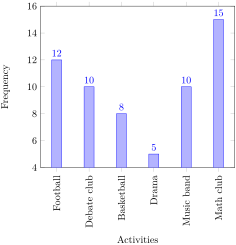
If the school can support only one activity next term, they should choose to support the Math club because it is the most preferred activity among the students, as indicated by the highest frequency in the data.
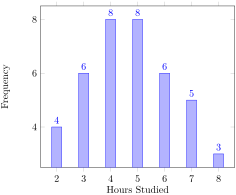
A school principal wants to introduce an extra Mathematics clinic on Saturdays. Before making a decision, she records the number of hours \(40\) students spend studying Mathematics per week.
Based on the data, it appears that a majority of students are already dedicating a reasonable amount of time to studying Mathematics. However, there is a portion of students who may benefit from additional support. Therefore, the principal could consider introducing an extra Mathematics clinic, but it may be more effective to target it towards students who are struggling or spending less time on Mathematics rather than making it compulsory.
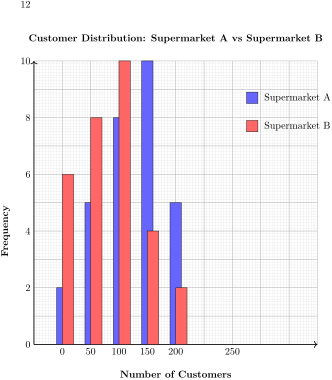
Supermarket A is more consistent because it has a higher frequency of customers in the middle range, while Supermarket B has a more spread out distribution with higher frequencies in the lower range.
Based on the estimated mean number of customers, Supermarket A has a higher average (150) compared to Supermarket B (105). Additionally, Supermarket A is more consistent with a higher frequency in the middle ranges. Therefore, it would be advisable for the company to expand Supermarket A as it has a larger customer base and more consistent traffic.
Since the most common number is \(25\) students and the average is about \(28\text{,}\) increasing seats to \(40\) is not necessary at the moment. Increasing to around \(30\) seats would be reasonable.
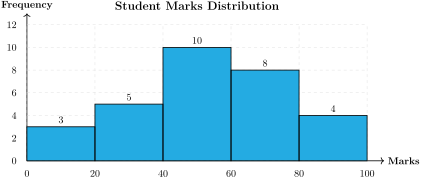
The histogram shows a relatively uniform distribution of marks, with the highest frequency in the \(40\) to \(60\) range and the average mark is about \(53\text{.}\)
The shop should stock about \(100\) to \(110\) litres to avoid shortage, since average sales are \(100\) litres and stocking only \(85\) litres may lead to running out on busy days.