Subsection 2.1.1 Introduction to Similarity
Teacher Resource 2.1.2.
To assist your teaching, we have prepared lesson resources, aligned with this textbook and the CBC. The Lesson Plan links to syllabus learning outcomes and provides suggest time allocations. The Step-by-Step Guide provides more detailed guidance on how to teach the content, including suggested questions to ask learners, and possible answers.
Learner Experience 2.1.1.
Work in pairs
(a)
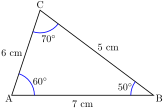
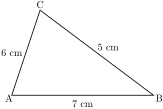
Draw triangle \(ABC\) with the following side lengths as shown in the figure below:
(b)
Label the angles in triangle \(ABC\) as follows:
(c)
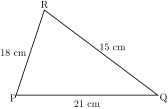
Draw triangle \(PQR\) with the following side lengths as shown in the figure below:
(d)
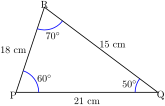
Label the angles in triangle \(PQR\) as follows:
(e)
Find the ratio of corresponding sides:
(f)
What do you notice about the ratios of corresponding sides above?
(g)
What do you observe between \(\angle ABC \) and \(\angle PQR \text{,}\) \(\angle BCA \) and \(\angle QRP \) ,\(\angle BAC \) and \(\angle QPR \)
(h)
What do you observe about the two triangles based on their corresponding sides and angles?
(i)
(j)
Discuss your findings and share your conclusions with the class.
Exploration 2.1.2. Similar Triangles.
Instructions.
In this interactive, triangle \(ABC\) is the original triangle. You may click and drag vertices \(A\text{,}\) \(B\text{,}\) and \(C\) to change its shape, expand it, or shrink it.
Triangle \(PQR\) is constructed to be similar to triangle \(ABC\text{.}\) Use the slider at the top to change the scale factor \(k\text{,}\) which enlarges or reduces triangle \(PQR\text{.}\)
The angle measures of both triangles are displayed. As you manipulate the triangles, observe carefully:
-
What happens to the side lengths?
-
What happens to the angle measures?
-
Which properties stay the same even when the size changes?
Key Takeaway 2.1.4.
-
Two triangles are similar if their corresponding angles are equal and their corresponding sides are in the same ratio.
-
Similarity refers to a relationship between two shapes or figures where one can be transformed into the other through scaling (enlargement or reduction), without changing its shape.The two shapes are similar if they have the same shape but may differ in size.
Example 2.1.5.
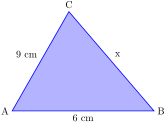
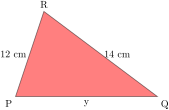
In the figure below, the triangles \(PQR\) and \(ABC\) are similar. Calculate the lengths marked with letters \(x\) and \(y\text{.}\)
Solution.
\(AB\) corresponds to \(PQ\text{,}\) \(BC\) corresponds to \(QR\text{,}\) and \(AC\) corresponds to \(PR\text{.}\)
\begin{align*}
\text{Therefore,} \amp \frac{AB}{PQ}= \frac{AC}{PR}= \frac {BC}{QR} \\
=\amp \frac{6\, \text{cm}}{y}= \frac{9\, \text{cm}}{12\, \text{cm}}= \frac {x}{14\, \text{cm}} \\
\frac{6\, \text{cm}}{y}=\amp \frac{9\, \text{cm}}{12\, \text{cm}}\\
y \times 9\, \text{cm}= \amp 6\, \text{cm} \times 12\, \text{cm} \\
y= \amp \frac{72\, \text{cm}^2}{9\, \text{cm}} \\
y =\amp 8\, \text{cm} \\
\text{Therefore PQ}= \amp 8 \text{cm}\\
\frac{9\, \text{cm}}{12\, \text{cm}}=\amp \frac{x}{14\, \text{cm}}\\
x \times 12\, \text{cm}= \amp 9\, \text{cm} \times 14\, \text{cm} \\
x= \amp \frac{126\, \text{cm}^2}{12\, \text{cm}} \\
x =\amp 10.5\, \text{cm} \\
\text{Therefore BC}= \amp 10.5\, \text{cm}
\end{align*}
Example 2.1.6.
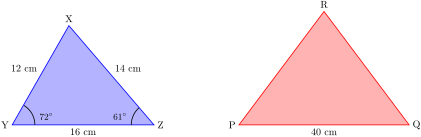
Given that triangles \(XYZ\) and \(PQR\) in figure 2.1.3 are similar, Find the size of \(\angle\, QPR\text{,}\) \(\angle\, PQR\) and the length of line \(PR\)
Solution.
Since the two triangles are equal, then their corresponding angles must be equal
Since \(\angle\, ZYX=72^\circ\text{,}\) then
\(\angle\, QPR= 72^\circ \)
Since \(\angle\, YZX=61^\circ\text{,}\) then
\(\angle\, PQR= 61^\circ \)
Now to find the length of \(PQ\text{,}\) We use the concept of similarity
\begin{align*}
\frac{YZ}{PQ} =\amp\frac{XY}{PR} \\
\frac{16}{40}= \amp \frac{12}{PR}\\
PR \times 16= \amp 40 \times 12\\
PR= \amp \frac{480}{16}\\
PR= \amp 30\, \text{cm}
\end{align*}

Checkpoint 2.1.8. Using Similar Triangles to Find Unknown Side Lengths.
Load the question by clicking the button below.
Checkpoint 2.1.9. Using Similarity to Determine Unknown Lengths and Scale Factor.
Load the question by clicking the button below.
Exercises Exercises
1.
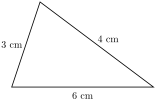
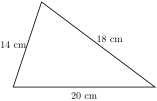
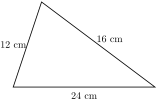
In the triangles below, Determine which triangles are similar by comparing their corresponding sides:
Answer.
Triangles similar by corresponding sides:
Triangle \(1\) has sides \(6\) cm, \(4\) cm, \(3\) cm. Triangle \(2\) has sides \(20\) cm, \(18\) cm, \(14\) cm. Triangle \(3\) has sides \(24\) cm, \(16\) cm, \(12\) cm.
Check ratios:
\(\text{Triangle 1:Triangle 3} = \frac{6}{24} = \frac{4}{16} = \frac{3}{12} = \frac{1}{4}\)
Triangles \(1\) and \(3\) are similar (ratio \(1:4\)). Triangle \(2\) is not similar to \(1\) or \(3\) because the side ratios differ.
2.
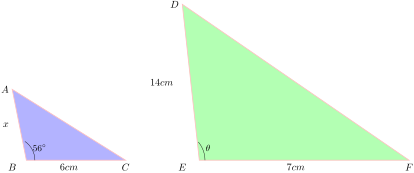
Given that triangle \(ABC\) is similar to triangle \(DEF\text{,}\) as shown in the diagram below,
Answer.
-
Corresponding angles in similar triangles are equal. Therefore:\(\theta = 56^\circ\)
-
Using corresponding sides ratio:\begin{align*} \frac{BC}{EF} \amp = \frac{AB}{DE}\\ \frac{6}{7} \amp = \frac{x}{14}\\ x \amp = \frac{6 \times 14}{7} = 12\; \text{cm} \end{align*}
3.
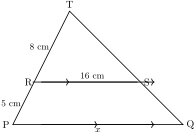
Find the value of x.
4.
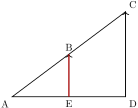
Triangle \(ABE\) is similar to triangle \(ACD\text{,}\) as shown in the figure below, Given that \(DC=24\) cm , \(AE=6\) cm \(ED=12\) cm, determine the length of \(BE\text{.}\)