Subsection 2.8.5 Volume of Cones
Teacher Resource 2.8.29.
To assist your teaching, we have prepared lesson resources, aligned with this textbook and the CBC. The Lesson Plan links to syllabus learning outcomes and provides suggest time allocations. The Step-by-Step Guide provides more detailed guidance on how to teach the content, including suggested questions to ask learners, and possible answers.
Learner Experience 2.8.5.
Constructing a cone.
-
Materials NeededSheets of paper or cardboardScissors, glue/tape, and rulersA cylinder (e.g., cup or bottle) for comparison
-
"How can we turn this into a cone?"Take a piece of paper and \(\textbf{cut a circle}\) any radius.
-
\(\textbf{Cut out a sector and roll}\) the remaining part into a cone shape.
-
Measure the radius and height of their cones.
-
Calculate the volume using the formula .
-
Equally, we can try this activity using; Empty Ice cream cones, A cylindrical cup of the \(\textbf{same height}\) and \(\textbf{base}\) as the cone and water.Steps:
-
Fill the cone with water and pour it into the cylinder severally until the cylinder is full.
-
How many cones of rice will fill the cylinder?
-
\(\textbf{Notice that it takes exactly 3 full cones to fill the cylinder}\text{.}\)This is why the formula includes \(\frac{\textbf{1}}{\textbf{3}} \text{!}\)Mathematical Insightβ This shows the formula:\begin{equation*} V_\text{cone} = \frac{1}{3} V_\text{cylinder} = \frac{1}{3} \pi r^2h \end{equation*}β The cone is one-third of the volume of a cylinder with the same base and height.
-
Key Takeaway 2.8.30.
What is a Cone? A cone is a three-dimensional solid with a circular base and a curved surface that tapers to a point called the apex or vertex.
Formula:
Volume of a Cone \(= \frac{1}{3} \times r^2 \times h\)
Where:
-
\(r\) is the radius of the circular base
-
\(h\) is the height of the cone (perpendicular distance from base to apex)
-
\(\displaystyle \pi \approx 3.14 \text{or} \frac{22}{7} \)
Why \(\frac{1}{3}\)
Three cones with the same base and height fit exactly inside a cylinder with the same base and height. Therefore, the volume of a cone is one-third the volume of a cylinder.
Relationship to Cylinder:
Scaffolding Strategies to Address Misconceptions:
| Misconception | Clarification |
|---|---|
| A cone is the same as a cylinder | No, a cone has a circular base and tapers to a point, while a cylinder has two parallel circular bases |
| The volume formula is \(\pi \times r^2 \times h\) | No, you must multiply by \(\frac{1}{3}\) |
| The height is the slant height | No, the height is the perpendicular distance from the base to the apex, not the slant height along the curved surface |
| I can use the diameter instead of the radius | No, the formula uses the radius. If you have the diameter, divide by 2 to get the radius |
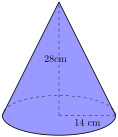
Example 2.8.31.
Find the volume of the following cone (correct to 1 decimal place):
Solution.
Step 1: Find the area of the base .
\begin{align*}
\text{Area of a Circle} = \amp \pi r^2 \\
= \amp \frac{22}{7} \times 14\, \text{cm} \times 14 \, \text{cm} \\
= \amp 616{cm}^2
\end{align*}
Step 2: Calculate the volume
\begin{align*}
\text{V} =\amp \frac{1}{3} \times \pi r^2\times H \\
= \amp 616\, \text{cm}^2 \times 28\, \text{cm} \\
= 17, 248\, \text{cm}^3 \amp
\end{align*}
Example 2.8.32.
Find:
-
The vertical height of the cone.
-
The volume of the cone (Give your answer in terms of \(\pi\) and then correct to two decimal places).
Solution.
-
In a cone, the radius, height and slant height form a right-angled triangle.\(l^2 = r^2 + h^2\)\(13^2 = 5^2 + h^2\)\(169 = 25 + h^2\)\(h^2 = 144\)\(h = 12 \;\text{ cm}\)
-
Use the volume formula\begin{align*} V =\amp \frac{1}{3}\pi r^2 h\\ = \amp \frac{1}{3}\pi (5)^2 (12)\\ = \amp \frac{1}{3}\pi (25)(12)\\ = \amp \frac{1}{3}\pi (300)\\ V = \amp 100\pi \end{align*}Therefore, \(V = 100\pi \;\text{ cm}^3\)Using \(\pi \approx 3.142\)\(V \approx 314.16 \;\text{ cm}^3\)
Checkpoint 2.8.33.
Checkpoint 2.8.34.
Exercises Exercises
1.
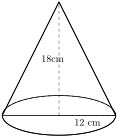
A cone has a radius of 12 cm and a height of 18 cm. Calculate the volume of the cone.
2.
An ice cream cone has a radius of 3 cm and a height of 8 cm. Estimate how much ice cream it can hold?
3.
Two cones have the same height of 84 cm but different radii. The first cone has a radius of 14 cm, and the second cone has a radius of 42 cm. Calculate and compare the volumes of the two cones. Which one has a larger volume?
4.
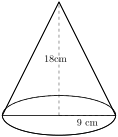
A cone-shaped funnel has a radius of 9 cm and a height of 18 cm.How much water can the funnel hold? (Leave your answer in cubic meters.)
5.
A cone has an outer radius of 7 cm and an inner radius of 5 cm. The height of the cone is 12 cm.Calculate the volume of the hollow cone.