Skip to main content
Contents
Search Book
Search Results:
No results.
Read aloud Readability settings Prev Up Next \(\newcommand{\N}{\mathbb N} \newcommand{\Z}{\mathbb Z} \newcommand{\Q}{\mathbb Q} \newcommand{\R}{\mathbb R}
\newcommand{\lt}{<}
\newcommand{\gt}{>}
\newcommand{\amp}{&}
\definecolor{fillinmathshade}{gray}{0.9}
\newcommand{\fillinmath}[1]{\mathchoice{\colorbox{fillinmathshade}{$\displaystyle \phantom{\,#1\,}$}}{\colorbox{fillinmathshade}{$\textstyle \phantom{\,#1\,}$}}{\colorbox{fillinmathshade}{$\scriptstyle \phantom{\,#1\,}$}}{\colorbox{fillinmathshade}{$\scriptscriptstyle\phantom{\,#1\,}$}}}
\)
Subsection 1.3.2 Quadratic Identities
In algebra, an
identity is an equation that is true for all values of the variable.
A
quadratic identity is an identity in which the highest power of the variable is
\(2\text{.}\)
For example:
\((x+1)^2 = x^2 + 2x + 1\)
Both sides contain the variable
\(x\text{,}\) and both sides give the same result for any value of
\(x\text{.}\) Therefore, this equation is an identity.
In this section, we will learn important quadratic identities that help us expand and factorise algebraic expressions.
Subsubsection 1.3.2.1 Perfect Squares
Curriculum Alignment
Strand
Sub-Strand
1.3 Quadratic Expressions and Equations
Specific Learning Outcomes
Derive the quadratic identities from the concept of area
Teacher Resource 1.3.27 .
To assist your teaching, we have prepared lesson resources, aligned with this textbook and the CBC. The Lesson Plan links to syllabus learning outcomes and provides suggest time allocations. The Step-by-Step Guide provides more detailed guidance on how to teach the content, including suggested questions to ask learners, and possible answers.
Learner Experience 1.3.28 .
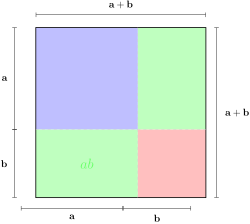
Study the diagram below carefully. Use what you know about area to investigate what is happening.
Figure 1.3.29. Geometric Decomposition of \((a+b)^2\)
Find the areas of the smaller regions
Identify the side lengths of each colored region; the blue square, the two green rectangles, and the red square.
Add all these smaller areas together.
Write your total area as a simplified algebraic expression.
Find the area of the large square
What is the total length of one side of the large outer square?
Using the formula for the area of a square, calculate the area of the whole square directly.
Express your answer in algebraic form.
Compare the total area you found by adding the smaller parts with the area you found using the side length of the large square.
Are the two expressions the same?
What conclusion can you make about
\((a+b)^2\text{?}\)
How does breaking a square into smaller regions help explain why
\((a+b)^2\) expands the way it does?
What does each smaller region represent in the expansion?
Example 1.3.31 .
Expand and simplify:
\((x + 5)^2\text{.}\)
Solution .
Use the perfect square identity
\((a+b)^2 = a^2 + 2ab + b^2\text{.}\)
Here,
\(a = x\) and
\(b = 5\text{.}\)
\((x+5)^2 = x^2 + 2(x)(5) + 5^2
= x^2 + 10x + 25.\)
Example 1.3.32 .
Expand and simplify:
\((2y - 3)^2\text{.}\)
Solution .
Use the perfect square identity
\((a-b)^2 = a^2 - 2ab + b^2\text{.}\)
Here,
\(a = 2y\) and
\(b = 3\text{.}\)
\((2y - 3)^2 = (2y)^2 - 2(2y)(3) + 3^2
= 4y^2 - 12y + 9.\)
Example 1.3.33 .
Show that
\(9x^2 + 24x + 16\) is a perfect square and express it in factorized form.
Solution .
Compare the expression with the identity
\((a+b)^2 = a^2 + 2ab + b^2\text{.}\)
\(9x^2 = (3x)^2, \quad 16 = 4^2,
\quad \text{and} \quad 2(3x)(4) = 24x.\)
Therefore,
\(9x^2 + 24x + 16 = (3x + 4)^2.\)
Checkpoint 1.3.34 .
Checkpoint 1.3.35 .
Exercises Exercises
1. Expand and simplify the following expressions:
\(\displaystyle (x + 7)^2\)
\(\displaystyle (3a - 2)^2\)
\(\displaystyle (2m + 5n)^2\)
Answer .
\(\displaystyle x^2 + 14x + 49\)
\(\displaystyle 9a^2 - 12a + 4\)
\(\displaystyle 4m^2 + 20mn + 25n^2\)
2. Show that
\(x^2 - 10x + 25\) is a perfect square and write it in factorized form.
Answer .
\(x^2 - 10x + 25 = (x - 5)^2\)
3. Factorize:
\(16y^2 + 40y + 25\text{.}\)
Answer .
\(16y^2 + 40y + 25 = (4y + 5)^2\)
4. Determine whether
\(4x^2 + 12x + 7\) is a perfect square. Give a reason for your answer.
Answer .
It is not a perfect square because
\(4x^2 = (2x)^2\) and
\(7\) is not a perfect square, and the middle term
\(12x\) does not match
\(2(2x)(\sqrt{7})\text{.}\) Therefore, it cannot be written in the form
\((a+b)^2\text{.}\)
Subsubsection 1.3.2.2 Difference of Squares
Curriculum Alignment
Strand
Sub-Strand
1.3 Quadratic Expressions and Equations
Specific Learning Outcomes
Derive the quadratic identities from the concept of area
Grade Level
Estimated Duration
Learner Experience 1.3.36 .
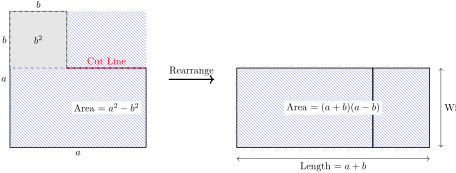
What you require: Graph paper, a pair of scissors, a ruler, and a pencil.
(a) On your graph paper, draw a large square with side length
\(a\) (for example, let
\(a = 10\) units). Calculate its area (
\(A = a^2\) ).
(b) In the top-left corner of your large square, draw a smaller square with side length
\(b\) (for example, let
\(b = 4\) units).
(c) Shade this small square. Its area is
\(b^2\text{.}\)
(d) The unshaded region represents the area of the large square minus the small square. Write down the expression for this area (
\(a^2 - b^2\) ).
(e) Draw a horizontal line extending from the bottom of the small square to the right edge of the large square. This divides the unshaded region into two rectangles.
(f) Cut out the L-shaped unshaded region from your paper. Then, cut along the horizontal line you drew to separate it into two rectangles.
(g) Rearrange the pieces: Take the smaller rectangle and place it next to the larger rectangle to form one long, single rectangle.
(h) Measure the length and width of this new large rectangle in terms of
\(a\) and
\(b\text{:}\)
(i) Calculate the area of this new rectangle using the formula
\(\text{Length} \times \text{Width}\text{.}\)
(j) Compare the area from step
(d) with the area from step
(i) . Since the amount of paper has not changed, conclude the relationship between the two expressions.
Figure 1.3.37.
Example 1.3.39 .
Factorise each of the following expressions completely:
\(\displaystyle x^2 - 49\)
\(\displaystyle 16y^2 - 25\)
\(\displaystyle 9a^2 - 4b^2\)
Hint .
Recall the Difference of Two Squares identity:
\begin{equation*}
a^2 - b^2 = (a - b)(a + b)
\end{equation*}
Solution .
To use this identity, we must first express both terms as
\((\text{something})^2\text{.}\)
Factorising \(x^2 - 49\text{:}\)
Rewrite as squares: \(x^2 - 7^2\)
Identify \(a\) and \(b\text{:}\) Here,
\(a = x\) and
\(b = 7\text{.}\)
Apply Identity: \((x - 7)(x + 7)\)
Factorising \(16y^2 - 25\text{:}\)
Rewrite as squares: \((4y)^2 - 5^2\)
Identify \(a\) and \(b\text{:}\) Here,
\(a = 4y\) and
\(b = 5\text{.}\)
Apply Identity: \((4y - 5)(4y + 5)\)
Factorising \(9a^2 - 4b^2\text{:}\)
Rewrite as squares: \((3a)^2 - (2b)^2\)
Identify \(a\) and \(b\text{:}\) Here,
\(a = 3a\) and
\(b = 2b\text{.}\)
Apply Identity: \((3a - 2b)(3a + 2b)\)
Checkpoint 1.3.40 .
Checkpoint 1.3.41 .
Exercises Exercises
1. Factorise completely the following expressions:
\(\displaystyle 25x^2 - 81\)
\(\displaystyle 49a^2b^2 - 16\)
\(\displaystyle 8x^2 - 18\)
\(\displaystyle m^4 - 81\)
\(\displaystyle 36x^2y^2 - 121z^2\)
Answer .
\(\displaystyle (5x - 9)(5x + 9)\)
\(\displaystyle (7ab - 4)(7ab + 4)\)
\(\displaystyle 8x^2 - 18 = 2(4x^2 - 9) = 2(2x - 3)(2x + 3)\)
\(\displaystyle m^4 - 81 = (m^2 - 9)(m^2 + 9)
= (m - 3)(m + 3)(m^2 + 9)\)
\(\displaystyle (6xy - 11z)(6xy + 11z)\)
Subsubsection 1.3.2.3 Quadratic Identities in Numerical Cases
Curriculum Alignment
Strand
Sub-Strand
1.3 Quadratic Expressions and Equations
Specific Learning Outcomes
Apply quadratic identities in numerical cases
Teacher Resource 1.3.42 .
To assist your teaching, we have prepared lesson resources, aligned with this textbook and the CBC. The Lesson Plan links to syllabus learning outcomes and provides suggest time allocations. The Step-by-Step Guide provides more detailed guidance on how to teach the content, including suggested questions to ask learners, and possible answers.
Learner Experience 1.3.43 .
Work in groups Scenario : Imagine you are planning a new garden in your backyard. You want to create a rectangular vegetable patch that has an area of
\(48\) square feet . You decide to set the length of the garden to be
twice the width .
(a) Let
\(w\) represent the width of the garden. If the length
\(l = 2w\text{,}\) write an equation for the area
\(A = l \times w\text{.}\)
(b) Subsitute
\(l = 2w\) into the area equation. Show that it simplifies to
\(2w^2 = 48\)
(c) Solve for
\(w\) to find the width, then calculate the length.
(d) Verify your answer by checking that
\(l \times w = 48\text{.}\)
(e)
Discussion : Suppose you wanted a
square garden instead, with a side length of
\((x + 3)\) metres. Discuss with your group how you would calculate the area without just multiplying the numbers directly.
Example 1.3.45 .
Use a quadratic identity to calculate
\(103^2\) without using a calculator.
Solution .
We can rewrite
\(103\) as
\((100 + 3)\text{.}\) Using the identity
\((a+b)^2 = a^2 + 2ab + b^2\text{:}\)
\(\begin{aligned} 103^2 \amp = (100 + 3)^2 \\
\amp = 100^2 + 2(100)(3) + 3^2 \\
\amp = 10,000 + 600 + 9 \\
\amp = \mathbf{10,609} \end{aligned}\)
Example 1.3.46 .
A square garden has a side length of
\((x+3)\) metres. Find the area using a quadratic identity. If
\(x=5\text{,}\) what is the area in square metres?
Solution .
The area of a square is given by
\((\text{side})^2\text{.}\) Using the identity
\((a+b)^2 = a^2 + 2ab + b^2\text{:}\)
\(\begin{aligned} \text{Area} \amp = (x+3)^2 \\ \amp = x^2 + 2(x)(3) + 3^2 \\ \amp = x^2 + 6x + 9 \end{aligned}\)
Now, substitute
\(x=5\text{:}\)
\(\begin{aligned} \text{Area} \amp = 5^2 + 6(5) + 9 \\ \amp = 25 + 30 + 9 \\ \amp = \mathbf{64 \text{ m}^2} \end{aligned}\)
Checkpoint 1.3.47 .
Checkpoint 1.3.48 .
Checkpoint 1.3.49 .
Exercises Exercises
1. Use a quadratic identity to evaluate
\(202^2\text{.}\)
2. Calculate
\(63 \times 57\) using the difference of squares identity.
3. A rectangular field has dimensions
\((x+5)\) metres by
\((x-5)\) metres. Express the area using a quadratic identity. If
\(x=12\text{,}\) find the area.
4. A square playground has a side length of
\((y+7)\) metres. Write the area as a quadratic expression and find the area when
\(y=3\text{.}\)
Exercises 1.3.2.4 Exercises
1.
Use the quadratic identities to write down the expansions of each of the following expressions:
\(\displaystyle (4x + 5)^2\)
\(\displaystyle \left( \frac{1}{x} + \frac{1}{y} \right) \left( \frac{1}{x} - \frac{1}{y} \right)\)
\(\displaystyle (8 - x)^2\)
\(\displaystyle (x - 7)^2\)
\(\displaystyle \left( x + \frac{1}{2} \right)^2\)
\(\displaystyle \left( \frac{1}{4} - \frac{3}{4}b \right)^2\)
\(\displaystyle (x + 2)^2\)
\(\displaystyle (x + 5)^2\)
Answer .
Using the perfect squares identity:
\begin{align*}
(4x + 5)^2 \amp = (4x)^2 + 2(4x)(5) + 5^2\\
\amp = 16x^2 + 40x + 25
\end{align*}
Using the difference of squares identity:
\begin{align*}
\left( \frac{1}{x} + \frac{1}{y} \right) \left( \frac{1}{x} - \frac{1}{y} \right) \amp = \left( \frac{1}{x} \right)^2 - \left( \frac{1}{y} \right)^2\\
\amp = \frac{1}{x^2} - \frac{1}{y^2}
\end{align*}
Using the perfect squares identity:
\begin{align*}
(8 - x)^2 \amp = 8^2 - 2(8)(x) + x^2\\
\amp = x^2 - 16x + 64
\end{align*}
Using the perfect squares identity:
\begin{align*}
(x - 7)^2 \amp = x^2 - 2(x)(7) + 7^2\\
\amp = x^2 - 14x + 49
\end{align*}
Using the perfect squares identity:
\begin{align*}
\left( x + \frac{1}{2} \right)^2 \amp = x^2 + 2\left(x\right)\left(\frac{1}{2}\right) + \left(\frac{1}{2}\right)^2\\
\amp = x^2 + x + \frac{1}{4}
\end{align*}
Using the perfect squares identity:
\begin{align*}
\left( \frac{1}{4} - \frac{3}{4}b \right)^2 \amp = \left( \frac{1}{4} \right)^2 - 2\left( \frac{1}{4} \right)\left( \frac{3}{4}b \right) + \left( \frac{3}{4}b \right)^2\\
\amp = \frac{1}{16} - \frac{3}{8}b + \frac{9}{16}b^2
\end{align*}
Using the perfect squares identity:
\begin{align*}
(x + 2)^2 \amp = x^2 + 2(x)(2) + 2^2\\
\amp = x^2 + 4x + 4
\end{align*}
Using the perfect squares identity:
\begin{align*}
(x + 5)^2 \amp = x^2 + 2(x)(5) + 5^2\\
\amp = x^2 + 10x + 25
\end{align*}