Subsection 2.4.4 Trigonometry Using Tables and Calculators

Learner Experience 2.4.9.

\(\textbf{Work in pairs}\)
What you require:
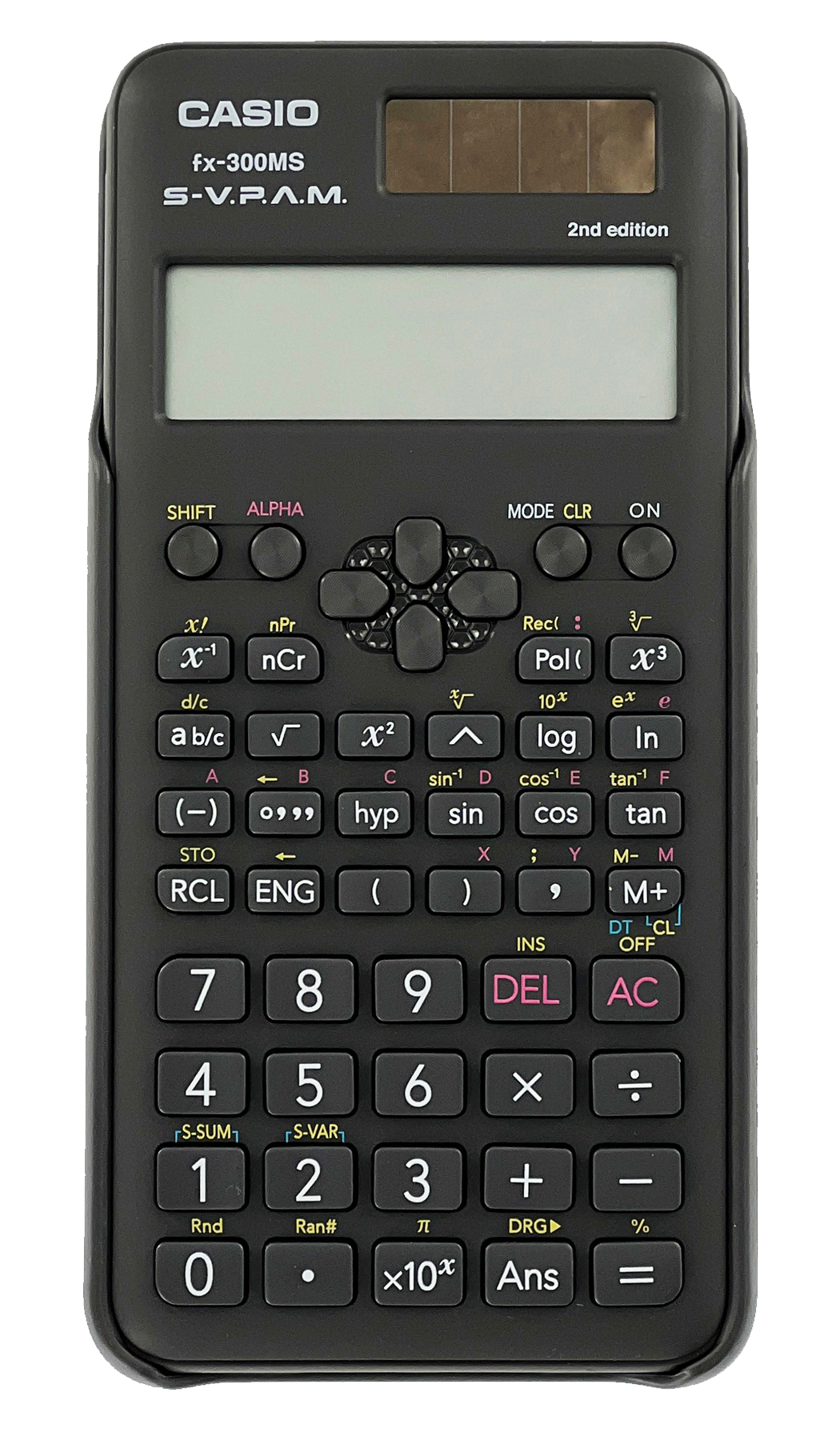
  • Scientific calculators or any other calculator having \(\sin\text{,}\)\(\cos\) and \(\tan\) buttons.
  • Protractor and ruler (for optional verification with a drawn triangle).
  • Worksheet with a table.
  1. Turn on your scientific calculator.
  2. Ensure your calculator is set to degree mode (not radians).
  3. For each given angle (\(0^\circ\text{,}\) \(25^\circ\text{,}\) \(30^\circ\text{,}\) etc.), do the following;
    • Press the sin button followed by the angle, then note the value.
    • Press the cos button followed by the angle, then note the value.
    • Press the tan button followed by the angle, then note the value.
  4. Record all values in the table below.
    • Use a calculator to find the sine, cosine, and tangent of the given angles, and fill in the table.
      Angle (\(^\circ\)) \({\color{blue} \sin}\) \({\color{blue} \cos}\) \({\color{blue} \tan}\)
      \(0^\circ\)
      \(25^\circ\)
      \(30^\circ\)
      \(45^\circ\)
      \(60^\circ\)
      \(75^\circ\)
      \(90^\circ\)
  5. Observe and Answer
  6. Discuss your work with other learners.

Exploration 2.4.10. Trigonometric Analysis Dashboard.

This interactive tool is organized into three stacked sections: the input slider, the numerical calculations, and the geometric representation.
In a right-angled triangle, the trigonometric ratios describe the relationship between an angle and the lengths of the sides. Use the dashboard and follow the guiding questions below to explore these connections as you would when using tables or a scientific calculator.

Instructions.

Explore the dashboard and think carefully about what you observe.
  • Adjust the Angle: Move the slider to select different values of \(\alpha\text{.}\) What happens to the values of \(\sin \alpha\text{,}\) \(\cos \alpha\text{,}\) and \(\tan \alpha\) as the angle increases?
  • Choose specific angles such as \(0^\circ\text{,}\) \(30^\circ\text{,}\) \(45^\circ\text{,}\) \(60^\circ\text{,}\) and \(90^\circ\text{.}\) Compare the displayed values with what you would expect from a calculator or trigonometric table. Do they match?
  • Observe the triangle in the bottom board. As \(\alpha\) increases, how do the side lengths \(a\) (opposite), \(b\) (adjacent), and \(c\) (hypotenuse) change?
  • Look at the sine values as the angle increases from \(0^\circ\) to \(90^\circ\text{.}\) Do they increase or decrease? What pattern do you notice?
  • Now observe the cosine values over the same interval. How does their pattern compare with the sine values?
  • As \(\alpha\) approaches \(90^\circ\text{,}\) what happens to the tangent value? Why does the display show a Math Error at \(90^\circ\text{?}\) What does this suggest about \(\tan 90^\circ\text{?}\)
  • Using the triangle, explain how the ratios \(\sin \alpha = \frac{\text{opposite}}{\text{hypotenuse}}\text{,}\) \(\cos \alpha = \frac{\text{adjacent}}{\text{hypotenuse}}\text{,}\) and \(\tan \alpha = \frac{\text{opposite}}{\text{adjacent}}\) are reflected in the changing side lengths.
Discuss your observations with a partner and summarize the patterns you discovered.
Figure 2.4.37. Trigonometry Dashboard: Input, Calculation, and Geometry

Key Takeaway 2.4.38.

When you look at your table, you will notice that,
  1. The values of their sines increase from \(0\) to \(1\text{.}\)
  2. The values of their cosines decrease from \(1\) to \(0\)
When given an acute angle, a calculator can be used to determine these ratios accurately.

How to determine trigonometric ratios using a calculator.

calculator
  1. Ensure the calculator is in degree mode.
    • Press the "MODE" button and select "DEG" (if using a scientific calculator).
  2. Enter the angle value.

Example 2.4.39.

Use calculator to find the following (round to \(\textbf{4 decimal places}\)).
  1. \(\displaystyle \sin\,40^\circ\)
  2. \(\displaystyle \cos\,40^\circ\)
  3. \(\displaystyle \tan\,40^\circ\)
Solution.
Ensure the calculator is in degree mode
  1. \(\sin\,40^\circ\)
    Press sin \(\to\) Press 40 \(\to\) Press =
    \(\sin\,40^\circ=0.6428\)
  2. \(\cos\,40^\circ\)
    Press cos \(\to\) Press 40 \(\to\) Press =
    \(\cos\,40^\circ=0.7660\)
  3. \(\tan\,40^\circ\)
    Press tan \(\to\) Press 40 \(\to\) Press =
    \(\tan\,40^\circ=0.8391\)

Tables of Tangents, Sines, and Cosines.

Table 2.4.40. Trigonometry Table for Acute Angles
Degrees Sine Cosine Tangent Degrees Sine Cosine Tangent
0 0.0000 1.0000 0.0000 45 0.7071 0.7071 1.0000
1 0.0175 0.9998 0.0175 46 0.7193 0.6947 1.0355
2 0.0349 0.9994 0.0349 47 0.7314 0.6820 1.0724
3 0.0523 0.9986 0.0524 48 0.7431 0.6691 1.1106
4 0.0698 0.9976 0.0699 49 0.7547 0.6561 1.1504
5 0.0872 0.9962 0.0875 50 0.7660 0.6428 1.1918
6 0.1045 0.9945 0.1051 51 0.7771 0.6293 1.2349
7 0.1219 0.9925 0.1228 52 0.7880 0.6157 1.2799
8 0.1392 0.9903 0.1405 53 0.7986 0.6018 1.3270
9 0.1564 0.9877 0.1584 54 0.8090 0.5878 1.3764
10 0.1736 0.9848 0.1763 55 0.8192 0.5736 1.4281
11 0.1908 0.9816 0.1944 56 0.8290 0.5592 1.4826
12 0.2079 0.9781 0.2126 57 0.8387 0.5446 1.5399
13 0.2250 0.9744 0.2309 58 0.8480 0.5299 1.6003
14 0.2419 0.9703 0.2493 59 0.8572 0.5150 1.6643
15 0.2588 0.9659 0.2679 60 0.8660 0.5000 1.7321
16 0.2756 0.9613 0.2867 61 0.8746 0.4848 1.8040
17 0.2924 0.9563 0.3057 62 0.8829 0.4695 1.8807
18 0.3090 0.9511 0.3249 63 0.8910 0.4540 1.9626
19 0.3256 0.9455 0.3443 64 0.8988 0.4384 2.0503
20 0.3420 0.9397 0.3640 65 0.9063 0.4226 2.1445
21 0.3584 0.9336 0.3839 66 0.9135 0.4067 2.2460
22 0.3746 0.9272 0.4040 67 0.9205 0.3907 2.3559
23 0.3907 0.9205 0.4245 68 0.9272 0.3746 2.4751
24 0.4067 0.9135 0.4452 69 0.9336 0.3584 2.6051
25 0.4226 0.9063 0.4663 70 0.9397 0.3420 2.7475
26 0.4384 0.8988 0.4877 71 0.9455 0.3256 2.9042
27 0.4540 0.8910 0.5095 72 0.9511 0.3090 3.0777
28 0.4695 0.8829 0.5317 73 0.9563 0.2924 3.2709
29 0.4848 0.8746 0.5543 74 0.9613 0.2756 3.4874
30 0.5000 0.8660 0.5774 75 0.9659 0.2588 3.7321
31 0.5150 0.8572 0.6009 76 0.9703 0.2419 4.0108
32 0.5299 0.8480 0.6249 77 0.9744 0.2250 4.3315
33 0.5446 0.8387 0.6494 78 0.9781 0.2079 4.7046
34 0.5592 0.8290 0.6745 79 0.9816 0.1908 5.1446
35 0.5736 0.8192 0.7002 80 0.9848 0.1736 5.6713
36 0.5878 0.8090 0.7265 81 0.9877 0.1564 6.3138
37 0.6018 0.7986 0.7536 82 0.9903 0.1392 7.1154
38 0.6157 0.7880 0.7813 83 0.9925 0.1219 8.1443
39 0.6293 0.7771 0.8098 84 0.9945 0.1045 9.5144
40 0.6428 0.7660 0.8391 85 0.9962 0.0872 11.4301
41 0.6561 0.7547 0.8693 86 0.9976 0.0698 14.3007
42 0.6691 0.7431 0.9004 87 0.9986 0.0523 19.0811
43 0.6820 0.7314 0.9325 88 0.9994 0.0349 28.6363
44 0.6947 0.7193 0.9657 89 0.9998 0.0175 57.2900
45 0.7071 0.7071 1.0000 90 1.0000 0.0000 undefined

Learner Experience 2.4.11.

\(\textbf{Work in groups}\)
What you require: Printed Table of Tangent, a \(30\,cm\) ruler, pencil, and calculator (for verification).
  1. What is the tangent of an angle?
  2. How do we use a Table of Tangents?
  3. Use your Table of Tangent to find the folowing tangents.
    1. \(\displaystyle 42^\circ\)
    2. \(\displaystyle 35^\circ\)
    3. \(\displaystyle 90^\circ\)
    4. \(\displaystyle 42^\circ \, 47^β€²\)
  4. Discuss your findings with other groups in your class.

Key Takeaway 2.4.41.

Special tables have been prepared and can be used to obtain tangents of acute angle. The technique of reading tables of tangents is similar to that of reading tables of logarithms or square roots.
Here’s how you can use them:
  1. Identify the angle
    • Find the given angle in the leftmost column (if degrees) or the top row (if radians).
  2. Locate the Tangent Value
    • Read across the row (or down the column) to find the corresponding tangent value.
Note
  1. In the tables of tangents, the angles are expressed in decimals and degrees or in degrees and minutes.
  2. One degree is equal to \(60^β€² \, (60\, \text{minutes})\) . Thus, \(30^β€² = 0.50^\circ, \,54^β€² = 0.9^\circ\, \text{and} \,6^β€²= 0.1^\circ.\text{.}\)
From the table, the values of tangents increase as the angles approach \(90^\circ\)

Example 2.4.42.

Find the tangent of each of the following angles from the table:
  1. \(\displaystyle 60^\circ\)
  2. \(\displaystyle 52^\circ\)
  3. \(\displaystyle 46.7^\circ\)
  4. \(\displaystyle 52^\circ \, 47^β€²\)
Solution.
  1. Find \(\tan(60^\circ)\)
    Locate \(60^\circ \)in the table.
    Read the corresponding tangent value. that is
    \begin{equation*} \tan(60^\circ)=1.732 \end{equation*}
  2. Find \(\tan(52^\circ)\)
    Locate \(52^\circ\) in the table.
    Read the corresponding tangent value. that is
    \begin{equation*} \tan(52^\circ)=1.279 \end{equation*}
  3. Find \(\tan(46.7^\circ)\)
    Locate \(46.7^\circ\) in the table.
    Read the corresponding tangent value. that is
    \begin{equation*} \tan(46.7^\circ)=1.0612 \end{equation*}
  4. Find \(\tan(52^\circ \, 47^β€²)\)
    Convert \(47^β€²\) to degrees by deviding by \(60\)
    \begin{align*} (\frac{47}{60})^\circ =\amp 0.78^\circ \end{align*}
    Therefore,
    \begin{equation*} 52^\circ \, 47^β€²= 52.78^\circ \end{equation*}
    Using decimal tables, \(\tan\, 52.7^\circ = 1.3127 \text{.}\) From the difference column under \(8\) reads \(0.0038\)
    Therefore,
    \begin{align*} \tan\,52^\circ \, 47^β€²=\amp 1.3127+ 0.0038\\ =\amp 1.3165 \end{align*}

Example 2.4.43.

Read the sine and cosine values of the following angles from the tables.
  1. \(\displaystyle 46^\circ\)
  2. \(\displaystyle 45.5^\circ\)
  3. \(\displaystyle 75.67^\circ\)
Solution.
  1. \(\sin\,46^\circ\)
    Locate \(46^\circ\)in the sine and cosine table.
    Read the corresponding sine value. That is
    \begin{equation*} \sin\,46^\circ= 0.7193\text{,} \end{equation*}
    \(\cos\,46^\circ\)
    Read the corresponding cosine value. That is
    \begin{equation*} \cos\,46^\circ= 0.6947\text{,} \end{equation*}
  2. \(\sin\,45.5^\circ\)
    Locate \(45.5^\circ\)in the sine and cosine table.
    Read the corresponding sine value. That is
    \begin{equation*} \sin\,45.5^\circ= 0.7133\text{,} \end{equation*}
    \(\cos\,45.5^\circ\)
    Read the corresponding cosine value. That is
    \begin{equation*} \cos\,45.5^\circ= 0.7009\text{,} \end{equation*}
  3. \(\sin\,75.67^\circ\)
    Using decimal tables, \(\sin\,75.6^\circ=0.9686\text{.}\) From the difference column under \(7\) reads \(0.0003\)
    Therefore,
    \begin{align*} \sin\,75.67^\circ=\amp 0.9686+0.0003\\ = \amp 0.9689 \end{align*}
    \(\cos\,75.67^\circ\)
    Using decimal tables, \(\cos\,75.6^\circ=0.2487\text{.}\) From the difference column under \(7\) reads \(0.0012\)
    Therefore,
    \begin{align*} \cos\,75.67^\circ=\amp 0.2487-0.0012\\ = \amp 0.2475 \end{align*}

Example 2.4.44.

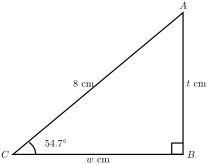
Find the value of \(t\) and \(w\) in the figure shown below (Using sine and cosine tables).
Solution.
Recall that;
\(\sin\,\theta=\frac{\text{opposite}}{\text{Hypotenuse}}=\frac{t}{8}\)
\(\cos\,\theta=\frac{\text{adjacent}}{\text{Hypotenuse}}=\frac{w}{8}\)
Therefore,
\begin{align*} \sin\,54.7^\circ=\amp \frac{t}{8}\\ 8\,\sin\,54.7^\circ=\amp t \end{align*}
But, from tables of sine, \(\sin\,54.7^\circ \approx \sin \,55^\circ = 0.8192\)
Therefore,
\begin{align*} t =\amp 8 \times 0.8192 \\ =\amp 6.5536 \end{align*}
\begin{align*} \cos\,54.7^\circ=\amp \frac{w}{8}\\ 8\,\cos\,54.7^\circ=\amp w \end{align*}
But, from tables of cosine, \(\cos\,54.7^\circ \approx \cos\,55^\circ = 0.5736\)
Therefore,
\begin{align*} w =\amp 8 \times 0.5736 \\ =\amp 4.5888 \end{align*}

Example 2.4.45.

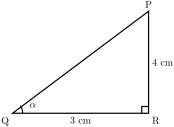
Using tangents in your mathematical tables, find \(\alpha\) as shown in the figure below.
Solution.
Opposite \(=4\,cm\)
Adjacent \(=3\,cm\)
\begin{align*} \tan \, \alpha =\amp \frac{\text{Opposite}}{\text{Adjacent}} \\ = \amp \frac{4\,cm}{3\,cm} \\ = \amp 1.3333 \end{align*}
Note that \(1.3333\) cannot be read directly from the tables of tangents. Therefore, look for a number nearest to \(1.3333\) from the tables. In this case, the nearest number is \(1.3270\text{.}\)The angle whose tangent is \(1.3270\) is \(53^\circ\text{,}\) so we have \(\alpha \approx 53^\circ\text{.}\)

Exercises Exercises

6.

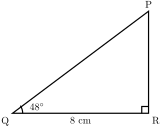
Use tangents to find the length \(PR\) in the figure below. (leave your answer to \(2\, \textbf{decimal places}\))
Answer.
From the diagram, \(\tan 48^\circ = \dfrac{PR}{QR} = \dfrac{PR}{8}\text{,}\) so \(PR = 8 \tan 48^\circ \approx 8.88\, \text{cm}\text{.}\)

7.

A ladder leans against a wall so that its foot is \(4.5 \,m\) away from the foot of the wall and its top is \(10\,\) up the wall. Calculate the angle it makes with the ground .
Answer.
Taking the wall as vertical, \(\tan\theta = \dfrac{10}{4.5}\text{,}\) so \(\theta = \tan^{-1}\!\left(\dfrac{10}{4.5}\right) \approx 65.77^\circ\text{.}\)

8.

In a right-angled triangle, the shorter sides are \(6.5\, cm\) and \(12.2 \,cm\) long. Find the sizes of its acute angles.
Answer.
Let the acute angle opposite the side of length \(6.5\,\text{cm}\) be \(\theta\text{.}\) Then \(\tan\theta = \dfrac{6.5}{12.2}\text{,}\) so \(\theta = \tan^{-1}\!\left(\dfrac{6.5}{12.2}\right) \approx 28.07^\circ\text{.}\)
Since the angles in a right triangle add to \(90^\circ\text{,}\) the other acute angle is \(90^\circ - 28.07^\circ \approx 61.93^\circ\text{.}\)

10.

  1. Find from tables the angle whose sine is \(0.4540\text{.}\)
  2. Find from tables the angle whose cosine is \(0.5878\text{.}\)
  3. Find from tables the angle whose tangent is \(7.1154\text{.}\)
Answer.
  1. Looking up \(0.4540\) in the sine table gives an angle of approximately \(27^\circ\text{.}\)
  2. Looking up \(0.5878\) in the cosine table gives an angle of approximately \(54^\circ\text{.}\)
  3. Looking up \(7.1154\) in the tangent table gives an angle of approximately \(82^\circ\text{.}\)

11.

Read from the tables the sine and the cosine of:
  1. \(\displaystyle 45.46^\circ\)
  2. \(\displaystyle 52^\circ\, 9^β€²\)
  3. \(\displaystyle 25^\circ\, 45^β€²\)
Answer.
  1. \(\sin 45.46^\circ = 0.7132\text{,}\) \(\cos 45.46^\circ = 0.7009\)
  2. \(\sin 52^\circ 9^β€² = 0.7880\text{,}\) \(\cos 52^\circ 9^β€² = 0.6156\)
  3. \(\sin 25^\circ 45^β€² = 0.4348\text{,}\) \(\cos 25^\circ 45^β€² = 0.9005\)

12.

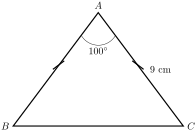
The figure below shows an isosceles triangle in which \(AB = AC = 9\, cm\text{.}\) Angle \(BAC\) is \(100^\circ\text{.}\) Calculate the length of BC.
Answer.
Dropping a perpendicular from \(A\) to \(BC\) bisects the angle at \(A\text{,}\) so each right triangle has hypotenuse \(9\,\text{cm}\) and acute angle \(50^\circ\text{.}\) Thus \(\dfrac{BC}{2} = 9\sin 50^\circ\text{,}\) so \(BC = 2 \times 9\sin 50^\circ \approx 13.8\,\text{cm}\text{.}\)