Upon completion of this lesson, learners will be able to:
Know (Conceptual Understanding): Understand that symmetry means an object looks exactly identical on both sides when folded, flipped, rotated, or reflected. Understand that a line of symmetry divides a shape into two identical halves where one half is the mirror image of the other.
Do (Procedural Skill): Identify lines of symmetry in plane figures by folding, drawing, and visual inspection. Determine the number of lines of symmetry for regular polygons, letters, and everyday objects.
Apply (Application/Problem-Solving): Recognise and identify lines of symmetry in real-world objects, classroom items, and everyday situations involving reflection and congruence.
To assist your teaching, we have prepared lesson resources, aligned with this textbook and the CBC. The Lesson Plan links to syllabus learning outcomes and provides suggest time allocations. The Step-by-Step Guide provides more detailed guidance on how to teach the content, including suggested questions to ask learners, and possible answers.
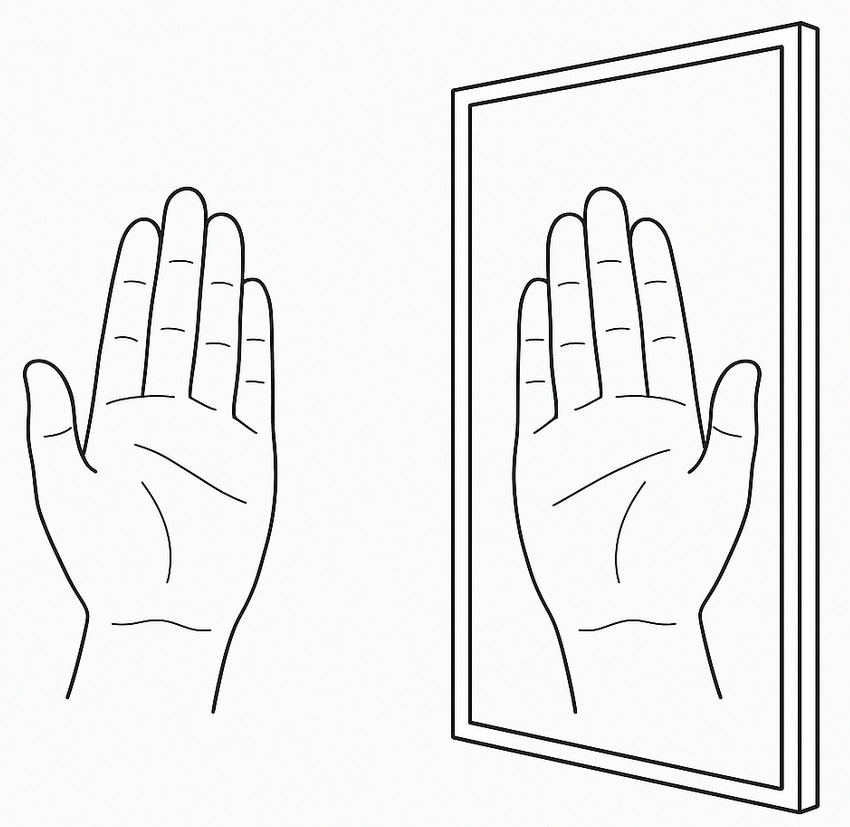
Turn your hand so that the back of your hand faces the mirror instead. Observe again. How does the reflection mimic the shape of your hand? Is there symmetry between your hand and its relection?
Hold your hand in front of the mirror with your palm facing the mirror, then fold your fingers to make a fist. Does the reflection mimic your hand movements in the same direction?
Slowly rotate your hand in different directions (up, down, sideways) while watching the mirror. Discuss how the mirror’s reflection always mirrors the real movement.
The mirror does not create a random image but produces a reversed copy of the object in front of it. From your activity, you will notice that when you hold your right hand in front of the mirror, the reflection is a reverse which appers as the left hand. This phenomena is called lateral inversion. Lateral inversion is when a reflected object appears to be flipped along a vertical axis.
As you move your hand closer to the mirror, you notice that the distance between reflection and the mirror reduces. When you touch the mirror, the image appears to touch your hand. Your hand and its reflection are in symmetry.
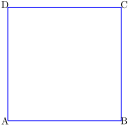
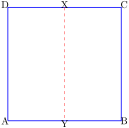
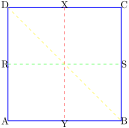
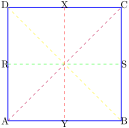
Fold the square in half from left to right such that the corner \(A\) aligns with corner \(B\) and corner \(D\) aligns with corner \(C.\) This will create a rectangle.
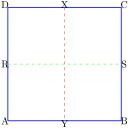
Now, fold the square in half from the top to the bottom such that the corner \(D\) aligns with corner \(A\) and corner \(C\) aligns with corner \(B.\) This will create another rectangle.
Therefore symmetry is when an object/shape looks exactly similar or identical on one side and the other side when the object is folded/flipped, rotated or reflected.
Explore the properties of reflection dynamically! Click and drag the vertices of the original blue triangle (\(A\text{,}\)\(B\text{,}\) or \(C\)) to see how the green reflected image responds.
You can also drag points \(M1\) and \(M2\) to change the angle of the red Mirror Line. Notice how the dashed construction lines always remain perpendicular (at a \(90^\circ\) angle) to the mirror line, and the object and image always remain exactly the same distance from the mirror.
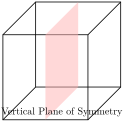
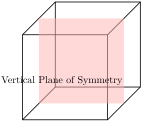
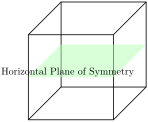
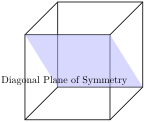
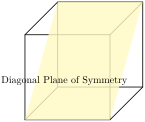
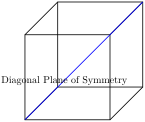
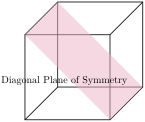
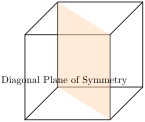
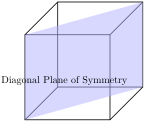
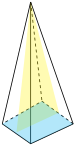
In 3D, a plane of symmetry is an imaginary flat surface that divides an object into two equal halves, such that one half is the mirror image of the other half.
When you cut a banana vertically into two equal halves such that one half is the reflection of the other half, you create a plane of symmetry of the banana.
One example is a (curved) banana. When you cut a banana vertically down the middle, you create a plane of symmetry. When you cut a banana horizontally along the banana, you create another plane of symmetry. Therefore, a banana has 2 planes of symmetry.
One example is a (curved) banana. When you cut a banana vertically down the middle, you create a plane of symmetry. When you cut a banana horizontally along the banana, you create another plane of symmetry. Therefore, a banana has 2 planes of symmetry.